
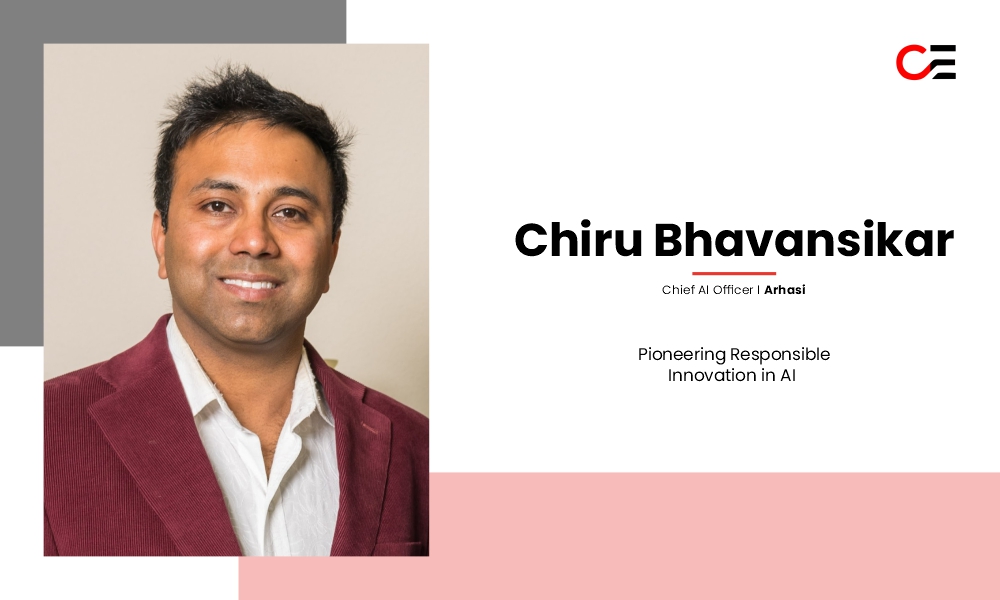
In an age where algorithms often steer the conversation, few leaders speak with the clarity, conviction, and grounded wisdom of the Chief AI Officer at Arhasi. With a career that stretches over two decades across global landscapes; from laying the groundwork for cloud systems in Australia to building AI frameworks that genuinely serve people; his story is a testament to how ethics, vision, and leadership can come together to shape something truly lasting.
But this isn’t just another tale of a tech expert chasing the next big thing. It’s the story of a systems thinker, strategist, and steward of responsible AI who has quietly but powerfully shaped the future of intelligent automation.
From Cloud Pioneer to AI Strategist: A Journey Anchored in Values
The trajectory began in 2005, at a time when cloud computing was more theory than infrastructure. Tasked with leading Australia’s first large-scale distributed computing platform, he saw beyond servers and scalability. What he saw early on was a new kind of infrastructure, one that could empower small businesses by giving them access to computing capabilities once reserved for giants.
That hands-on experience with system design became the bedrock of a career that has never been just about keeping up with innovation, but about guiding it in a direction that serves real human needs. By the time he moved to Silicon Valley in 2011; joining forces with the likes of Dell, EMC, and Cloudera; the data revolution was already gathering speed. He, however, was already looking further ahead: toward artificial intelligence not as automation, but augmentation. A means to enhance human judgment, not replace it.
That vision deepened during his time with Deloitte and PwC, where he moved from execution to enterprise transformation. “I wasn’t just building platforms,” he reflects, “I was reshaping how institutions think.” His clients spanned finance, healthcare, and the public sector, but the guiding principle was consistent: technology must serve people—not the other way around.
Designing the Future at Arhasi: Where AI Meets Operational Intelligence
Today, as Chief AI Officer at Arhasi and strategic leader at Ops Intelligence, his remit spans far beyond code. His mission: to build intelligent automation systems that function like the digital nervous system of a modern enterprise, reflexive, modular, and context-aware.
“What excites me most,” he explains, “is how AI is evolving from isolated tools to enterprise-wide ecosystems. We’re not just optimizing workflows; we’re enabling real-time orchestration of decisions across entire organizations.”
The crown jewel of this transformation is the R.A.P.I.D. platform; an architecture for Responsible AI that weaves integrity, provisioning, and defence into the fabric of every deployment. From real-time anomaly detection in global supply chains to GenAI-enabled diagnostics in healthcare, the platform underscores a deeper belief: intelligence is only meaningful when it is ethical, explainable, and human-aligned.
At Arhasi, innovation isn’t just a goal; it’s a responsibility.
Leading with Empathy, Driving with Discipline
Despite his technical gravitas, what sets this AI leader apart is his human-first approach to leadership. He describes his style as “vision with discipline”; a philosophy that balances ambition with execution, experimentation with accountability.
“My goal is to create environments where bold ideas can flourish, but within the guardrails of ethical clarity and commercial relevance,” he says. That vision has taken shape through cross-functional “innovation pods,” where designers, engineers, HR, legal, and compliance professionals co-create solutions from day one.
It’s also embedded in the organization’s culture of “fail fast, learn loud”; a model that treats setbacks not as failures, but as data points. Objectives and Key Results (OKRs) tie innovation directly to business value, ensuring that creativity and accountability evolve hand-in-hand.
Empathy, he adds, is not a soft skill. It’s a strategic one. “When people feel heard, they take ownership. When teams trust each other, they move faster, smarter, and with greater purpose.”
Defining Moments: From IMF to Intelligent Infrastructure
Among his many milestones, a few moments remain especially meaningful.
Launching Australia’s first elastic infrastructure platform was a foundational achievement, but it was his leadership in organizing “Big Data Day” at the International Monetary Fund that signalled his ability to influence at a global scale. Bringing data science into the heart of economic forecasting wasn’t just timely; it was transformative.
Later, his leadership in AI-led healthcare programs focused on eliminating algorithmic bias in underserved regions. These projects weren’t just about deploying AI; they were about equity, access, and social responsibility.
At Arhasi, that ethos took shape in the R.A.P.I.D. platform and the company’s shift toward platform intelligence, modular AI ecosystems that enable real-time decision-making across entire industries. From AI control towers in manufacturing to portfolio optimization in finance, these platforms are operationalizing intelligence at scale.
Navigating Complexity: Consulting as a Crucible
The transition into management consulting in 2017 was a crucible moment. For someone who had led large-scale engineering efforts, entering the world of enterprise advisory meant shedding the illusion of control and embracing influence.
“There was resistance,” he admits. “Many clients still saw AI as buzz, not business value. Projects stalled. Scepticism ran high.”
Rather than retreat, he retooled introducing investment models tied to ROI, embedding users in the design process, and forming cross-functional innovation teams. One breakthrough came when his team built a financial forecasting platform that shifted decision cycles from days to minutes; by integrating AI outputs with real business incentives.
“It was proof,” he says, “that AI adoption hinges on clarity, not complexity; on empathy as much as engineering.”
The Road Ahead: Platform Thinking and Ethical Agility
Looking to the next five years, he sees hyper automation and platform intelligence as the defining trends. “The winners won’t be those with the most AI tools,” he notes, “but those who build the most ethical, intelligent, and resilient systems.”
But he’s also pragmatic. “The greatest challenge isn’t technical—it’s cultural readiness.” Many enterprises still lack the frameworks, talent strategies, and governance models needed to move from pilots to platforms.
That’s why the R.A.P.I.D. framework remains core to Arhasi’s vision guardrails for AI systems that are explainable, secure, and future-proof. It’s a philosophy that keeps innovation in check without slowing it down.
Building Human-Cantered Innovation Cultures
At the heart of his leadership is a commitment to continuous learning. He mentors globally; empowering engineers in South America to become AI strategists; and builds teams that thrive on intellectual curiosity and mutual respect.
Innovation, he says, isn’t a department. It’s a discipline. “Every project is a learning lab. Every person, a multiplier.”
From internal upskilling to design thinking workshops and AI ethics roundtables, his teams are challenged to think beyond the algorithm to design for the real world, not just the model.
And crucially, diversity and inclusion are not afterthoughts they’re structural principles. “Homogeneity leads to blind spots. Diverse teams don’t just build better AI they build more human systems.”
Grounded Leadership in a Turbulent World
How does one stay cantered while leading AI innovation at such scale?
For him, well-being starts with purpose. “Clarity of intent reduces noise,” he says. His practices include yoga, immersive travel, and deep spiritual reflection tools that help him recalibrate when complexity peaks.
He blocks time for deep work. Prioritizes mentorship. Delegates with trust. And perhaps most powerfully embraces the Bhagavad Gita’s wisdom:
He often quotes a line from the Bhagavad Gita: “You have a right to perform your prescribed duty, but you are not entitled to the fruits of action.” Chapter 2, Verse 47 (karmaṇy-evādhikāras te mā phaleṣu kadācana)
To him, it’s a grounding principle reminding us that what defines true leadership isn’t chasing results, but staying true to your values.
The Last Word: Where Ethics and Algorithms Converge
In an era where AI narratives are often dominated by hype or fear, the story of Arhasi’s Chief AI Officer offers a refreshingly grounded perspective. It’s a story not just about what technology can do, but what it should do.
As enterprises race to adopt AI, his journey offers a blueprint: lead with systems thinking, design with empathy, scale with discipline and above all, align every decision with the values that make intelligence truly human.