Recognized worldwide as leading specialists in calendering and mixing technologies, COMERIO ERCOLE supplies complete industrial solutions ranging from laboratory equipment to large-scale turnkey production plants.
COMERIO ERCOLE portfolio includes:
- Open mixing mills, patented internal mixers and complete rubber mixing rooms
- Strainers, compounding extruders, weighing, dosing and handling systems
- 2-roll, 3-roll, 4-roll and 5-roll calenders in multiple configurations
- Complete calendering lines for textile cord, steel cord, innerliner, rubber sheeting and conveyor belts
- Complete tire production process equipment and vulcanization solutions
- PVC, PU, CPE, PP and polyolefin calendering lines
- Stretching, laminating, embossing and winding systems
- Thermal bonding, spunbond, airlaid and nonwoven production technologies
- Special calendering solutions for technical textiles, gaskets, adhesive tapes, leather, paper, stainless steel and advanced materials
- Laboratory calenders, mixing mills, internal mixers and pilot lines for R&D activities
- Recycling and circular economy technologies for rubber recovery and reprocessing
- Revamping, modernization and Industry 5.0 upgrades of existing production plants
Beyond machinery manufacturing, COMERIO ERCOLE provides complete engineering services including feasibility studies, process development, know-how transfer, laboratory testing, FEM analysis, digital solutions, safety assessments and turnkey project management.
Through its worldwide service organization, COMERIO ERCOLE supports customers with installation, commissioning, training, teleservice, predictive maintenance, original spare parts, refurbishment activities and process optimization.
Today, COMERIO ERCOLE technologies are operating in leading manufacturing plants across the world, serving the tire industry, technical rubber goods, plastic films, nonwovens, technical textiles, conveyor belts and many other advanced industrial applications.
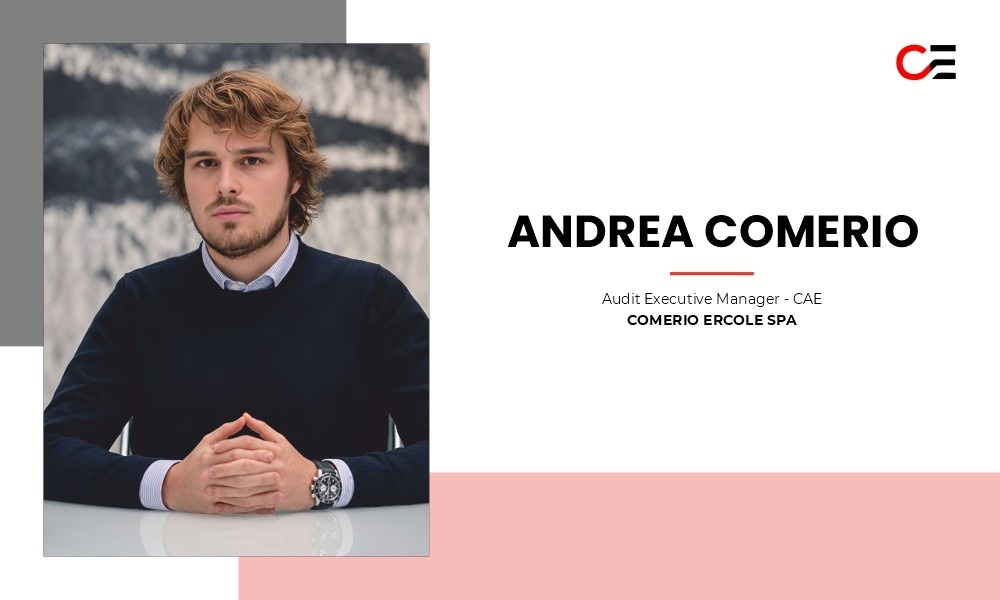
Within this structure, Andrea Comerio represents the fifth generation of family involvement. He serves as Audit Executive Manager and ESG Impact Manager, contributing to governance, operational discipline, and sustainability integration in a business that continues to expand across global markets.
His perspective is shaped by two parallel influences: a family legacy deeply rooted in manufacturing and a professional foundation built outside the industry in consulting. Together, these experiences define how he approaches leadership, decision-making, and long-term industrial development.
A Professional Journey Built on Industrial Curiosity and Analytical Thinking
Andrea Comerio’s interest in manufacturing did not begin as a career decision but as an observation of how industrial systems function. Growing up in a family associated with manufacturing gave him early exposure to the complexity behind industrial production, where engineering, innovation, and structured execution come together.
He describes manufacturing as a sector where technical knowledge and human capability intersect in a practical way. It is not only about machinery but about transforming raw materials into functional outputs that support multiple industries.
Before joining Comerio Ercole, Andrea began his professional journey in consulting. That experience became foundational to his later work. In consulting, he worked across different industries and focused on analyzing business processes, governance frameworks, organizational structures, and performance improvement systems.
This period helped him develop a structured way of thinking. It strengthened his ability to evaluate problems objectively, understand operational inefficiencies, and approach decision-making through data, risk awareness, and business logic rather than assumptions.
When he eventually transitioned into manufacturing, he brought this analytical discipline into an environment defined by engineering depth and long production cycles. His move into the company was not a shift away from consulting but an expansion of its principles into an industrial context.
Today, he works alongside his cousin, Guglielmo Comerio, as part of the fifth generation involved in the company. Members of the fourth generation remain active within the organization, creating continuity across leadership layers. However, Andrea is careful to emphasize that the company’s strength has never been limited to family participation.
Its development has been driven by engineers, technicians, managers, and operational teams who have contributed over many decades. The organization functions as a collective system rather than an individual-driven structure.
Leadership in an Industry Defined by Constant Pressure
The machinery and manufacturing sector is currently shaped by multiple external pressures. These include digital transformation, sustainability requirements, geopolitical uncertainty, cost volatility, labor shortages, and rapid technological change.
Within this environment, Andrea views leadership as a balance between strategic clarity and operational discipline. He does not define leadership through authority but through decision quality and execution consistency.
He identifies integrity, adaptability, technical awareness, and structured decision-making as essential leadership traits. However, he places equal importance on the ability to manage tension between competing priorities. Innovation must be balanced with practicality, and ambition must remain aligned with operational capability.
He also emphasizes that manufacturing is fundamentally a people-driven industry. While automation, artificial intelligence, and digital tools are transforming production environments, human expertise remains central to problem-solving, continuous improvement, and innovation.
Another defining aspect of his leadership philosophy is long-term thinking. Industrial investments typically operate on timelines that extend across decades. This requires patience and the ability to maintain consistency even when short-term conditions fluctuate.
A Collaborative Leadership Model Within a Family-Owned Structure
Andrea describes his leadership approach as collaborative, analytical, and performance-oriented. His role involves connecting strategic direction with operational execution across multiple functions.
He works across departments and ensures that governance, financial performance, and operational objectives remain aligned. His focus is not only on outcomes but on how those outcomes are achieved.
Within Comerio Ercole, leadership is distributed rather than centralized. Although the company is family-owned, its operational strength comes from coordination between ownership, management, and technical teams.
The organization includes more than 200 professionals working across engineering, production, quality, and support functions. The structure is based on collaboration rather than hierarchy.
Andrea highlights that decision-making is not treated as an individual responsibility but as a shared process involving experienced professionals from different disciplines. The emphasis is on transparency, mutual accountability, and knowledge exchange.
This model allows the company to combine the flexibility of a family-owned business with the operational discipline required in global industrial markets.
Balancing Industrial Heritage With Technological Transition
Founded in 1885, Comerio Ercole has operated through multiple industrial transformations. Over time, it has maintained its engineering focus while adapting to changing technological conditions.
Andrea explains that the company does not treat tradition and innovation as opposing forces. Instead, both are integrated into the same development cycle.
Technical knowledge accumulated over generations remains a core asset. At the same time, the company continues to invest in automation systems, digital control technologies, artificial intelligence applications, predictive maintenance, and smart manufacturing solutions.
This combination enables the organization to design highly customized machinery rather than standardized equipment. Each solution is developed based on specific customer requirements and operational objectives.
The company does not position itself as a mass producer of machinery. Its focus is on engineered-to-order systems that respond to precise industrial needs.
Sustainability as an Operational Requirement, Not an External Layer
In his role as ESG Impact Manager, Andrea works to integrate sustainability into operational and strategic decision-making processes.
He describes sustainability as a business function rather than a separate initiative. It is embedded into investment planning, governance systems, operational frameworks, and risk evaluation processes.
Within industrial manufacturing, sustainability begins with efficiency. This includes reducing material waste, improving energy usage, and helping customers optimize production processes through better machine performance.
However, the scope extends beyond environmental performance. It also includes workplace safety, employee development, governance standards, ethical sourcing, and long-term organizational stability.
Andrea does not treat sustainability and industrial performance as competing priorities. Instead, he views them as interconnected. When properly structured, ESG principles support efficiency, resilience, and long-term value creation.
Customer Proximity as a Core Design Principle
A significant part of Andrea’s responsibility involves direct engagement with global customers. These interactions are essential for understanding production environments, technical requirements, and investment expectations.
This feedback is particularly important because Comerio Ercole specializes in highly customized machinery. Each project begins with a detailed understanding of customer needs before any technical solution is developed.
The company serves a wide range of industries, including tire manufacturing, rubber compounding, packaging, and technical materials production. Despite differences across sectors, the underlying approach remains consistent.
Engineering value is defined by how effectively a solution addresses real operational challenges.
Technology and innovation are important, but they are meaningful only when they solve practical problems in production environments.
Navigating Structural Challenges in Global Manufacturing
The global machinery industry is currently affected by several structural challenges. These include supply chain instability, rising energy costs, geopolitical uncertainty, skill shortages, and accelerated technological change.
Andrea describes resilience as the result of three elements: engineering capability, global diversification, and long-term customer relationships.
With operations in more than 100 countries and approximately 95 percent of production exported outside Italy, Comerio Ercole has built a wide international footprint. This global presence allows the company to respond to regional variations and market disruptions.
Despite this scale, the company maintains a consistent focus on reliability, performance, and long-term machine durability.
Continuous Improvement as a Structural Discipline
Operational excellence, according to Andrea, is not a final objective but an ongoing process. The company relies on structured quality systems, customer feedback, and technical review mechanisms to improve performance continuously.
Each project is treated as a learning opportunity. Engineering insights from one machine are carried forward into future designs, creating a continuous improvement loop across the organization.
This approach ensures that knowledge is not isolated but distributed across teams and projects.
Excellence, in this sense, is not treated as a destination but as an evolving system built on experience and repetition.
Data and Digital Transformation in Industrial Decision-Making
Digital transformation is increasingly shaping how industrial companies operate. Andrea views data not as a separate innovation domain but as a practical decision-support tool.
Data analytics is used to improve machine performance, optimize maintenance cycles, and enhance production efficiency for customers.
The company is investing in monitoring systems, predictive maintenance technologies, and digital services that complement its mechanical engineering capabilities.
The long-term competitive advantage, according to Andrea, will belong to companies that successfully combine engineering expertise with digital intelligence.
Long-Term Direction and Global Expansion
The company’s strategic direction is focused on expanding its international presence while strengthening its technological capabilities.
Key growth regions include North America, Latin America, Europe, India, China, Southeast Asia, Africa, and the Middle East.
However, expansion is not defined only by geography. It is also defined by the company’s role as a long-term industrial partner rather than a transactional equipment supplier.
The objective is to support customers throughout their industrial development cycles, not only at the point of equipment delivery.
A Closing Perspective on Industrial Consistency
Reflecting on his experience, Andrea emphasizes that industrial success is built through consistency rather than acceleration.
Markets change, technologies evolve, and economic cycles fluctuate, but long-term value is created through reliability, technical competence, and trust.
Many machines built by Comerio Ercole decades ago are still in operation today. For him, this reflects the importance of designing for durability rather than short-term performance gains.
His guiding principle is simple and consistent with his approach to leadership: True innovation creates value when technology, people, and responsibility move forward together.