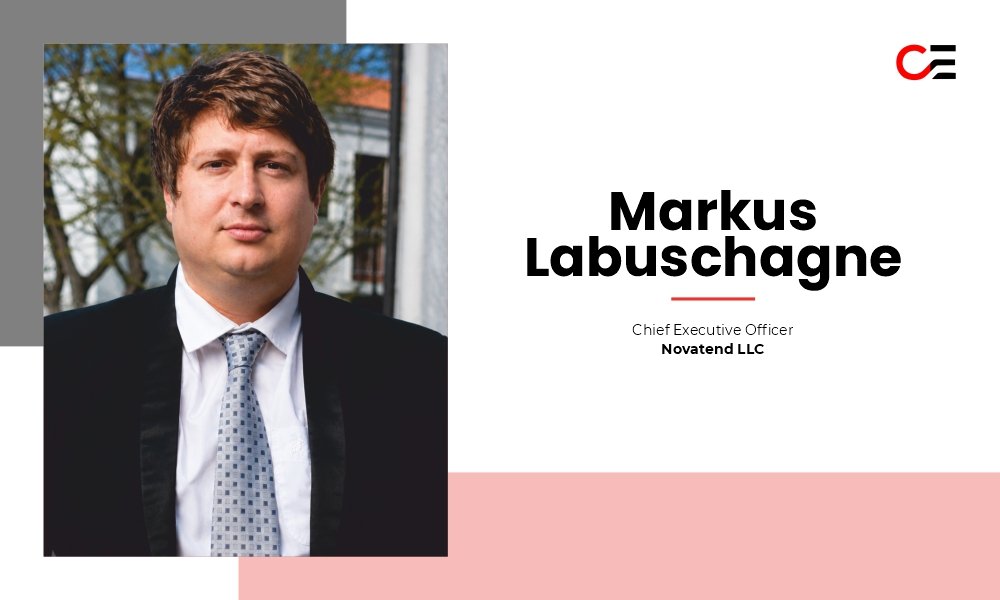
Scientific breakthroughs rarely happen overnight. They are built through years of curiosity, persistence, and countless small decisions that gradually shape an idea into something capable of improving lives. For Markus Labuschagne, Founder and Chief Executive Officer of Novatend LLC., innovation has never been about chasing recognition or creating technology for its own sake. It has always been about solving real clinical problems and giving healthcare professionals better tools to care for their patients.
Over the past decade, Markus has built a career across biotechnology, tissue engineering, regenerative medicine, and medical devices, translating scientific research into practical healthcare solutions. His work reflects a simple philosophy: science should leave the laboratory only when it can make a meaningful difference in everyday clinical practice.
Today, through Novatend, he is helping advance regenerative medicine in South Africa by developing locally manufactured biomaterials that support bone healing while reducing dependence on expensive imported alternatives. Yet his journey into this highly specialized field was anything but carefully planned.
A Scientist Before an Entrepreneur
Markus often says that regenerative medicine found him rather than the other way around.
From an early age, he knew he wanted to become a scientist. During his school years, biology fascinated him more than any other subject, and his interest gradually narrowed toward understanding living organisms and the remarkable ways the human body functions. Although he initially enrolled in dentistry, he soon realized his passion lay elsewhere. Changing direction to biological sciences became one of the most important decisions of his career.
Rather than viewing that decision as a setback, Markus saw it as an opportunity to pursue work that genuinely excited him. Tissue engineering and regenerative medicine offered the perfect combination of scientific discovery and practical healthcare application-an opportunity to spend his career helping the body repair itself through science.
Another defining moment came shortly after completing his master’s degree, when he was headhunted by one of South Africa’s leading orthobiologics companies.
“It was very much being thrown into the deep end,” he recalls.
Instead of gradually easing into industry, Markus found himself working in a fast-paced commercial environment where research, product development, customer engagement, manufacturing, and commercialization all happened simultaneously. The experience demanded rapid learning, but it also provided an education that no classroom could have offered.
Those early years taught him that developing medical technologies requires much more than scientific expertise. Success depends equally on understanding regulatory requirements, manufacturing realities, customer expectations, quality systems, and commercial viability. Scientific excellence may begin the journey, but bringing innovation to patients requires an entirely different set of skills.
Leadership Without Chasing the Title
Unlike many founders who aspire to become executives, Markus never actively pursued leadership positions.
“I don’t feel that I have an ego about leadership. If something needs to be done, someone should step up and make sure it gets done well.”
That mindset has quietly shaped his career.
Rather than seeking authority, Markus built credibility by accepting responsibility whenever challenges arose. Over time, leadership became less about holding a title and more about being willing to solve problems-regardless of whether those problems involved science, operations, customers, or strategy.
Today, as CEO of Novatend, that same philosophy continues to define his work.
His days rarely follow a predictable schedule. One morning may begin with meetings at hospitals or discussions with distributors, while the afternoon could involve reviewing regulatory documentation, ensuring compliance with the company’s quality management system, or planning future expansion into new markets.
Running a biotechnology company, he believes, means becoming a genuine “jack of all trades.”
Sometimes leadership involves discussing regenerative medicine with surgeons. Other times it means reviewing manufacturing processes, evaluating new business opportunities, or even fixing a label printer if that’s what the business needs that day.
For Markus, none of those responsibilities are beneath the role of a CEO. Building a company means doing whatever is necessary to move it forward.
Building Novatend from the Ground Up
Years before Novatend officially launched, Markus had already been developing ideas that would eventually become the company’s foundation.
Many of the concepts behind its products had been taking shape since around 2014. As his industry experience grew, so did his confidence that these ideas could become commercially viable technologies capable of addressing genuine clinical needs.
That vision became reality in 2022 with the founding of Novatend LLC.
As founder, Markus was appointed Chief Executive Officer by the company’s board, taking responsibility for transforming years of scientific thinking into a sustainable healthcare business.
Like many startups, Novatend began with far more ambition than resources.
In those early days, Markus wore almost every hat imaginable. He designed brochures, worked on packaging, prepared marketing material, visited hospitals, contacted surgeons one by one, and personally introduced the company’s technologies to medical professionals across South Africa.
Every conversation mattered.
Each meeting helped him better understand the realities surgeons faced in daily practice while providing valuable feedback that refined both the company’s products and its approach to the market.
There were no shortcuts.
Trust within the healthcare industry had to be earned through consistency, product quality, and personal relationships rather than marketing campaigns.
Four years later, those early efforts have helped transform Novatend into a growing organization serving hundreds of medical practices across South Africa with a dedicated team supporting its expanding operations.
For Markus, however, the company’s growth has never been measured simply by numbers. Every milestone represents another opportunity to bring practical regenerative medicine closer to the patients who need it most.
Solving a Real Clinical Challenge
At the heart of Novatend’s work is a problem that surgeons encounter every day-helping damaged bone heal when the body’s natural regenerative ability is not enough.
Bone is the second most transplanted tissue in the world after blood. While it has an extraordinary capacity to repair itself, healing does not always occur as expected. In a significant number of cases, surgeons require additional support to regenerate bones successfully.
For decades, treatment options have largely revolved around two approaches.
The first is an autograft, where healthy bone is harvested from another part of the patient’s own body and transplanted into the damaged area. Although clinically effective, it requires an additional surgical procedure, increases operating time, and often results in pain at the donor site.
The second option is an allograft, which uses donor bone. While this avoids creating a second surgical wound, it introduces other considerations, including biological variability, limited availability, and differing patient preferences.
Markus believed there should be another option.
That belief led Novatend to develop injectable biomaterials designed to support the body’s own regenerative process rather than replace it.
Delivered through a specially engineered syringe, the material forms a regenerative paste that is placed directly into the bone defect, where it signals the body to deposit new bone naturally. The approach can simplify procedures that traditionally require more invasive surgery and, in many cases, allows treatment to be performed on an outpatient basis.
Just as importantly, Novatend manufactures these products locally.
For Markus, this is about more than reducing costs. It is about giving South African healthcare providers access to advanced regenerative technologies without relying entirely on imported products priced in foreign currencies.
“We’re giving patients and surgeons a third option,” he explains. “One that’s designed around predictable outcomes while also making advanced treatment more accessible locally.”
Innovation Begins with the End User
Markus has worked across biotechnology, regenerative medicine, medical devices, and even cultivated meat technologies. While the industries differ, he believes they all teach the same lesson: good science alone does not guarantee a successful product.
Over the years, experience has helped him develop an instinct for identifying which ideas are likely to work outside the laboratory.
Many technically impressive innovations never succeed because they solve problems nobody has. Others become unnecessarily complicated when a simpler solution would have delivered greater value.
For Markus, successful innovation always begins with understanding the people who will ultimately use the product.
His advice to innovators is refreshingly straightforward.
“Get your product in front of customers as early as possible.”
Real feedback, he believes, is far more valuable than endless internal discussions. Surgeons quickly identify what works, what doesn’t, and what can be improved. Listening carefully and being willing to change direction, when necessary, often determines whether an innovation succeeds or quietly disappears.
He has also learned not to become emotionally attached to every idea.
Some concepts deserve further investment.
Others should simply be abandoned.
Knowing the difference early saves years of unnecessary effort.
From the Laboratory to the Marketplace
Developing medical technology is only the beginning.
Transforming scientific research into a commercially successful healthcare product requires funding, regulatory approval, manufacturing capability, market acceptance, and considerable patience.
Among the greatest obstacles Markus has faced is securing investment.
For many life science companies across Africa, early-stage funding remains difficult to obtain. Entrepreneurs are often expected to demonstrate commercial success before investors are willing to provide the capital needed to achieve it.
Rather than allowing rejection to discourage him, Markus treated every investor meeting as another opportunity to improve.
“Keep knocking on the doors,” he says. “You only need to be right once.”
Each unsuccessful pitch sharpened both the business model and the presentation, gradually building a stronger company in the process.
Regulatory compliance presents an equally demanding challenge.
Medical technologies must satisfy rigorous standards before reaching patients, requiring years of documentation, testing, validation, and quality assurance. While Markus fully appreciates why those standards exist, he also understands the burden they place on smaller companies competing with multinational corporations.
Building a biotechnology business, he says, demands accepting that reality from the very beginning.
Anyone hoping to move an idea from the laboratory to the hospital must understand the commitment involved not only financially, but personally. The journey often means long hours, difficult decisions, and years of uncertainty before success becomes visible.
A Culture Built on Trust
As Novatend has expanded, Markus has worked to preserve the same collaborative culture that existed when the company was only a handful of people.
The nature of the business leaves little room for disconnected teams.
Research depends on manufacturing.
Manufacturing depends on quality assurance.
Sales rely on regulatory compliance.
Every department succeeds only when every other department performs its role equally well.
That shared responsibility naturally creates trust and accountability.
Rather than closely managing every decision, Markus believes in giving people clear ownership while encouraging close cooperation across the business.
Maintaining quality, he says, becomes even more important as the company grows.
Growth should never come at the expense of the confidence surgeons to place in Novatend’s products.
Technology Should Support Human Relationships
Artificial intelligence continues to reshape healthcare, research, and medical innovation.
Markus acknowledges its value, particularly for reviewing scientific literature, identifying emerging clinical trends, and accelerating research.
But he draws a clear distinction between using technology to improve efficiency and allowing it to replace genuine human interaction.
Healthcare remains a relationship-driven industry.
Surgeons want to ask questions, discuss clinical experiences, and understand the reasoning behind the products they use. Those conversations cannot be replaced by automated marketing or mass communication.
At Novatend, face-to-face engagement remains central to the company’s approach.
Technology can make information easier to access, Markus believes, but trust is still built through knowledgeable people having honest conversations with other professionals.
Preparing for the Next Generation of Regenerative Medicine
Regenerative medicine continues to evolve rapidly, and Novatend is preparing for the next phase of that evolution.
One of the most significant changes Markus sees is the growing global demand for fully synthetic biomaterials. Religious considerations, cultural preferences, and advances in material science are encouraging healthcare providers to seek alternatives that avoid both human- and animal-derived materials.
Novatend has already developed its first fully synthetic product range and is currently completing its validation process.
Rather than replacing the company’s existing technologies, these products will expand the options available to surgeons, allowing them to choose the solution that best fits each patient’s individual needs.
For Markus, that flexibility is what matters most.
The company’s role is not to dictate treatment decisions but to provide clinicians with reliable, scientifically validated tools that support better clinical outcomes while respecting professional judgement.
A Grounded View of Sustainability
Sustainability has become a defining theme across industries, but Markus prefers a measured approach over broad claims.
For Novatend, responsible business begins with understanding its role and executing it well.
“We don’t try to exceed our mandate,” he says.
As a company focused on developing bone graft biomaterials, Novatend concentrates on manufacturing responsibly, using resources efficiently, and minimizing unnecessary waste wherever possible. Rather than making promises that are difficult to measure, Markus believes organisations should remain transparent about what they can genuinely achieve.
It is a philosophy that mirrors the way he approaches innovation itself and focuses on doing meaningful work well instead of trying to be everything at once.
Recognition That Reinforced the Journey
Although Markus has received several awards throughout his career, he has never viewed recognition as the destination.
One award, however, remains especially meaningful.
Receiving the Health Entrepreneur for Africa Award in 2015 marked an important milestone early in his career. More than the trophy itself, it provided reassurance that years of hard work, scientific research, and persistence were moving in the right direction.
“It was confirmation that what I had been doing was worth it.”
Since then, other recognitions have followed, but Markus still measures success differently.
For him, the greatest achievement is seeing a product leave the laboratory, reach surgeons, and ultimately help improve patient care. Awards may acknowledge that journey, but they have never been the reason for undertaking it.
Looking Beyond South Africa
Novatend has established a strong presence within South Africa, but Markus believes the company’s greatest opportunities still lie ahead.
Over the next three to five years, the priority is to continue strengthening the domestic market while preparing for carefully planned international expansion.
The company is building a strong local foundation before entering markets such as the United States, South America, and fellow BRICS nations.
Expansion, however, is not simply about entering new countries.
For Markus, growth only has value if the company can maintain the same scientific standards, product quality, and customer relationships that earned the trust of surgeons at home.
Scaling responsibly, he believes, is far more important than growing quickly.
Advice for the Next Generation
Having built businesses in one of the world’s most demanding industries, Markus has developed a practical perspective on entrepreneurship.
His first piece of advice is surprisingly simple.
Make sure you genuinely want the journey.
Building a company requires resilience, patience, and a willingness to work through uncertainty for years. Goals will evolve, markets will change, and unexpected opportunities will appear. Remaining flexible without losing sight of the broader direction is one of the most valuable qualities an entrepreneur can develop.
He also believes many people wait too long before acting.
Skills are rarely mastered before the journey begins—they are acquired along the way.
Every challenge solved, every mistake is corrected, and every difficult decision becomes part of that education.
Another lesson has stayed with him throughout his career: choose carefully where you invest your energy.
Every entrepreneur will encounter people who encourage progress and others who create unnecessary distractions.
Learning to recognise the difference early and walking away from situations that drain time and focus is often just as important as making the right business decision.
As Markus puts it, there is little value in fighting every battle when simply moving forward achieves far more.
Leadership Begins with Character
Despite leading an innovative biotechnology company, Markus remains refreshingly understated when discussing leadership.
“I don’t claim to be a leader,” he says. “I’ll lead until someone better comes along.”
Rather than defining leadership through authority or titles, he believes it begins with character.
His guiding philosophy is remarkably straightforward.
“Be a good man.”
To him, that means doing what you know is right, avoiding what you know is wrong, treating people with respect, and causing no unnecessary harm.
Those principles shape every part of his life—not only as a business leader, but as a husband and father.
“My family comes first.”
He believes professional success should never come at the expense of the people who matter most. Building a company is important, but so is being present for those closest to you and passing on values of honesty, responsibility, and kindness to the next generation.
That balance has helped him remain grounded throughout the demands of entrepreneurship.
Understanding the Rules of the Game
Looking across the broader biotechnology industry, Markus believes opportunities have never been greater.
Scientific progress continues to accelerate; new technologies are emerging rapidly, and regenerative medicine is entering an exciting period of development.
At the same time, entrepreneurs face familiar challenges.
Access to investment remains limited for many early-stage companies, while increasingly complex regulatory requirements demand significant time, expertise, and resources.
Rather than viewing these realities with frustration, Markus chooses to approach them with pragmatism.
He often recalls advice shared by a mentor during a fundraising trip.
“You don’t have to agree with the rules of the game but if you want to play, you need to know them.”
It is a lesson that continues to shape his approach to business.
Success is rarely determined by having the best idea. It also depends on understanding regulations, adapting to changing markets, building resilient teams, and remaining persistent when progress feels slow.
Purpose That Endures
Throughout his career, Markus Labuschagne has remained remarkably consistent in what motivates him.
He has never chased titles, recognition, or attention.
His focus has always been on applying science to solve real problems, building technologies that surgeons trust, and creating products capable of improving patients’ lives.
That same philosophy continues to guide Novatend as it expands its product portfolio and prepares international growth.
For Markus, innovation is not measured by how advanced a technology appears on paper, but by whether it works where it matters most—in the hands of healthcare professionals caring for patients.
His journey reminds us that meaningful progress is rarely dramatic. More often, it is built quietly through curiosity, resilience, disciplined execution, and the willingness to keep moving forward, even when the path is uncertain.
And perhaps his most lasting lesson has little to do with biotechnology at all.
Be kind where you can.
Put your family first.
Teach your children right from wrong.
Keep learning.
Keep building.
And when opportunities come your way, have the courage to step into the deep end because that is where real growth begins.