
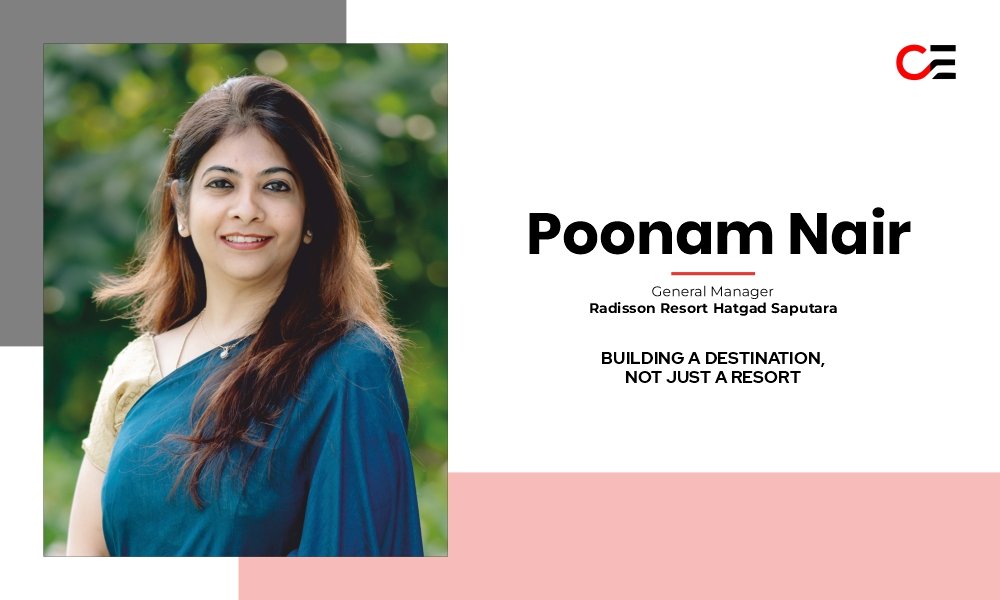
For Poonam Nair, a career in hospitality began almost by accident. In 2004, her ambition was to pursue mass media or journalism. When admission to the colleges she had applied to did not work out, she chose to explore Hotel Management at Rizvi College of Hotel Management. What initially appeared to be a practical alternative soon became a career that would span nearly two decades and take her through some of India’s recognised hospitality organisations.
The early reality of hotel management was far removed from what Poonam had imagined. Culinary training, housekeeping, bed-making, service operations and long working hours introduced her to the demanding fundamentals of hospitality. There were moments when she questioned whether she had made the right decision. But rather than making an early judgment, she chose to give the discipline her full effort.
That approach produced an immediate result. Poonam stood first in college throughout all three years and eventually ranked second in the Maharashtra state merit list in her final year.
Her first significant professional step came at The Leela Mumbai, where she joined as a Management Trainee. The experience gave Poonam an operational foundation and established principles that would remain relevant throughout her career: discipline, attention to detail and consistency in service.
Over the years, her career expanded across operations, sales, marketing and commercial leadership, with experience at The Leela, Marriott International, IHG and Radisson Hotel Group. This cross-functional exposure became important to the way Poonam eventually approached hotel leadership. Rather than viewing operations and commercial performance as separate disciplines, she came to see them as interconnected parts of the same business.
One of the defining chapters of her journey was her nine-year tenure at Radisson Blu Udaipur Palace Resort & Spa, where she served as Vice President – Commercials. The property was involved in several high-profile occasions, including the Isha Ambani pre-wedding celebration, the G20 Summit and celebrity weddings. More importantly from a business perspective, the period saw annual revenue grow from approximately ₹35 crore to ₹100 crore.
The number is significant, but the lesson behind it is perhaps more relevant to her current role: a property’s commercial trajectory is shaped by positioning, persistence, market understanding and disciplined execution.
Today, as General Manager of Radisson Resort Hatgad Saputara, Poonam is applying that experience to a very different challenge. Rather than leading an established city property or a mature luxury destination, she is working to build demand and identity for a resort in an emerging destination.
Leadership Built Around People and Accountability
Poonam’s leadership philosophy is straightforward: put people first, but do not allow empathy to replace accountability.
Hospitality remains a people business. Guest experience ultimately depends on the people delivering it, which means employees need to feel respected, trusted and empowered. But a positive workplace alone does not create a successful hotel. Processes, measurable goals, commercial awareness and operational discipline remain equally important.
Her approach therefore sits between empathy and accountability, empowerment and ownership, warmth and performance.
Poonam believes in remaining accessible to her team and leading from the front, while ensuring that managers understand the wider business rather than focusing exclusively on their individual functions. For her, leadership is less about having every answer and more about creating the conditions in which people can find answers themselves.
That distinction becomes particularly important when developing future leaders. A capable manager should eventually be able to make sound decisions without constantly depending on the person above them.
Her measure of leadership is therefore not simply how well a team performs when its leader is present. It is whether the team has developed enough confidence and capability to perform exceptionally when the leader is absent.
Turning Hatgad Saputara into a Destination
At Radisson Resort Hatgad Saputara, Poonam’s responsibility extends across the entire business, including operations, guest experience, financial performance, commercial strategy, talent development, stakeholder relationships, brand standards and destination positioning.
The 103-key luxury resort sits near Saputara, surrounded by the Sahyadris and within reach of major feeder markets such as Mumbai, Pune, Nashik, Surat and Vadodara, along with other markets across western and central India.
The opportunity is clear, but so is the challenge. An emerging destination cannot rely entirely on an established demand base. It has to create a reason for people to visit.
That is where Poonam’s destination strategy begins.
“We don’t sell rooms. We curate breathing space.”
The idea reflects a broader shift in traveller behaviour. For many guests, particularly those living in busy urban environments, the value of a leisure destination is no longer limited to accommodation. Nature, wellness, food, time with family, meaningful experiences and simply having space away from routine can all become part of the proposition.
Hatgad is therefore being positioned around what Poonam describes as slow, sustainable and soulful hospitality.
Nature walks, mindful experiences, experiential dining, local culture, wellness, music and community activities can all contribute to that positioning. Weddings, corporate offsites, celebrations and wellness retreats provide additional reasons for different customer segments to choose the destination.
The resort’s vegetarian culinary identity is another practical differentiator. Its outlets, including Coracana, Moreish, Must and H2O, allow the property to offer varied dining experiences while catering strongly to Jain, Marwari, Gujarati and other vegetarian markets.
The objective is not simply to increase room nights. It is to give the destination a distinct identity that can support multiple revenue streams.
Connecting Guest Experience with Business Performance
For Poonam, guest experience, employee engagement, operational excellence and financial performance are not competing priorities.
They form a chain.
A financially healthy hotel can invest in its people and experiences. A motivated team can deliver stronger service. Better service can contribute to guest satisfaction, reputation and repeat demand. Stronger demand, in turn, supports commercial performance.
Her own routine reflects this integrated approach. While operational issues remain a daily priority, she also stays connected with sales, revenue, guest feedback and financial performance.
The emphasis is on being hands-on without becoming a bottleneck.
Delegation and ownership therefore play an important role. Heads of departments are expected to take responsibility for their functions, while training, recognition and team engagement programmes help reinforce the wider culture.
The principle is simple: when employees feel that they matter, they are more likely to make guests feel that they matter.
Building People Who Can Build the Business
People development is one of the strongest themes running through Poonam’s leadership approach.
Training, mentoring, recognition and empowerment are supported by opportunities for younger professionals to understand the hotel beyond their immediate job descriptions. Leadership sessions, service excellence workshops, knowledge-sharing activities and team engagement programmes are intended to build broader business understanding.
There is also a more human side to that process.
Celebrating festivals and special occasions together gives employees from different departments an opportunity to interact beyond their daily responsibilities. In an industry where people often work long hours under considerable pressure, these connections can have a practical impact on belonging and team cohesion.
But Poonam’s focus goes beyond creating an engaged workforce. She wants managers to develop into leaders.
That means giving people opportunities to make decisions, take ownership and learn from the consequences of those decisions. It also means accepting that developing capable people requires leaders to give up some direct control.
The long-term payoff is a stronger organisation that does not depend on one individual for every decision.
Sustainability as an Operating Discipline
At Hatgad, sustainability is being approached through operational measures rather than treated simply as a marketing message.
The resort has invested in solar power, energy-efficient LED lighting, water conservation, wastewater treatment and recycling, glass bottles and dispensers, reduced single-use plastics, linen-reuse practices, drip irrigation and EV charging infrastructure.
One of the more tangible initiatives is the Organic Waste Converter. Organic waste generated at the resort is processed in-house and converted into compost, supporting the property’s approximately four acres of landscapes and lawns.
The model creates a basic circular system: organic material generated through hotel operations becomes a resource for the property’s own green spaces.
Water management is another area of focus. STP-treated and recycled water is used for appropriate applications, while drip irrigation helps control water consumption across gardens and lawns. Waste segregation and the reduction of single-use materials remain ongoing operational priorities.
For Poonam, however, responsible hospitality extends beyond environmental measures.
Local employment, local sourcing and opportunities for regional artisans and communities are part of the wider definition of sustainability.
The objective is not simply to reduce the property’s environmental footprint, but to ensure that the economic benefits of tourism reach beyond the boundaries of the resort.
Technology Should Strengthen Hospitality, Not Replace It
Poonam’s commercial background naturally influences how she approaches technology.
Data can provide a clearer understanding of feeder markets, booking behaviour, pricing, demand patterns and customer preferences. For an emerging resort, this information becomes particularly useful because destination creation requires continuous testing of what works and where demand is coming from.
Digital marketing is equally important. A resort in an emerging destination cannot depend entirely on traditional distribution channels. It needs to communicate its proposition consistently and build awareness among potential travellers.
Poonam expects artificial intelligence to become increasingly relevant across forecasting, personalisation, reservations, guest communication, workflow automation and decision-making.
But there is a boundary she does not see technology crossing.
Technology should support hospitality rather than remove its human element.
As more processes become automated, genuine human interaction may actually become more valuable. The competitive advantage will belong to businesses that understand how to combine data and technology with the instinct, empathy and personal attention that remain central to hospitality.
What the Next Five Years Could Bring
Poonam sees five major shifts shaping the sector.
Personalisation is likely to become increasingly important, with guests valuing experiences designed around their interests rather than standardised versions of luxury.
AI and data will continue to influence forecasting, distribution, communication and operational efficiency.
Wellness and slow travel are also expected to expand as travellers look for nature, meaningful food, mental space and experiences that allow them to step away from constant digital stimulation.
Sustainability is moving from an optional initiative towards an expectation.
And despite the acceleration of technology, people and emotional intelligence will remain central to hospitality.
These trends are already influencing the direction being taken at Hatgad, particularly around wellness, nature, experiential travel and destination-led hospitality.
The Wider Opportunity for Indian Hospitality
The Indian hospitality sector has considerable room to grow, but growth will not come without challenges.
Skilled manpower, talent retention, infrastructure, connectivity and consistency of service remain areas requiring continued attention.
At the same time, the opportunities are broad. Domestic tourism, weddings, MICE, experiential travel, wellness, spiritual tourism and emerging destinations are creating new avenues beyond the traditional metropolitan hotel market.
Poonam believes some of the most interesting growth will come from destinations that offer something cities cannot easily replicate: nature, authenticity, space and experiences.
The challenge will be developing these destinations without disconnecting them from the communities and environments that make them attractive in the first place.
Measuring a Career Beyond Titles
Looking back, some milestones stand out.
Ranking second in Maharashtra state merit during Hotel Management gave Poonam an early indication that she had found an area in which she could perform. Joining The Leela Mumbai provided the professional foundation. Her years at Radisson Blu Udaipur Palace Resort & Spa brought exposure to large-scale events and commercial transformation.
The increase in annual revenue from approximately ₹35 crore to ₹100 crore remains one of her most significant business milestones.
At Hatgad, however, the challenge is different. The task is to build the property’s business while simultaneously developing the identity of the destination, strengthening guest experience, supporting sustainability and creating a capable team.
Industry recognition, including Radisson Hotel Group’s “Yes I Can” and “Every Moment Matters” culture and her recent recognition as a Great Manager to Work With®, has also been meaningful.
Yet Poonam places greater value on a less visible measure of success: seeing people she has mentored become more confident and capable.
That perspective is consistent with the way she defines leadership.
The Next Chapter
Poonam’s immediate ambition is to establish Radisson Resort Hatgad Saputara as one of western India’s distinctive leisure, wedding and experiential resort destinations.
Mumbai, Pune, Nashik, Surat and other feeder markets remain important to that strategy. Weddings and MICE are expected to remain significant business segments, while leisure, wellness and experiential travel provide opportunities to broaden the property’s demand base.
Beyond Hatgad, Poonam hopes to continue taking on roles with greater strategic responsibility while remaining involved in developing the next generation of hospitality professionals.
Her career began with an unplanned decision. What made that decision work was not a predetermined career path, but the willingness to learn, adapt and give the profession a genuine chance.
That is also the advice she offers to people entering hospitality: be willing to start anywhere, learn everything and give your best before deciding what is or is not for you.
Hospitality can be demanding. Long hours, operational pressure, changing markets and high guest expectations are part of the profession. But it also offers something few industries can: the ability to influence how people feel and remember an experience.
Poonam’s own definition of success has therefore moved beyond titles and recognition.
It is measured through stronger businesses, better guest experiences and people who become more capable because they had the opportunity to work with her.
For a career built on an accidental beginning, that is a fairly deliberate legacy.