
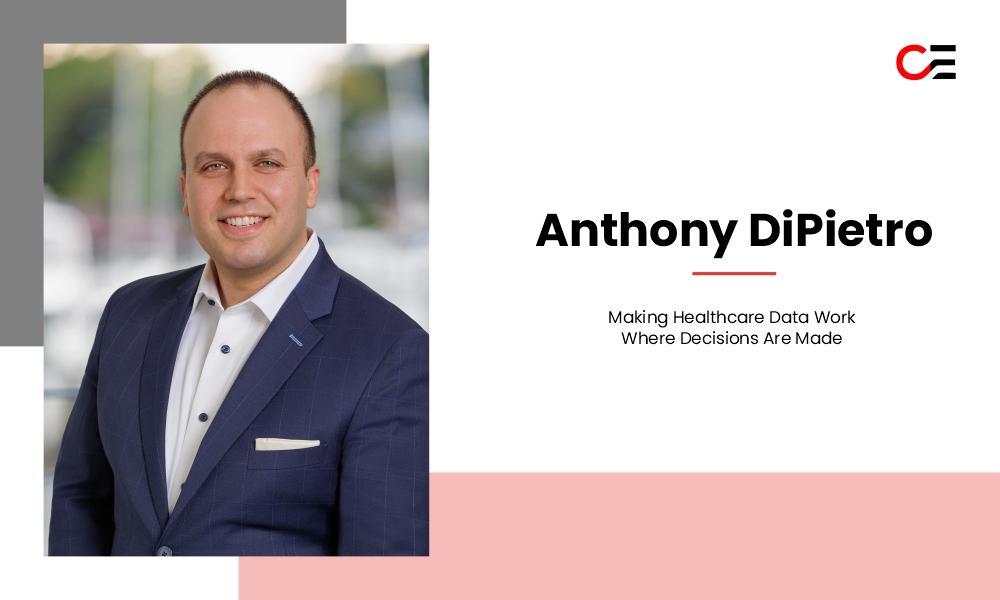
Long before wearables, interoperability, and EHR-native analytics entered the conversation, Anthony DiPietro started his career on the front lines of healthcare—selling copiers and printers to ambulatory practices, inpatient and outpatient facilities, and provider organizations. That experience gave him an early, ground-level view into how healthcare systems manage patients, process claims, and operate against the many metrics that directly influence care delivery and outcomes.
Over time, those details mattered more as populations grew and technology advanced.
“I began my career selling copiers and printers to healthcare providers,” he says simply. No mythology—just an early education in how healthcare organizations managed patient information before digital systems became the norm.
As his career progressed from physical hardware to healthcare IT services, he found himself alongside frontline clinicians and C-suite executives alike, working inside both small practices and large health systems. That vantage point exposed the seams.
Fragmented data. Inefficient workflows. Technology that promised efficiency but delivered friction. Clinician burnout that wasn’t theoretical—it was structural.
What ultimately pulled him deeper was something more troubling. Patients with chronic disease—especially those managing diabetes—were falling through the cracks. Not because the data didn’t exist, but because it wasn’t usable. It wasn’t timely. And it wasn’t embedded in the exact moment a clinician needed to act.
“I saw enormous volumes of patient-generated health data living outside the EHR, locked in vendor portals and disconnected from care teams.”
Healthcare was drowning in information while starving for actionable intelligence.
That contradiction became the foundation of TheraponHealth.
The Workflow, Not the Widget
As Founder & CEO, Anthony started TheraponHealth to solve a single, fundamental problem. Making healthcare data clinically actionable, not just available.
It sounded simple. It was everything but.
As we began designing and architecting our solution, we deliberately validated every step with clinical teams, physicians, and frontline healthcare professionals. Through those conversations, a clear gap emerged: there was widespread misunderstanding around what real-time, autonomous, and continuous patient data actually looks like once it reaches the EHR—and how it should function inside clinical workflows.
We also uncovered a deeper, systemic issue: physician burnout. Clinicians weren’t just caring for patients all day; they were spending their nights at desks, manually entering data, copying and pasting information, and reconciling fragmented systems just to keep records up to date.
That friction—data that exists but isn’t usable in the moment it’s needed—is one of the core problems TheraponHealth was built to solve.
We had to be direct and impactful.
If insight is not delivered inside the workflow, it does not exist.
TheraponHealth was built as a cloud-native Platform as a Service that unifies patient-generated data from continuous glucose monitors (CGMs), CPAP devices, and leading connected wearables. The platform normalizes and harmonizes this data using industry interoperability standards, including FHIR and HL7.
Insights are delivered directly inside the EHR through SMART on FHIR launches and embedded, EHR-native experiences—allowing clinicians to access real-time information within their existing workflows, using their native credentials, without switching systems or disrupting care.
No portal switching. No separate dashboards. No context loss.
Embedding intelligence directly into existing EHR workflows is technically harder. It is slower at the outset. It demands architectural discipline and regulatory alignment from day one. But Anthony and his team made the call early. No bolt-on dashboards. No standalone analytics.
“We committed to integrating intelligence directly into core EHR environments, even though it was technically harder and slower upfront.”
That decision became the company’s architectural blueprint.
This approach accelerated enterprise trust and drove clinician adoption—not through marketing campaigns, but through true workflow alignment. We deliberately avoided a one-size-fits-all model, recognizing that healthcare systems don’t operate that way.
In a healthcare technology landscape crowded with incremental solutions, TheraponHealth differentiates itself by addressing the hard problems many platforms choose to mask—or claim to solve without delivering. These include real-time interoperability, EHR-embedded analytics, and adoption that is clinically sustainable at scale.
Tatsujin is software-, device-, hardware-, and EHR-agnostic. It is engineered to scale across enterprise health systems, payers, life sciences organizations, and federal agencies such as the Veterans Affairs and NASA—while meeting the highest security, privacy, and compliance standards.
Anthony’s belief runs deeper than architecture.
“Technology in healthcare should work for clinicians and patients, not the other way around.”
That is not a slogan. It is a non-negotiable design constraint.
Speed Versus Trust
In healthcare, innovation does not fail from lack of demand. It stalls at the gate of institutional trust.
Theraponhealth reframes it.
“The biggest challenge has been navigating the tension between speed and trust.”
Early demand for TheraponHealth moved more slowly than expected—not because of lack of interest, but because enterprise healthcare wasn’t ready. Health systems wanted innovation, yet many were unprepared to adopt it or fully understand its implications. What followed were exhaustive security reviews, legal evaluations, compliance checks, and clinical validation cycles that stretched on for months. For an early-stage company, it felt like a lifetime.
Rather than pushing harder, he chose to go deeper.
TheraponHealth strengthened its security posture, aligned its architecture with enterprise and federal standards, and embedded clinical stakeholders directly into development and validation. Growth wasn’t forced—it was paced deliberately, building trust, credibility, and readiness alongside the market.
“The biggest lesson was that in healthcare, durability matters more than velocity. Trust compounds.”
Trust in infrastructure, is as critical as code or compliance.
When he quotes the principle, he lives by, it is not abstract.
“It takes 20 years to build a reputation and five minutes to ruin it. If you think about that, you will do things differently.”
In healthcare, that is not philosophy. It is survival.
Clinician in the Loop
Inside TheraponHealth, innovation is inseparable from clinical reality.
One of Anthony’s most consequential decisions was establishing a clinician-in-the-loop development model. Clinical stakeholders are not brought in at the end to validate features; they are embedded continuously throughout the design, build, and validation process.
This approach eliminates theoretical use cases and prevents the creation of features that may look compelling in demos but add cognitive burden in real-world practice. Success is not measured by feature velocity, but by tangible outcomes: reduced workflow friction, time returned to clinicians, and measurable improvements in patient care. The metrics are operational, not cosmetic.
His leadership mirrors the product philosophy—hands-on, outcome-driven, and deeply collaborative. He leads with clarity, speed, and accountability, setting expectations transparently and communicating not just what the team is building, but why it matters clinically and operationally.
He values alignment over consensus, encourages constructive debate, and listens closely to clinicians—translating their needs into scalable, enterprise-ready technical solutions.
Leadership, in his view, is not about hierarchy. It is about accountability to outcomes.
From Data Collection to Clinical Intelligence
When asked about the next five years in healthcare, Anthony points to structural shifts already in motion. The industry is moving from data collection to clinical intelligence. From episodic encounters to continuous, longitudinal care. From siloed systems to embedded interoperability.
Real-time, patient-generated health data—from wearables, continuous glucose monitors, connected devices, and home diagnostics—will become foundational to chronic disease management and patient visibility. The challenge won’t be access to data; it will be transforming overwhelming volume into actionable insight that clinicians trust.
TheraponHealth has prepared for this shift by building a real-time ingestion and normalization layer that delivers clinically relevant signals directly into the EHR, where decisions are made.
Workflow friction is increasingly recognized as a strategic risk. Portal sprawl, alert fatigue, and disconnected tools contribute directly to clinician burnout and undermine technology adoption—regardless of how advanced the data may be.
Embedding analytics natively within EHR workflows is not merely a design decision. It is a clinician retention strategy.
Interoperability, long treated as a compliance obligation, is becoming a competitive advantage. Platforms capable of operating securely across EHRs, devices, and partners will lead.
“We are designing and building infrastructure, not just features.”
Value-Based Care and Accountability
The shift toward value-based care is accelerating, and stakeholders are no longer satisfied with dashboards alone. They are demanding measurable improvements in efficiency, utilization, and patient outcomes.
TheraponHealth aligns its platform, Tatsujin, around outcome-driven use cases that enable earlier clinical intervention, reduce avoidable utilization, and improve chronic disease management. By embedding insights directly into EHR workflows, care teams can act faster—without adding operational or cognitive burden.
From a reimbursement perspective, the platform supports accurate documentation, performance measurement, and longitudinal outcome tracking, ensuring that clinical action translates directly into financial performance.
Healthcare organizations are being held to a higher standard of measurable accountability. TheraponHealth is built to operate inside that reality.
Sustainability as Discipline
For Anthony, sustainability is both technological and human.
On the technology side, a cloud-native, digital-first platform reduces reliance on physical infrastructure, redundant hardware, and paper-based processes. By embedding intelligence directly into existing EHR systems, TheraponHealth minimizes system duplication and lowers the overall operational footprint.
But the more urgent sustainability challenge is human.
Reducing workflow friction preserves clinician time and cognitive focus—two of the most critical factors in addressing burnout and improving retention. For patients, earlier intervention and continuous monitoring help prevent avoidable escalations and support better long-term outcomes.
Sustainability means building systems organizations can rely on technologically, economically, and operationally over time.
Milestones That Matter
TheraponHealth measures progress through enterprise validation, not awards.
The company has secured and advanced engagements with large health systems, completed rigorous technical evaluations, and progressed through comprehensive security, legal, and compliance reviews. It has also launched clinical research initiatives within acute care environments.
Among its most significant milestones is the signing of a global healthcare system, positioning TheraponHealth at the forefront of delivering advanced, scalable technology to clinicians and patients at enterprise scale. In parallel, the company secured an exclusive partnership with a leading global medical device manufacturer, granting access to its full data ecosystem.
Together, these milestones establish TheraponHealth as a differentiated interoperability and clinical intelligence company and partner within chronic disease management.
“Recognition is measured by the caliber of organizations willing to deploy our technology and the outcomes we enable.”
Looking Forward
If Anthony could change one aspect of his career journey, he would have started building sooner—with the confidence to create solutions, not just sell them. His early years selling into healthcare provided a deep, practical understanding of clinical workflows, reimbursement realities, and enterprise complexity. That grounding ultimately shaped TheraponHealth into a platform rooted in operational truth.
In the years ahead, clients and stakeholders can expect disciplined execution focused on outcomes—not noise. He is intentionally challenging fragmented data, portal-based workflows, and analytics that live outside clinical decision-making. In their place, he is building infrastructure that enables real interoperability, real-time insight, and measurable clinical and financial impact—embedded directly where care happens.
Healthcare rarely rewards volume. It consistently rewards credibility.
As the industry moves into 2026 and beyond—toward continuous care models, embedded intelligence, and outcome accountability—leaders will be judged less by how boldly they promise transformation and more by how reliably they deliver it.
Anthony DiPietro built TheraponHealth around a simple principle: Insights must live where decisions are made.
In an industry saturated with data yet starving for clarity, that discipline is what separates noise from leadership.