
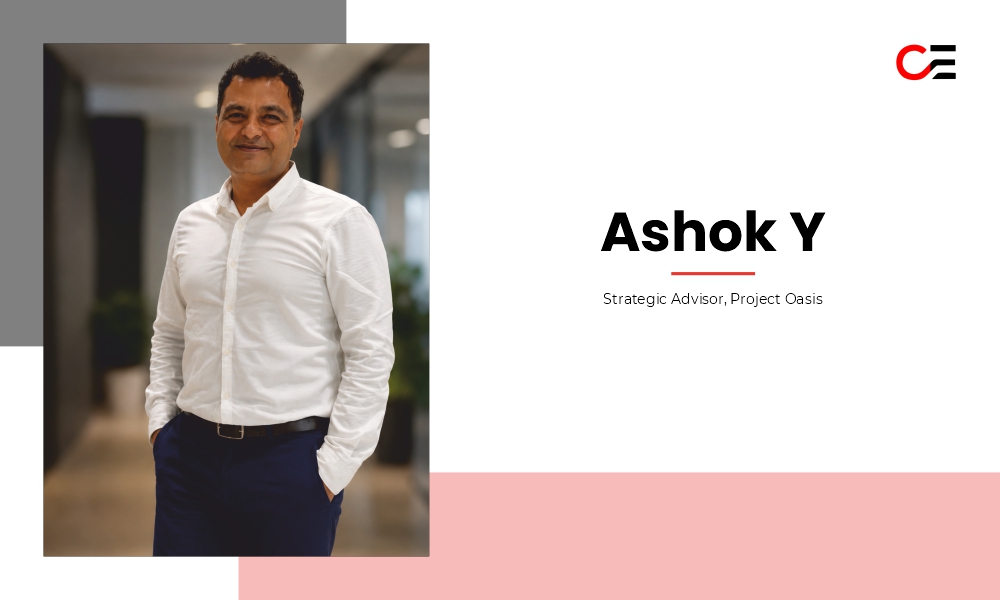
Lessons in Leadership, Transformation, and Sustainable Growth
Over the course of more than three decades, Ashok has worked across industries, technologies, business models, and organizational environments. His career has taken him from software development and consulting to entrepreneurship, business transformation, customer success, strategic partnerships, and organizational leadership. Yet amid changing markets, evolving technologies, and shifting business priorities, one belief has remained constant:
Every problem is an opportunity.
It is a principle that has guided his leadership decisions, shaped his professional journey, and influenced the way he approaches both business and life. For Ashok, transformation has never been solely about technology, strategy, or operational improvements. Instead, it has always been about helping people and organizations unlock their potential by navigating uncertainty, embracing change, and converting challenges into momentum.
His story offers a perspective shaped not by theory alone, but by years of firsthand experience leading turnarounds, managing complex transformations, building businesses, and helping organizations adapt in rapidly changing environments.
A Career Shaped by Curiosity and Problem Solving
Reflecting on his professional journey, Ashok identifies three forces that have consistently influenced his path: curiosity, constraints, and an enduring desire to solve problems.
Unlike many professionals who specialize in a single function early in their careers, he was exposed to multiple aspects of business from the outset. Working within a small software company during a period when technology was still establishing its role in business operations, he gained experience across consulting, software development, implementation, customer support, pre-sales, and sales.
This broad exposure provided a unique understanding of how organizations function and, more importantly, how customers experience value.
Rather than viewing business through a single lens, Ashok learned to appreciate the interconnected nature of strategy, technology, operations, and customer experience. These early experiences laid the foundation for a leadership style that would later emphasize alignment, execution, and customer-centricity.
One of the defining moments of his early career came through an e-Governance initiative for the Government of Goa. While the project involved significant technological transformation, the most valuable lesson had little to do with technology itself.
The experience revealed that technology is often the simplest component of transformation. The real challenge lies in people.
Aligning stakeholders, managing expectations, addressing concerns, and building support for change proved just as important as delivering technical solutions. The lesson would continue to influence his thinking throughout his career and become a recurring theme in his approach to transformation leadership.
Entrepreneurship and the Reality of Building Something New
Ashok’s professional journey eventually led him into entrepreneurship, where he founded a SaaS startup and participated in building a patent-pending CRM platform designed to improve customer experiences through intelligent use of historical data.
In many ways, the platform anticipated trends that would later become central to customer intelligence and AI-driven engagement strategies.
Yet the most important lessons came not from the technology itself but from the entrepreneurial journey behind it.
Building a startup exposed him to the realities that many entrepreneurs know well: limited resources, uncertainty, difficult trade-offs, constant decision-making, and the need to move forward without complete information.
It was an environment where resilience became essential and adaptability was often the difference between progress and stagnation.
Although the venture ultimately achieved a successful exit, Ashok regards the experience primarily as a lesson in perseverance and resourcefulness. It reinforced his belief that meaningful growth often emerges from difficult circumstances rather than ideal conditions.
Discovering What Drives Organizational Success
As his career evolved, Ashok found himself leading business turnarounds, scaling partnerships, managing transformation initiatives, and helping organizations navigate periods of uncertainty and growth.
Across these experiences, he observed an intriguing pattern.
Some organizations possessed exceptional talent yet struggled to achieve desired outcomes. Others, operating with far fewer resources, consistently exceeded expectations.
The difference, he discovered, was rarely intelligence or talent alone.
Instead, successful organizations tended to share three common characteristics: clarity of purpose, disciplined execution, and the ability to transform challenges into opportunities.
This realization gradually became one of the cornerstones of his leadership philosophy. Over time, it also inspired the development of a structured framework that would eventually become known as INTACT.
Every Problem Is an Opportunity
Many leaders are energized by opportunities. Ashok is energized by problems.
The philosophy that now defines much of his work was not developed in a strategy workshop or executive retreat. It emerged through years of navigating challenges across different stages of his career.
Economic downturns, customer escalations, organizational restructuring efforts, talent shortages, business disruptions, and rapidly changing market conditions all presented themselves at various points along the way.
Initially, these situations appeared as obstacles.
Over time, however, Ashok began viewing them differently.
He came to see challenges as opportunities for learning, growth, and reinvention.
Whenever faced with adversity, he asks three questions:
- What is this situation trying to teach us?
- What opportunity are we missing?
- How can we emerge stronger than before?
These questions shift attention away from limitations and toward possibilities. They encourage reflection rather than reaction and create space for innovation when conventional approaches are no longer sufficient.
This mindset has helped him remain optimistic during periods of uncertainty, make difficult decisions with greater confidence, and support teams through complex transformations.
Leadership Tested by Real-World Challenges
When asked to identify the most challenging leadership experience of his career, Ashok finds it difficult to select a single example.
Each challenge taught a different lesson and contributed to his development as a leader.
One early experience dates back to an era before cloud computing, remote access, and instant software updates. After traveling a considerable distance to support an important customer, he discovered that the software media required for implementation had become corrupted.
There was no immediate solution available through technology.
The situation demanded calm thinking, systematic problem solving, and the ability to maintain customer trust under pressure.
Another experience involved an ambitious e-Governance initiative that began as a technology transformation project but gradually encountered political realities and competing stakeholder interests.
The project reinforced a lesson that many leaders eventually learn: successful transformation depends as much on managing perceptions, expectations, and relationships as it does on technology and process.
Later, he inherited a critical project from a competitor under highly challenging circumstances. Rather than focusing on blame or confrontation, his team chose transparency and collaboration, working closely with the client to stabilize the situation and rebuild confidence.
The experience reinforced the value of humility, partnership, and trust in leadership.
A different kind of challenge emerged during his entrepreneurial journey, where uncertainty became a daily reality. Securing resources, attracting talent, earning customer trust, and making decisions without complete information tested both resilience and adaptability.
Yet perhaps one of the most revealing experiences involved assuming responsibility for a major customer account where the client openly expressed their intention to replace the organization.
Instead of treating the situation as a lost cause, the team approached it as an opportunity to rebuild trust.
Through transparency, consistent delivery, and an unwavering focus on customer success, the relationship was not only preserved but strengthened over time.
Across all of these experiences, a common lesson emerged.
Leadership is not about controlling circumstances.
Leadership is about controlling your response to circumstances.
Industries change. Technologies evolve. Markets fluctuate. Crises emerge unexpectedly.
What ultimately matters is the ability to remain composed, find opportunities within uncertainty, and create momentum when the path forward is unclear.