
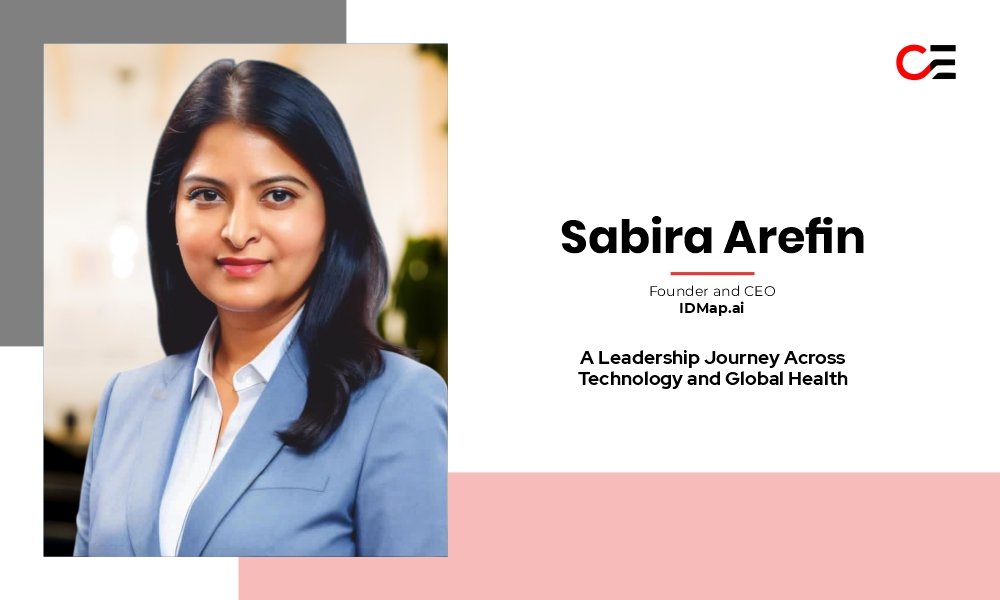
Some professional journeys begin with a defined career plan. Others take shape after encountering problems that are difficult to ignore. For this entrepreneur and technology leader, the journey began with firsthand exposure to the frustrations and limitations within healthcare systems, particularly for women and underserved communities with complex needs.
Those experiences created an early interest in finding technology-driven solutions to challenges that traditional systems had struggled to address. Her interest in the intersection of healthcare, data and technology eventually led her to pursue advanced doctoral studies in health technology innovation and artificial intelligence for diagnostic systems, deepening her understanding of how AI could influence the future of healthcare delivery.
Today, her work sits at the intersection of AI, identity intelligence and global health. As Founder and CEO of IDMap.ai, she focuses on building trusted data and identity intelligence solutions while advocating for a more responsible approach to digital identity. She is also the Founder of the Global Health Alliance; a nonprofit platform focused on preventive healthcare and improving access for underserved communities.
The motivation behind this work is straightforward. She believes technology should do more than create efficiency. It should improve lives. For her, the most meaningful innovation combines intelligence with empathy and considers the people affected by technology, not just the systems being built.
Leadership Through Clarity and Collaboration
Her leadership style is deliberate, collaborative, and decisive. She does not view effective leadership as being the loudest voice in the room. Instead, she places greater value on clarity, empathy, and the ability to make thoughtful decisions.
Her communication style reflects the same approach. She is direct but caring, and believes in listening carefully before speaking, questioning assumptions with curiosity, and translating complex technical concepts into language that people can understand and act upon.
Creating the right environment is also important to her leadership philosophy. She believes different perspectives should be respected, and that innovation is stronger when people work toward a shared purpose rather than competing internally for influence.
This approach is particularly relevant to the areas in which she operates. AI, identity, and data are technical subjects, but their consequences are increasingly personal. Decisions involving digital identity, privacy, and information can affect individuals, organizations, and communities in very practical ways.
For her, leadership therefore involves not only deciding what can be built but also considering how it should be built and used.
Designing Technology Around Trust
As Founder and CEO of IDMap.ai, she oversees strategic vision, product innovation, partnerships and global expansion. A central responsibility is ensuring that innovation and responsible data use develop together.
One concept she has consistently championed is trust architecture: the idea that trust, privacy and accountability should be considered from the beginning of the technology lifecycle rather than added later as compliance requirements.
In practice, this means paying attention to transparency, verifiability, responsible data use, and privacy throughout the development and application of technology.
Her work extends across identity intelligence, data infrastructure, and smart-city environments, where reliable information can support organizations in making better-informed decisions.
IDMap.ai operates at the intersection of identity intelligence, data and AI, with work supporting areas such as identity resolution, fraud prevention, risk intelligence, digital identity and data-driven decision-making.
The company’s differentiation lies as much in its philosophy as in its technology. Privacy, transparency, and responsible data practices are not treated simply as regulatory obligations. They are considered fundamental components of good technology.
As AI becomes increasingly accessible, sophisticated intelligence itself is becoming less difficult to obtain. The more difficult question is how that intelligence is used.
Her position is that trust can become an important differentiator. The objective is not simply to create more data or more sophisticated algorithms, but to help organizations use intelligence in ways that are accurate, responsible, and deserving confidence.
Extending Technology Into Preventive Healthcare
Her work through the Global Health Alliance reflects the same underlying belief that technology should have a practical human purpose.
Through the nonprofit platform, she has advocated for a preventive-health model that uses technology to support earlier intervention, mental-health screening, health education, and broader access to information for underserved communities.
The emphasis is on giving people better tools before a health problem becomes a crisis.
This represents a broader perspective on innovation. Technology does not create meaningful impact simply because it is advanced. Its value also depends on whether it can be translated into practical solutions and reach people who need them.
For her, the goal is therefore not simply to treat illness more efficiently, but to help individuals and communities become better equipped to protect their health.
Turning Difficult Experiences Into Better Judgment
Her career has also included moments in which professional trust broke down, whether through relationships, conflicting interests, or situations where her intentions and vision were misunderstood.
Those experiences became an important part of her development as a leader.
Rather than allowing them to make her more guarded, she became more disciplined. She sought advice from mentors, legal counsel, and experienced professionals, while developing a deeper understanding of governance, contracts, and policy.
One of the most important lessons was learning to distinguish between reacting emotionally and responding strategically.
For her, resilience is not simply the ability to endure difficult circumstances. It is the ability to take something constructive from them and use that experience to make better decisions in the future.
She also developed a different perspective on boundaries. They do not necessarily have to be walls. Instead, they can provide a structure for self-respect and responsible decision-making.
The experience ultimately reinforced a broader lesson about leadership: being liked and being trusted are not the same thing.
For her, lasting leadership is built on trust.
Technology as a Reflection of Human Intention
Her view of technology is balanced between its possibilities and its responsibilities. She sees technology as a reflection of human intention. Poorly designed systems can amplify inequality and division, while responsibly designed technology can expand access, opportunity, and human potential.
At IDMap.ai, AI and data are not viewed as the final objective. They are tools for developing better intelligence, understanding identity, identifying risks, and supporting more informed decisions while maintaining attention to privacy and responsible governance.
The same philosophy informs her work in global health.
Through the Global Health Alliance, AI and digital platforms are being explored as tools for preventive-health education, screening and access to information, particularly for underserved communities.
The underlying principle is practical: innovation has greater meaning when advanced technology can become useful to the people who need it most.
Preparing for the Next Generation of Digital Identity
Looking toward the next five years, she identified three developments that are likely to influence the technology landscape.
The first is the movement toward greater individual control over identity and personal data. Verifiable credentials, privacy-enhancing technologies and decentralized approaches to identity could increasingly change how people prove who they are without unnecessarily exposing additional information.
The second is the convergence of AI, identity intelligence, and connected infrastructure. As cities, healthcare systems, financial institutions and other organizations become increasingly data-driven, trusted identity and data infrastructure will become more important.
The third is the rapid evolution of AI regulation and governance.
Governments around the world are establishing stronger expectations around transparency, privacy, accountability, and responsible AI. For organizations operating across markets, this creates complexity, but it also reinforces the need to consider governance from the beginning.
Her response is to treat trust and governance as part of product architecture rather than separate compliance exercises.
She believes the organizations that succeed in the next generation of AI will not necessarily be those with the most powerful technology alone. They will also be the organizations people trust to use that technology responsibly.
Sustainability Beyond the Environmental Question
Her understanding of sustainability extends beyond environmental considerations.
For her, sustainable technology should create systems that remain useful, inclusive, and responsible over time. Better data intelligence can help organizations allocate resources more effectively, improve planning, and reduce unnecessary inefficiencies.
The Global Health Alliance adds another dimension to this perspective through its focus on health equity.
Communities cannot thrive sustainably when significant populations lack access to preventive healthcare, health education, and early intervention. Improving access to these resources is therefore part of building stronger and more resilient communities.
Ultimately, she views sustainability as creating long-term value without compromising the wellbeing, privacy or dignity of the people those systems are designed to serve.
Recognition Is Not the End Goal
Her work as an entrepreneur, author, and technology leader has received recognition across technology and healthcare. These include the Author & Entrepreneur Excellence Award from the World Leaders Summit in 2024, recognition among the Top 100 Innovators & Entrepreneurs in 2024 and 2025, and recognition among influential women leaders in the United States in 2025.
She is grateful for these recognitions, but they are not what ultimately defines her career.
Some of the achievements she values most are quieter: women she has mentored, communities supported, partnerships developed and systems she has helped improve.
For her, awards recognize a moment. Impact is measured by what remains afterward.
That distinction is important to her because professional recognition can document an achievement, but it cannot by itself determine whether the work created lasting value.
Learning to Trust Her Own Conviction
If she could change one thing about her career, she would have trusted herself sooner.
Earlier in her journey, degrees, titles, awards and other forms of external recognition provided validation that her ideas deserved to be heard. Education and recognition remain important, but experience eventually changed the way she viewed them.
She realized that credentials do not create vision. They can strengthen it, but the conviction to pursue an idea must come from within.
That realization has influenced her leadership today. She continues to value learning but no longer confuses external validation with internal conviction.
The lesson she would give her younger self is simple: she did not need permission to think boldly.
Building the Next Chapter
Over the next several years, she expects IDMap.ai to expand its international presence, particularly across the United States, MENA and Europe, while continuing to develop trusted data and identity intelligence solutions for an increasingly AI-driven economy.
The convergence of identity, AI, smart infrastructure, and responsible data governance remains a key area of interest. She believes this intersection could become one of the defining technology opportunities of the coming decade.
Through the Global Health Alliance, she also hopes to expand scalable preventive-health initiatives, AI-enabled screening and digital health education for underserved communities.
Her plans extend beyond organizational growth. She is also working on a memoir exploring both the science and the human story behind her journey. Rather than simply documenting achievements, the memoir is intended to reflect resilience, innovation, identity, and what it means to build impact with integrity.
Across these different efforts, one principle remains consistent: technology should serve a meaningful human purpose.
When Intelligence Is Everywhere, Trust Must Be Built
One quote captures the philosophy behind much of her work:
“Intelligence is everywhere now. Trust must be built intentionally.”
The idea speaks directly to the challenge emerging alongside the rapid development of AI.
Artificial intelligence can generate information, analyze enormous datasets, and make increasingly sophisticated predictions. As these capabilities become more widely available, intelligence itself may become less scarce.
Trust is different.
It cannot simply be produced by an algorithm. It must be established through transparency, responsible decision-making, verification, accountability, and consistent behavior.
For her, leadership in this new era means building with integrity, verifying with responsibility, and innovating with purpose.
Technology may continue to become more intelligent, but making that technology worthy of human trust remains a human responsibility.