
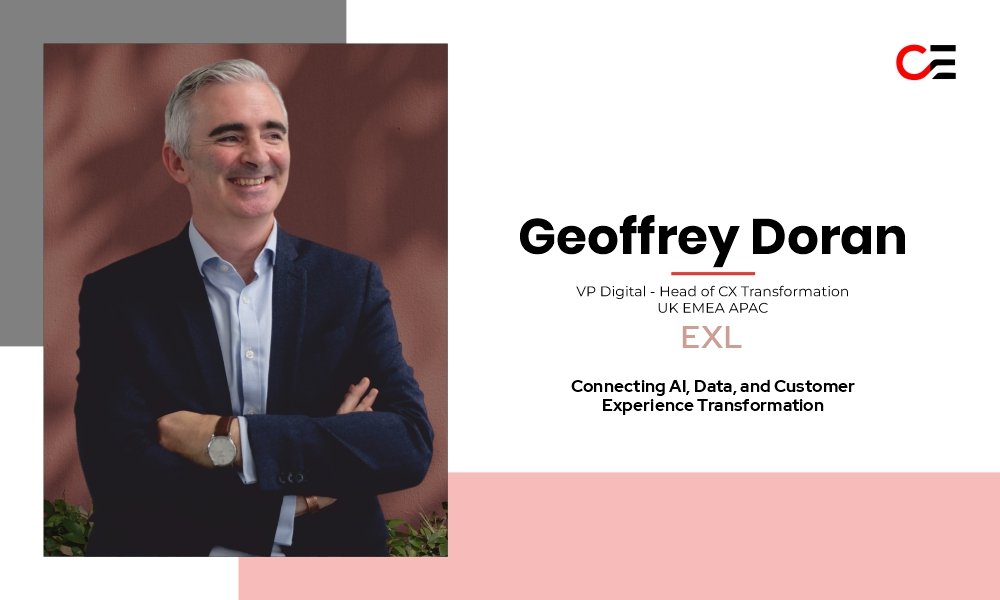
Customer experience transformation has evolved significantly over the past two decades. From the growth of websites and mobile applications to cloud computing and artificial intelligence, each technological shift has changed how organisations engage with customers. For Geoffrey Doran, VP, Digital – Head of CX Transformation at EXL, the central challenge remains consistent: making technology useful to customers while delivering measurable business outcomes.
His career has taken him through several stages of digital transformation, from building an IT business and developing digital experiences to establishing experience design capabilities and helping organisations navigate AI adoption. These experiences have shaped his approach to transformation, which combines technology, customer insight, business processes, and people.
From Early Computing to Digital Experience Design
Geoffrey’s interest in technology began very early with DOS-based computer games, before Windows became widely usedplaying games on early DOS-based machines and building desktops machines from scratch.. That early interest eventually led him to establish a start-up, Adare IT Solutions, where he became increasingly involved in experience design across digital channels.
At the time, social platforms were expanding, and online shopping was changing how people communicated, connected, and purchased products. Businesses were beginning to recognise that digital channels were not simply another way to reach customers; they were changing customer expectations and interactions.
A move to Belgium to become Director of Digital at Karakas, a design agency, marked another important stage in his career, building their digital capabilities. Smartphones and mobile applications were gaining prominence, and his work with multinational organisations and European associations brought him into contact with larger customer bases and higher volumes of digital interactions.
This experience strengthened his understanding of user experience (UX) design and its commercial value. Products and services that address genuine customer needs could improve the user experience while contributing to business growth.
At NTT DATA, Geoffrey built an experience design capability from the ground up, growing the team to 4025 people on-site, near-shore and off-shore. Working with interns, researchers, and experienced designers gave him the opportunity to develop talent alongside the function itself. It also reinforced his belief that transformation depends on people and organisational culture as much as technology.
Today, at EXL, he focuses on how AI is changing customer engagement across banking, insurance, utilities and other service-intensive industries. Having worked through the evolution of the web, mobile, and cloud, Geoffrey sees AI as another major transition, with the potential to connect customer experience, enterprise technology and data more effectively.
Turning AI Adoption into Business Value
As VP , Digital – Head of CX Transformation at EXL, Geoffrey helps organisations assess their existing capabilities, establish a transformation vision and develop practical roadmaps. A significant part of this work involves helping clients distinguish between vendor promises and capabilities that can deliver results in real operating environments.
The rapid growth of AI has created pressure on technology leaders to invest. However, adopting technology and achieving meaningful business values are different challenges. Geoffrey takes a technology-agnostic approach, helping organisations identify where AI is useful today, where capabilities are still developing and which applications are appropriate for their requirements.
For CIOs, this is also an architectural and operational challenge. AI needs to work with existing cloud platforms, customer data, customer relationship management (CRM) systems, contact centre infrastructure, and enterprise workflows. Deploying a standalone tool may demonstrate what the technology can do, but wider transformation requires these components to work together.
The focus, therefore, is on building an operating model in which technology, data, and people support the same business objectives. This means evaluating not only technical capability but also process readiness, operational requirements, and how employees will use the technology.
Making Customer Experience Genuinely Customer-Centric
Organisations face continuing pressure to improve efficiency and control costs, making automation an attractive option. Geoffrey cautions, however, that reducing costs at the expense of customer experience can create problems rather than solve them if not implemented carefully.
His background in user experience informs his approach. He encourages leaders to experience their own services as customers would: Is the journey intuitive? Can an issue be resolved without unnecessary effort? Does the experience give delight customers and give them a reason to remain with the organisation?
Personalisation also needs to account for more than purchasing history or product preferences. Accessibility requirements, language, digital confidence, and customer vulnerability can all influence what an appropriate experience looks like.
Consider a customer contacting an insurer. Instead of navigating several menus or repeating information, the organisation could can use relevant policy details and previous interactions to understand the likely reason for contact. It could can then guide the customer towards a suitable resolution, whether through fully or assisted digital self-service or direct to a human advisor.
The objective is not to direct every customer through the same automated journey. It is to understand individual circumstances and context and then make the most appropriate route to resolution available.
Where AI Is Delivering Practical Value
Geoffrey identifies two areas where AI is creating practical value: assisting customer service advisors and enabling more capable conversational experiences.
Real-time agent assistance, contextual knowledge retrieval, and workflow automation can help advisors manage live interactions more effectively. Rather than searching across multiple systems, they can receive relevant information, recommendations, and next-best actions while speaking with a customer. AI can also automate routine processes, reducing the cognitive burden on advisors, and supporting more consistent service. This in turn gives a greater customer experience with higher first-time resolution and reduced call-time.
Another development is the move from traditional conversational AI towards agentic experiences across voice, chat and digital channels. These systems can interpret customer intent, maintain conversational context, and execute tasks through enterprise integrations.
For example, a customer could change an appointment, update personal details or , or resolve a billing issue on one call, through a natural conversation without navigating complex menus or being transferred between multiple teams.
Delivering these experiences reliably requires more than a language model. Organisations need orchestration, secure API integrations, identity verification, business rules, monitoring, and appropriate human oversight. These elements help ensure that systems perform authorised actions and recognise when an interaction requires human intervention.
For Geoffrey, the opportunity lies in integrating AI into the service environment so that it improves how customers complete tasks and how employees advisors manage customer interactions.
Balancing Automation and Human Support
The decision to automate customer interaction should not depend solely on whether the request appears simple or complex. Geoffrey believes organisations must also consider customer intent, context, and individual circumstances.
Conversation signals, customer history, account status, and vulnerability indicators can help determine the appropriate resolution path. Customer preference matters as well.
A person contacting an insurer after a serious accident may need immediate reassurance from a human advisor. Another customer in a similar situation may prefer to complete the initial administrative process digitally, avoiding the need to explain a difficult highly emotive experience repeatedly.
The principle is choice supported by intelligent orchestration. AI can identify when self-service is appropriate and when a request should be transferred to a human specialist. This requires conversational intelligence to work alongside CRM and operational data, with clear mechanisms for escalation.
The aim is not to maximise automation for its own sake. It is to help each customer reach an appropriate resolution through the right channel and level of support.
Measuring Transformation Through Outcomes
For Geoffrey, outcome-driven transformation begins with understanding the current environment through data, identifying the business challenge, and agreeing on the results an initiative should deliver. What does success look like for the customer and the business.
At EXL, he notes; engagements increasingly include outcome-based commercial models in which delivery commitments are linked to agreed performance measures rather than simply the provision of technology or resources. Establishing a reliable baseline, understanding dependencies, and defining measurement criteria are essential to this approach.
A high containment rate, for example, does not necessarily mean that an automated service is working well. If customers call back because their original issues remain unresolved, the apparent improvement can be misleading.
An organisation seeking to increase digital self-service might therefore measure successful end-to-end resolution, cost per resolved interaction, customer satisfaction and reductions in avoidable contact. These indicators provide a more complete view of performance than automation volume alone.
Geoffrey also emphasises the need to understand the total cost of AI. Infrastructure, model inference, licensing, token consumption, integration, observability and ongoing optimisation all affect the economics of running these solutions. These costs must be considered when assessing return on investment.
Technology leaders also need realistic expectations about implementation complexity and the results that can be achieved. Ultimately, the measure of success is not how much AI an organisation has deployed, but whether the investment has improved business performance and customer outcomes.
Redesigning Contact Centres Around Resolution
Geoffrey expects contact centres to move away from models organised primarily around channels, queues and staffing efficiency towards operations built around customer intent and end-to-end resolution, and through route-call-analysis removing avoidable contact.
As AI handles more routine requests and becomes capable of addressing increasingly complex tasks, human advisors are likely to focus more on exceptions, sensitive situations and interactions requiring judgement or empathy. Their responsibilities may increasingly involve acting as customer experience specialists, supported by AI-generated insights and workflow assistance.
This shift will affect workforce management, training, quality assurance, and organisational design. Traditional measures such as average handling time will need to be considered alongside resolution of quality, customer effort, and the outcome of the overall journey.
Geoffrey does not expect human advisors to disappear in the near term. The pace of change will vary according to industry, customer demographics, and regulatory requirements. Instead, he anticipates hybrid operating models in which AI agents and human specialists work together, with intelligent orchestration determining the most appropriate way to resolve each request.
Organisations will need to redesign their operations thoughtfully rather than treating AI purely as a means of reducing headcounts.
Turning Customer Conversations into Business Intelligence
Many organisations have invested heavily in structured customer data through CRM systems, transactional platforms, and data environments. However, Geoffrey sees considerable scope to connect this information with unstructured data that reveals what customers are experiencing.
Voice calls, chats and emails contain valuable information about customer intent, friction, sentiment, product issues and unmet needs. Combining these signals with structured enterprise data can help organisations understand not only what customers are doing, but also why they are contacting the business.
At EXL, Geoffrey is developing capabilities that use conversational intelligence to identify intent, analyse resolution paths, detect emerging issues, and generate insights for other business functions.
One retail client example illustrates this potential. Connecting customer conversations with warehousing operations, digital product teams, and courier performance helped identify drivers of product returns and potentially fraudulent activity. These findings could inform improvements beyond customer service, including product development, operations, supplier performance, and retention strategies.
Making this intelligence useful requires appropriate data architecture, integration, governance, and data quality. Organisations must also protect customer privacy and ensure that insights reach the teams able to act on them.
Conversational intelligence will become increasingly important. Combining real-time customer intent with enterprise data could help organisations anticipate needs and address issues before they escalate. The challenge will be to create connected, trusted environments in which AI can act safely and effectively for both customers and businesses.
Customer conversations can therefore become a source of operational intelligence rather than remaining isolated within the contact centre.
Aligning Technology, Processes and People
One lesson Geoffrey has drawn from his career is that implementing technology is often easier than changing how an organisation works. Successful transformation requires a clear vision of connecting technology strategy with business priorities, customer outcomes, and everyday operations.
AI illustrates why this alignment matters. Introducing an AI agent into an inefficient process may automate individual tasks without improving the end-to-end customer journey. In some cases, the process needs to be redesigned before automation can deliver its intended value.
Technology architecture, business processes, operating models, and employee capabilities must therefore be considered together. As roles evolve, organisations also need to invest in training and career development so that employees can adapt to new responsibilities.
Geoffrey’s experience building multidisciplinary teams has reinforced the importance of helping people understand the purpose of change and giving them opportunities to contribute. Transformation is more effective when teams work towards shared outcomes rather than optimising individual functions in isolation.
Clear governance and accountability are equally important. Geoffrey encourages CIOs to establish responsibilities across technology, operations, data, risk and customer experience, particularly where multiple business functions are interconnected. AI transformation can affect many areas of an organisation, making coordination and informed decision-making essential.
Leadership Through Collaboration and Accountability
Geoffrey describes his leadership style as collaborative and transparent, with what he calls a glass-half-full mindset. Large transformation programmes often involve uncertainty, changing priorities, and setbacks. Leaders need to create an environment where people can question assumptions, raise concerns, and learn from experience.
At the same time, flexibility needs to be balanced with discipline. Programmes must accommodate necessary changes without allowing scope to creep to undermine agreed objectives. When the intended outcomes remain clear, teams can adapt to their approach while maintaining a shared understanding of success.
Communication is particularly important when transformation affects business functions or individual roles. People need to understand what is changing, why it matters, and how they will be supported. This requires early stakeholder engagement, opportunities for feedback, and decisions that account for operational impact.
Governance, accountability, clear decision-making responsibilities and delivery milestones help maintain direction, especially when multiple technology partners and business stakeholders are involved. However, Geoffrey believes governance should enable decisions rather than create unnecessary bureaucracy. Its purpose is to provide transparency, manage risk, and support progress.
In his experience, transformation works best when people feel involved in shaping the future rather than having change imposed upon them.
Agentic AI and the Changing Customer Relationship
Looking ahead, Geoffrey expects agentic AI to play a significant role in how organisations engage with customers. AI systems are moving beyond answering questions towards reasoning through tasks, coordinating workflows and taking actions across connected systems within defined controls.
One development that interests him is the emergence of personal AI agents acting on behalf of individuals. A personal assistant could can negotiate a service renewal, arrange an appointment, resolve an issue, or manage a calendar. It could can also interact directly with an organisation’s AI agent to complete a task.
This could will change the traditional relationship between brands and customers, raising questions about identity, delegated authority, authentication, interoperability, and security. Organisations will need to establish how agents demonstrate authorisation, which actions they may take, and how systems can exchange information safely.
Geoffrey also considers the possibility of people using separate AI assistants for work and family life. These systems could change how everyday tasks are managed and potentially reshape aspects of administrative roles, including executive assistance. The exact implications remain uncertain, but the way industries engage with customers could will change substantially.
Conversational intelligence will also become increasingly important. Combining real-time customer intent with enterprise data could help organisations anticipate needs and address issues before they escalate. The challenge will be to create connected, trusted environments in which AI can act safely and effectively for both customers and businesses.
From AI Experiments to Enterprise Transformation
For senior leaders seeking to move beyond AI pilots, Geoffrey recommends treating AI as an enterprise transformation capability rather than a collection of disconnected use cases.
The first step is to understand the business processes that need improvement. Automating an inefficient process rarely produces the best outcome, so organisations should be prepared to redesign workflows rather than simply overlay AI on existing systems.
Technology and data readiness also need to be assessed, including integration architecture, data quality, security, governance, and the ability to monitor performance in production. Success measures should balance operational efficiency with customer satisfaction, resolution of quality, reliability and total cost of ownership.
Starting with a focused use case can help demonstrate value, provided the organisation can then scale through reusable architecture rather than building isolated solutions. Change management, new skills, and revised operating models must be part of the plan.
Geoffrey also cautions against selecting only the easiest customer journeys for automation. Use cases should be selected according to their potential outcomes and the organisation’s ability to implement them, not complexity alone. Higher-complexity journeys may deliver considerable value when they can be solved effectively and reliably through AI. Use cases should be selected according to their potential outcomes and the organisation’s ability to implement them, not complexity alone.
Throughout this process, the customer must remain central. Improvements in customer outcomes provide a stronger foundation for commercial benefits than technology adoption by itself.
A Future Focused on Better Customer Experiences
Reflecting on approximately 25 years of digital and customer experience evolution, Geoffrey sees further changes ahead. He envisages brands using intelligent AI concierges to understand preferences, anticipate needs, and coordinate services across multiple channels.
Personal AI agents could will research options, manage services, and interact directly with organisations. This would will have implications for websites, mobile applications, customer service operations, and the wider digital ecosystem, requiring businesses to reconsider how customers find information, make decisions, and complete tasks.
Expectations will also continue to cross industry boundaries. An effective digital experience with a retailer can influence what a customer expects from a bank, insurer, or energy provider. Organisations will need to consider these wider expectations when designing their own services.
Geoffrey intends to continue helping organisations connect emerging technologies with practical transformation strategies. While he is optimistic about AI’s potential, he believes technology should give customers more control, not less.
For him, the future of customer experience is not about choosing between AI and people. It is about combining both effectively, supported by the right data, processes and governance, to make customer interactions more straightforward, relevant, and useful.