A Journey Driven by Curiosity, Purpose, and Continuous Growth
Every professional journey begins somewhere, but the most meaningful ones are often shaped by curiosity rather than a predetermined destination. For Lusine Aghajanyan, the maritime industry was never part of a carefully planned career path. Her foundation was built in finance, where a natural affinity for mathematics and analytical thinking led her toward solving complex business challenges. What began as a finance-focused career gradually evolved into a much broader understanding of how businesses operate, as she discovered that every financial outcome reflects operational decisions, human judgment, strategic priorities, and the quality of leadership behind them.
Over the past fourteen years, Lusine has developed a comprehensive understanding of ship management by looking beyond the boundaries of individual departments. She learned that finance cannot be viewed in isolation from operations, procurement, technical management, crewing, quality, or people. Every function contributes to the performance of an organization, and lasting success depends on how effectively those functions work together. This realization shaped the enterprise-wide perspective that defines her leadership today.
Alongside her maritime career, Lusine worked closely with entrepreneurs and businesses across diverse industries, including real estate, technology, safety equipment, wellness, and e-commerce. These experiences expanded her understanding of how organizations are built, scaled, and transformed. They also reinforced her ability to combine structured analytical thinking with entrepreneurial adaptability—an approach that continues to influence her leadership philosophy.
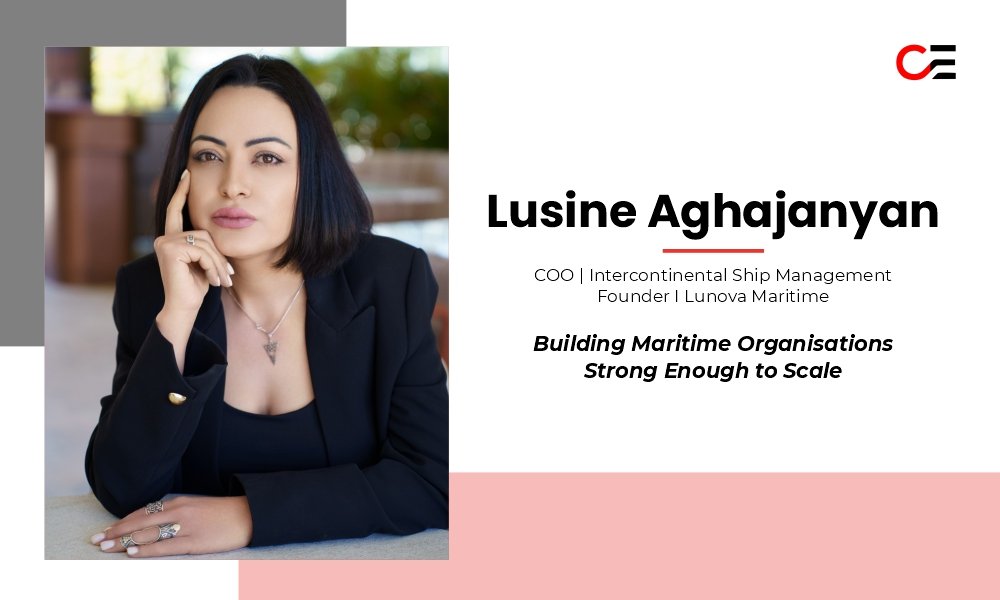
Today, Lusine brings together these complementary experiences in her dual roles as Chief Operating Officer at Intercontinental Ship Management and Founder of Lunova Maritime. While one role focuses on strengthening operational excellence within a leading ship management company, the other reflects her broader vision of helping maritime organizations navigate transformation through practical strategy, intelligent business architecture, and responsible leadership.
Leadership Rooted in Responsibility
Titles may define positions, but Lusine believes they should never define leadership. When asked how she describes herself, her answer is remarkably simple: “A Responsible Human.” It is a philosophy that influences every decision she makes and every relationship she builds within an organization.
For Lusine, leadership begins with accountability. Every decision carries consequences—not only for business performance but also for people, trust, and long-term organizational culture. She believes effective leaders create clarity rather than confusion, encourage responsibility rather than dependence, and build environments where honesty and respect exist together.
Her leadership style is structured, transparent, and deeply people-centered. While she values discipline and measurable performance, she equally believes that strong organizations are built by people who feel trusted to think independently. Rather than expecting employees to simply execute instructions, she encourages them to ask questions, challenge assumptions, and develop the confidence to make responsible decisions.
Integrity, fairness, curiosity, courage, and continuous learning remain the principles that consistently guide her leadership. These values influence not only how she manages teams but also how she approaches organizational transformation. Sustainable progress, in her view, is achieved when accountability, collaboration, and trust become part of an organization’s everyday culture rather than isolated management initiatives.
Creating a Stronger Operational Foundation at Intercontinental Ship Management
As Chief Operating Officer of Intercontinental Ship Management, Lusine’s role extends far beyond overseeing individual departments. Her responsibility is to connect the organization’s technical, operational, financial, and people functions into one disciplined operating model that supports long-term growth.
Her work spans technical management, vessel operations, finance, procurement, crewing, quality, compliance, technology, and organizational development. Instead of focusing on isolated improvements, she concentrates on creating alignment across the business so that every department contributes toward shared objectives.
One of her primary priorities has been strengthening the foundations required for sustainable growth. Under her leadership, the organization has introduced clearer accountability across teams, improved monthly vessel cost variance analysis and forward planning, strengthened owner reporting, enhanced procurement benchmarking, and encouraged closer collaboration between departments. These initiatives are designed not simply to improve operational efficiency but to create greater transparency, consistency, and confidence in decision-making.
Another significant focus has been improving visibility throughout the organization. By advancing the use of enterprise resource planning systems, management dashboards, and integrated reporting, Lusine is helping ensure that leaders make decisions based on reliable, consistent information rather than fragmented data. Better visibility enables faster responses, stronger governance, and greater transparency for clients while supporting more informed strategic planning across the business.
For Lusine, however, technology is valuable only when it simplifies work and strengthens decision-making. Digital systems should remove unnecessary complexity, clarify responsibilities, and enable people to perform at their best—not create additional administrative burdens. Technology should support the business, not become the business itself.
This balanced approach reflects a principle she has carried throughout her career: sustainable organizations are built through clarity, discipline, collaboration, and responsible leadership rather than complexity alone.
Looking Beyond Operational Improvement
Working across multiple business functions over the years gave Lusine a unique perspective on the challenges many organizations face. Despite having experienced professionals and strong technical capabilities, businesses often struggle because information remains fragmented, departments operate independently, and technology is introduced without sufficient alignment to business strategy.
These recurring challenges inspired her to think beyond operational improvement and explore a more integrated approach to organizational transformation.
Rather than viewing finance, operations, technology, procurement, quality, and people management as separate disciplines, she began to see them as interconnected components of one business ecosystem. When these elements operate in alignment, organizations become more agile, make better decisions, and create stronger long-term value.
This realization would eventually become the foundation for the next chapter of her professional journey—one that extended beyond a single organization and focused on helping the wider maritime industry build stronger, more connected businesses.
The Beginning of Lunova Maritime
After dedicating fourteen years to one organization, Lusine reached an important turning point in her career. Leaving a company that had played such a significant role in her professional development was a deeply personal decision, but it also created an opportunity to reflect on the broader contribution she wanted to make to the maritime industry.
Returning to Armenia gave her the time and perspective to evaluate not only what she had accomplished but also where she could create the greatest impact. Throughout her career, she had repeatedly observed the same challenges across organizations: valuable operational knowledge existed, yet information remained fragmented, departments often worked independently, and technology was frequently implemented without a clear understanding of business needs or the people expected to use it.
Those observations ultimately led to the creation of Lunova Maritime—an organization founded with the vision of helping maritime businesses strengthen their foundations by connecting strategy, operations, technology, and people through one integrated approach.
For Lusine, the mission has remained consistent from the very beginning: to help organizations make better decisions, build stronger operating models, and create sustainable growth through practical, business-focused transformation.
Introducing the Enterprise Intelligence Framework
The experience of working across finance, operations, strategy, technology, and organizational development gradually led Lusine to a broader realization: successful transformation cannot be achieved by technology alone. Businesses become stronger when people, processes, governance, and digital capabilities evolve together.
This belief became the foundation of Enterprise Intelligence—a framework developed through years of practical experience rather than theoretical models.
Throughout her career, Lusine observed that many transformation initiatives failed to deliver lasting value because organizations often invested in software before addressing the business challenges those systems were expected to solve. Processes remained fragmented; responsibilities were unclear, and departments continued operating independently despite new technology.
Enterprise Intelligence was designed to address this gap by encouraging organizations to begin with a clear understanding of how the business actually functions before introducing new tools or platforms.
The framework examines how decisions are made, how information flows across departments, where operational bottlenecks exist, and how leadership can strengthen alignment throughout the organization. Rather than treating finance, procurement, operations, technology, quality, and people management as separate disciplines, it views them as interconnected parts of one business ecosystem.
To support this philosophy, Lusine developed the 5D Methodology—Discover, Diagnose, Design, Deliver, and Drive.
The process begins with understanding an organization’s current reality before identifying opportunities for improvement. Practical solutions are then designed, implemented, and continuously refined to ensure that transformation produces measurable business value rather than temporary operational improvements.
For Lusine, Enterprise Intelligence is not simply another management framework. It is a practical approach that helps organizations become more agile, resilient, and better prepared for future challenges by creating stronger alignment between strategy, people, operations, and technology.
Technology Should Enable Better Decisions
Digital transformation continues to reshape the maritime industry, but Lusine believes technology should always remain a means to an end rather than an objective in itself.
Artificial Intelligence, automation, analytics, and enterprise systems undoubtedly provide significant opportunities, yet their effectiveness depends on the quality of the business processes and leadership decisions that support them. Technology cannot replace professional judgment, industry experience, or accountability—it should strengthen them.
This philosophy also guides the digital initiatives being advanced at Intercontinental Ship Management.
By improving ERP utilization, strengthening management reporting, developing integrated dashboards, and enhancing operational visibility, the company is building a stronger digital foundation that enables leaders to make faster, more informed decisions. Reliable information improves collaboration across departments, supports proactive planning, and provides clients with greater transparency.
Once robust business processes and dependable data structures are established, technologies such as Artificial Intelligence can create even greater value. They can identify operational patterns, improve forecasting, automate repetitive tasks, enhance knowledge accessibility, support risk monitoring, and provide valuable decision-support insights.
However, Lusine maintains that responsibility for decisions must always remain with people.
In her view, Human Intelligence provides judgment and accountability, Business Intelligence delivers operational and financial insight, Strategic Intelligence defines direction, and Artificial Intelligence expands an organization’s ability to analyze information and respond more effectively. When these capabilities work together, businesses become both more efficient and more resilient.
Preparing Maritime for the Next Era
The maritime industry is entering one of the most significant periods of change in its history. Regulatory expectations continue to evolve, environmental commitments are becoming more demanding, digital technologies are advancing rapidly, and geopolitical uncertainty is creating new operational challenges. At the same time, organizations must address cybersecurity risks, increasing cost pressures, and the growing shortage of experienced maritime professionals.
Lusine believes these challenges cannot be solved independently.
Future-ready organizations will require stronger governance, cleaner enterprise data, greater operational visibility, and leadership teams capable of making informed decisions quickly. Success will depend not only on adopting new technologies but also on creating cultures that encourage collaboration, adaptability, and continuous learning.
At Intercontinental Ship Management, this preparation includes strengthening governance, improving cost and performance discipline, enhancing operational transparency, and building systems that support sustainable growth as the organization expands.
Through Lunova Maritime, Lusine is helping companies prepare for these industry shifts by introducing business-focused transformation strategies that connect operational reality with technology and long-term planning. Rather than encouraging organizations to implement more systems, she advocates building operating models capable of adapting as the industry continues to evolve.
She believes the maritime sector has consistently demonstrated resilience throughout its history. The next stage of that evolution will depend on how effectively organizations connect people, technology, information, and strategy into one coordinated direction.
Building Sustainability into Everyday Decisions
For Lusine, sustainability extends well beyond environmental responsibility.
While decarbonization and regulatory compliance remain important priorities, she believes truly sustainable organizations also strengthen governance, improve operational discipline, invest in their people, and create long-term value through responsible decision-making.
She often describes sustainability through three connected dimensions—environmental, operational, and human. A company cannot consider itself fully responsible if it improves environmental performance while overlooking inefficient processes, weak governance, or the wellbeing of the people who keep the business running.
At Intercontinental Ship Management, this philosophy is reflected through preventive technical management, responsible procurement, compliance, improved operational planning, crew welfare, and stronger reporting practices. These initiatives support safer operations, greater efficiency, and more responsible business performance while creating lasting value for clients and stakeholders.
Through Lunova Maritime, Lusine extends this perspective by helping organizations integrate sustainability into broader business transformation strategies. By aligning operational performance with technology, enterprise data, and strategic planning, businesses can implement improvements that are commercially viable while supporting long-term environmental and operational responsibility.
For Lusine, sustainability is ultimately measured by the quality of everyday decisions. When organizations consistently consider the impact of their actions on the business, their people, their clients, and the wider industry, responsible growth becomes a natural outcome rather than a separate initiative.
Lessons Shaped by Experience
Every stage of Lusine’s career has contributed to the leader she has become.
Fourteen years within one organization provided her with deep industry knowledge, operational discipline, and a comprehensive understanding of ship management. It also taught her the importance of patience, resilience, and continuous learning—qualities that have continued to guide her throughout her professional journey.
One of the most defining moments in her career came when she chose to leave the organization that had shaped much of her professional identity. It was a decision that required courage, reflection, and a willingness to embrace uncertainty in pursuit of greater purpose.
Looking back, Lusine sees that transition not as a departure from the past but as the beginning of a new chapter.
The experience reinforced the importance of trusting one’s abilities, remaining open to change, and recognizing that professional growth sometimes requires stepping beyond familiar environments. It also strengthened her belief that careers should be defined not by titles or organizations but by the value individuals create and the positive impact they leave behind.
Those lessons ultimately led to the establishment of Lunova Maritime, giving Lusine the opportunity to transform years of experience into a platform dedicated to helping maritime businesses become stronger, more connected, and better prepared for the future.
Milestones That Reflect Continuous Growth
Throughout her career, Lusine has measured success not simply by titles or recognition but by the opportunity to create meaningful, lasting value.
Her progression from finance into executive leadership has given her a broad understanding of how organizations operate across multiple disciplines. Combined with executive education in Business Analytics at Cambridge, this journey has strengthened her ability to connect analytical thinking with strategic decision-making and operational execution.
Becoming Chief Operating Officer of Intercontinental Ship Management marked an important milestone, providing the opportunity to contribute to the company’s long-term operational and strategic direction while helping strengthen the foundations for future growth.
Another defining achievement was the establishment of Lunova Maritime. More than the launch of a new venture, it represented the realization of a broader vision—to help maritime organizations approach transformation through practical business strategy, operational alignment, Enterprise Intelligence, and responsible leadership.
Among the moments she remembers most fondly is receiving recognition at the Elite Leadership Awards Dubai 2026. Sharing that experience with her daughter made the occasion especially meaningful, reminding her that professional achievements become even more rewarding when they inspire the people closest to us.
Despite these accomplishments, Lusine believes the most meaningful recognition cannot be measured by awards alone. The confidence placed in her by colleagues, clients, and business partners—the trust to solve complex challenges, strengthen organizations, and support long-term growth—remains the achievement she values most.
Looking Ahead with Purpose
For Lusine, the future is not simply about expanding organizations or adopting new technologies. It is about building businesses that remain resilient, responsible, and capable of adapting to change without losing sight of their purpose.
At Intercontinental Ship Management, her focus is on continuing to strengthen governance, operational excellence, owner services, digital capabilities, and disciplined business practices that support sustainable growth while maintaining the high standards expected by clients.
Through Lunova Maritime, she plans to further develop the Enterprise Intelligence Framework and collaborate with maritime organizations seeking practical, business-driven approaches to transformation. Her vision is to help companies make better decisions by connecting strategy, operations, technology, and people into one intelligent operating model.
Beyond organizational goals, Lusine also hopes to contribute to wider industry conversations around leadership, digital transformation, sustainability, and organizational development. By sharing practical experience rather than theoretical concepts, she aims to encourage businesses to approach change with confidence, clarity, and responsibility.
Rather than pursuing growth for its own sake, she remains committed to helping organizations become stronger, more adaptable, and better prepared for the opportunities and challenges that lie ahead.
Advice for the Next Generation of Leaders
Reflecting on her own journey, Lusine believes that successful leadership is built through continuous learning, curiosity, and a willingness to understand the bigger picture.
She encourages aspiring leaders to look beyond the boundaries of their individual roles and develop a broader understanding of how businesses function as complete systems. Building knowledge across finance, operations, technology, strategy, and people management creates stronger decision-makers who can lead organizations through increasingly complex environments.
For women considering careers in the maritime industry, her message is both encouraging and practical.
The industry offers significant opportunities for those willing to learn, contribute, and lead with confidence. Success does not require conforming to traditional leadership stereotypes. Authenticity, competence, preparation, and consistency remain far more valuable than trying to imitate someone else’s leadership style.
She also emphasizes the importance of protecting one’s identity beyond a professional title. Careers evolve, industries change, and organizations transform. Leaders who continue learning, remain adaptable, and embrace new challenges are better positioned to grow throughout every stage of their professional journey.
Above all, Lusine encourages future leaders to lead with integrity, remain accountable for their decisions, and focus on creating value that extends beyond personal achievement.
Building the Future Through Responsible Leadership
Lusine Aghajanyan’s professional journey reflects the power of curiosity, resilience, and purposeful leadership. From her early career in finance to leading operational excellence at Intercontinental Ship Management and establishing Lunova Maritime, she has consistently demonstrated that sustainable business success is built by connecting people, strategy, operations, and technology rather than treating them as separate priorities.
Her approach is grounded in a simple yet powerful principle: every decision carries responsibility. Whether strengthening governance, improving operational performance, guiding digital transformation, or helping organizations prepare for the future, she believes leadership is ultimately measured by the value created for people, businesses, and the industry as a whole.
As maritime continues to evolve, Lusine remains committed to helping organizations navigate complexity with greater clarity, stronger collaboration, and practical innovation. Through responsible leadership, intelligent business thinking, and a steadfast commitment to continuous improvement, she is contributing to a future where maritime businesses are not only more efficient and competitive, but also more resilient, sustainable, and prepared for the opportunities ahead.
For Lusine, leadership has never been about titles or authority. It is about creating environments where people can think independently, organizations can make better decisions, and businesses can grow with confidence and purpose. It is this philosophy that continues to shape her work—and the lasting impact she hopes to leave on the global maritime industry.