
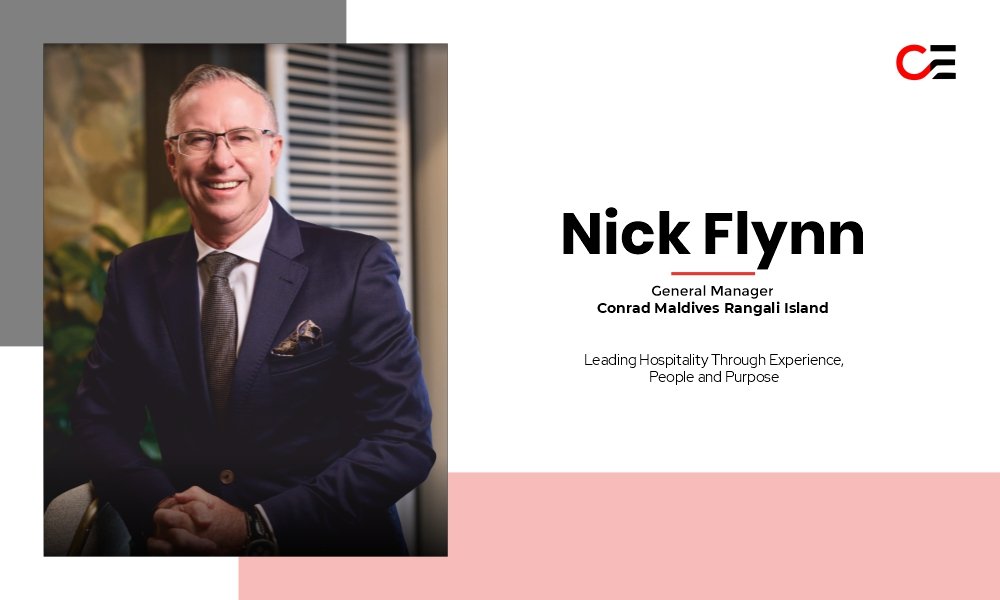
For Nick Flynn, hospitality has never been simply about hotels, rooms, or facilities. An Australian hotelier with almost four decades of experience, Nick has built his career from the kitchen upward, gaining an understanding of hospitality by working through its different functions and environments. Today, as General Manager of Conrad Maldives Rangali Island, he leads one of the Maldives’ best-known luxury resorts while remaining closely connected to the people and operations that have shaped his approach to the industry.
Nick began his career in the kitchen and spent 16 years as a chef before moving through F&B, operations, commercial leadership and eventually General Management. That early experience continues to influence the way he sees hospitality. Working from the ground up taught him to respect detail, understand how a hotel operates and, above all, appreciate the people who make the guest experience possible.
His career has also taken him across 12 countries, giving him the opportunity to work with different brands, cultures, and hotel environments. Each experience has contributed something different to his understanding of leadership and hospitality.
At the centre of that understanding is a simple belief: hospitality is a people business. Hotels can offer impressive design, facilities and amenities, but what guests ultimately remember is how they were treated and how the experience made them feel.
That is also why Nick prefers to stay close to the operation rather than spending most of his time behind a desk. He values speaking with team members, interacting with guests, and seeing firsthand what is happening across the property. For him, those everyday interactions provide a clearer understanding of what is working and where improvements can be made.
Today, no two days at Conrad Maldives Rangali Island are the same, and that is part of what continues to attract Nick to hospitality. Despite his experience, he considers himself a student of the industry, with curiosity, continuous learning and the ability to give people confidence remaining important parts of his leadership approach.
Learning Through Every Stage of the Journey
Looking back on his career, Nick does not necessarily identify the most obvious milestones as the experiences that shaped him most. Instead, he points to challenging situations, difficult decisions, and opportunities to work with people who see the world differently.
Moving from the kitchen through F&B and into senior operational and General Manager roles gave him exposure to almost every part of a hotel. Each transition brought another lesson about business and about people.
His international experience has been equally important. Working across different countries and cultures taught him that approaches to service, communication, leadership, and work can vary considerably. Those differences have helped broaden his perspective rather than giving him a single way of looking at hospitality.
Over time, Nick Flynn’s understanding of leadership has become less about having all the answers and more about creating an environment in which the right answers can emerge from the team.
His leadership philosophy is straightforward: be clear about where you are going, trust your people to help you get there, and never lose sight of the guest. At the same time, leaders need to remain curious. Hospitality continues to change, and those who stop learning, listening and adapting risk becoming disconnected from the realities of the business.
Balancing Operations, Guest Experience and Growth
For Nick, operational excellence, guest experience, and long-term business growth are not separate priorities. They are closely connected.
Operational excellence creates consistency, and consistency builds trust. When that consistency is combined with genuine hospitality, it creates the foundation for a strong guest experience.
At the same time, a luxury resort must remain commercially sustainable. Reputation alone cannot sustain a business. Markets need to be understood, costs need to be managed, investments need to be considered carefully, and the product needs to continue evolving.
Conrad Maldives Rangali Island has an exceptional natural and operational foundation, but Nick believes that its responsibility is to protect what makes the resort distinctive while continuing to improve it.
Being close to the operation remains central to that process. Time spent with team members and guests allows him to see what is working, identify opportunities, and understand issues that may not always be visible from an office or boardroom.
When making decisions, Nick comes back to a practical question: will the decision improve the guest experience while also strengthening the business for the future? If both sides of that equation are moving in the right direction, he believes the business is generally heading the right way.
A More Personal Definition of Luxury
The luxury hospitality landscape continues to evolve, and Nick believes one of the most important changes is the growing demand for personalisation.
Guests are increasingly looking beyond beautiful rooms and extensive facilities. They want experiences that feel relevant to them—experiences that are authentic, personal, and connected to the destination.
Wellness, culinary experiences, sustainability, and meaningful connections with the destination are likely to become increasingly important. Travellers want to return home having experienced something, learned something or simply felt genuinely different as a result of their time away.
For Conrad Maldives Rangali Island, many of those elements already exist naturally within the destination. The resort has marine life, nature, dining, and a distinctive setting as part of its environment.
The challenge is therefore not simply to add more experiences, but to find thoughtful ways of presenting what the destination already offers while protecting the simplicity and authenticity that make the Maldives special.
Finding Opportunity During a Crisis
One of the most challenging periods of Nick’s career came during the COVID-19 pandemic while he was working at Shangri-La Singapore.
When the first COVID case in Singapore was reported at the hotel and the situation was announced nationally, circumstances changed almost overnight. Guests wanted to leave; bookings were cancelled, and there was significant uncertainty about what would happen next.
The situation required resilience and adaptability. Nick and his team quickly recognised that they could not simply wait for normality to return. They needed to respond differently to the circumstances.
Shangri-La Singapore had one of the city’s few beachfront locations, creating an opportunity to develop a controlled beach experience. The team created a separated beach area and offered limited-access tickets, which were released weeks in advance and frequently sold out for the entire month.
The team also worked with a Michelin-starred chef to develop an experience in which guests could book a room together with a 13-course Michelin-style dinner on their own balcony. It gave guests something different to look forward to while creating another way of generating demand for the property.
The experience reinforced one of Nick’s key lessons about leadership: resilience is not simply about getting through a difficult period. It is about adapting, staying creative, and identifying opportunities when circumstances change.
For him, difficult situations can sometimes contain opportunities, although finding them requires the willingness to look beyond the immediate problem.
Building a Culture Around People
Nick believes that the quality of a hotel can never exceed the quality of its people.
Beautiful villas, restaurants, and sophisticated technology are important, but it is ultimately the team that brings the guest experience to life.
His approach to developing people is based on responsibility and trust. Talented individuals need room to make decisions, learn from mistakes, and develop confidence. Giving people responsibility also allows them to understand their contribution to the wider business.
But development alone is not enough. Nick believes people need to feel that they belong.
At Conrad Maldives Rangali Island, he wants team members to feel part of a family regardless of their department or position. Everyone should understand that their role has relevance to the overall success of the resort.
Recognition matters, but so does make people feel seen and valued in everyday interactions. A team member who genuinely cares about their work can have a significant impact on a guest’s experience.
For Nick, the goal is to make Conrad Maldives a place where people can build a career rather than simply a place where they come to work. When people develop a sense of belonging and pride in what they do, guests ultimately feel the difference.
Innovation Without Losing the Human Touch
Nick does not see innovation and tradition as opposites. Instead, he believes the key is understanding what should remain consistent and what should evolve.
The standards of luxury, the approach to service, and the emotional connection with guests should remain at the heart of the experience. However, the way those elements are delivered can change as technology and guest expectations develop.
Artificial intelligence is one area Nick finds particularly relevant. His interest is not in introducing technology for its own sake, but in using it where it can make hospitality more effective without removing the human element.
If AI can take care of repetitive or administrative tasks, it can give valuable time back to hotel teams. Nick would rather see a team member spending an additional 20 minutes with a guest than using that time on a task that technology could handle.
For him, the most useful innovation is often the kind that happens behind the scenes while making the guest experience feel more personal and effortless.
Making Sustainability Part of Responsible Luxury
For Nick, sustainability is not separate from luxury. It is part of operating responsibly, particularly in a destination where the surrounding natural environment is central to the guest experience.
At Conrad Maldives Rangali Island, the resort has a strong focus on protecting the marine environment. Its initiatives include a dedicated coral restoration programme, reef rehabilitation activities, and opportunities for guests to participate in coral planting and adoption.
The resort has also eliminated around 95% of single-use plastics and reduced energy consumption by approximately 40%. Its 500-square-metre hydroponic garden helps reduce food miles, while since 2022 the resort has supported hydroponic systems across 11 neighbouring islands, contributing to local food security.
Further work is taking place through a biogas project and expanded solar and battery systems, which are intended to reduce the resort’s carbon footprint further.
For Nick, however, sustainability is not only about infrastructure and operational changes. Education also has an important role.
The Maldives is surrounded by a fragile marine ecosystem, and Nick believes the hospitality industry has a responsibility to help people understand why that environment matters. The resort is a custodian of its surroundings and protecting them is essential for future generations.
That is his understanding of sustainable luxury: protecting the environment that makes the destination and the guest experience possible in the first place.
The Qualities Behind Effective Leadership
When considering the qualities required of leaders in a rapidly changing global environment, Nick identifies three that stand out: curiosity, resilience, and humility.
Curiosity keeps leaders learning. Resilience helps them continue moving when circumstances change. Humility provides the understanding that a leader does not have to be the smartest person in the room.
He also believes effective leaders need to be decisive. Listening to others is important, but eventually someone has to make the decision and accept responsibility for it.
Leadership, in his view, ultimately comes back to people. A strong strategy can remain only a document if a leader cannot bring people with them. ultimately comes back to people. A strong strategy can remain only a document if a leader cannot bring people with them.
Leaders also need to stay connected to the reality of the business. Hospitality cannot be fully understood from a boardroom or office. It requires being present, speaking with people, and understanding what is happening across the operation.
From Chef to General Manager
Becoming a General Manager represents one of the achievements Nick is most proud of.
He spent 16 years as a chef and worked his way from the bottom of the kitchen to eventually leading a hotel as General Manager. The transition was not an overnight achievement. It developed through years of learning, mistakes, additional responsibilities, and a continued willingness to grow.
The kitchen gave him a strong foundation, but every stage that followed contributed another part of his understanding. F&B, operations, commercial leadership, and General Management each taught him something different about the business.
He is also proud of the people he has developed throughout his career. Seeing someone become more confident, accept greater responsibility or achieve something they once believed was beyond their capabilities is particularly rewarding for him.
For Nick, therefore, the achievement is not simply reaching the position of General Manager. It is the journey from where he began, along with the people he has had the opportunity to meet, work with, and develop along the way.
Keeping Rangali Relevant for the Next Generation
Nick’s vision for Conrad Maldives Rangali Island is deliberately straightforward: never become complacent.
Being recognised as one of the world’s great resorts does not remove the responsibility to keep improving. The objective is to protect what makes Rangali special while ensuring that it remains relevant to the next generation of luxury travellers.
What distinguishes the resort, in his view, is not simply its villas, restaurants, or location. It is the combination of its people, marine environment, history, experiences, and ability to create genuine personal memories for guests.
Maintaining that position requires continued investment in the product, development of people, stronger culinary and guest experiences, and responsible progress in sustainability.
The opportunity is to make an already strong resort even more meaningful while remaining true to what has made it distinctive. The ambition is to remain iconic without becoming static.
For Nick personally, the next stage is also about continuing to learn, develop people, and contributing to businesses where there is an opportunity to create something meaningful.
Advice for the Next Generation of Hospitality Leaders
For the next generation of hospitality professionals and aspiring business leaders, Nick’s advice begins with curiosity.
Learn about the operation. Spend time with the people who actually deliver the experience. Understand the numbers. Understand the guests. And do not limit yourself to your own department.
He also encourages professionals not to be afraid of difficult assignments. Some of the experiences that create the greatest professional challenges can ultimately provide the most valuable lessons.
Passion is equally important. When people genuinely care about what they do, the quality of their work naturally improves. In hospitality, that can make a meaningful difference.
At the same time, Nick believes successful leaders need a balance between knowledge and real-world experience. Education and qualifications are important, but so are understanding people, reading situations, exercising sound judgement and navigating the realities of business.
Ultimately, hospitality remains an industry built around people. Professionals can learn systems, finance, revenue management and operations, but genuine care, empathy and the ability to make someone feel welcome will always matter.
Combining those qualities with commercial discipline, curiosity, passion, and a willingness to keep learning can create a rewarding career.
For Nick, there is also a simple reason to appreciate the industry: hospitality provides an opportunity every day to make someone’s experience better.
After almost four decades in the profession, that remains a meaningful reason to come to work.