
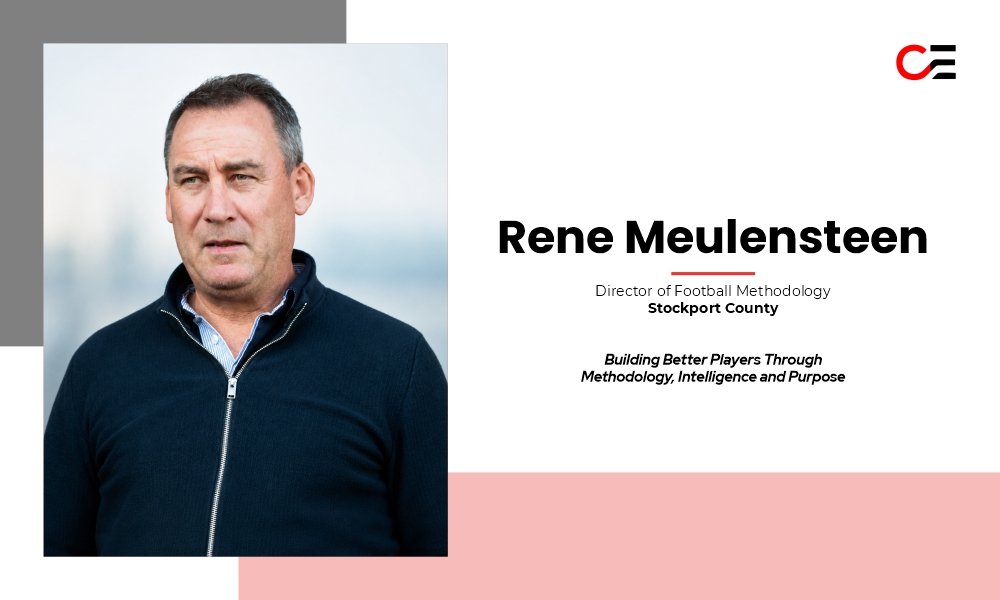
Football has been a constant throughout René Meulensteen’s life. What began as the ambition to play gradually developed into a deeper interest in a different question: why do some players improve more than others, and what kind of practice allows them to reach their potential?
That curiosity shaped a coaching career spanning more than 45 years, taking him from grassroots and youth development into elite club football and international football. Along the way, he worked across different football cultures and environments, experiences that helped form a coaching philosophy built around player development, technical quality, decision-making, and adaptability.
One of the significant stages of his journey came during eight years in Qatar, where he worked extensively in youth development and with national youth teams. The experience gave him the opportunity to examine player development closely and develop ideas that would later become central to his methodology.
He subsequently spent 12 years at Manchester United, including six years as First Team Coach under Sir Alex Ferguson. Working alongside and coaching players such as Cristiano Ronaldo, Wayne Rooney, Ryan Giggs and Paul Scholes provided an environment in which individual quality, tactical organisation and competitive demands came together at the highest level.
His career later took him to clubs and national teams in different countries, including Anzhi Makhachkala, Fulham, Maccabi Haifa and Kerala Blasters, as well as international assignments with Australia and Iraq. These experiences reinforced an important principle: there is no single formula for success in football.
Today, as Director of Football Methodology at Stockport County, alongside his Meulensteen Online Virtual Coaching Academy, his focus remains closely connected to the motivation that started his career, helping players and coaches become better.
Learning Across Football Cultures
Working across countries has given Meulensteen a broad perspective on the game. Football cultures differ in their priorities, traditions, and approaches. England has traditionally placed considerable emphasis on intensity, competitiveness and tempo, while the Netherlands has been strongly associated with technical development and tactical understanding. Other environments bring their own physical, cultural, and psychological characteristics.
For Meulensteen, the objective is not to choose one approach over another, but to learn from each environment while maintaining clear principles.
This has strengthened his belief that coaching should be player-centred rather than system-centred. Formations, tactical trends, and systems can change, but the fundamental requirements of a good footballer remain relatively consistent. Players still need technical quality, awareness, decision-making, confidence, and the ability to solve problems.
That distinction is important. A methodology should provide direction without becoming rigid. Coaches need enough clarity to understand what they are trying to develop, but enough flexibility to adapt their approach to different players, age groups, and circumstances.
Creating a Football Identity at Stockport County
At Stockport County, Meulensteen’s role is focused on creating alignment and consistency across the football structure while integrating skill development throughout the club.
His view is that a football club should be about more than the playing style of its first team. A recognisable football identity should connect player development, coaching, recruitment and first-team performance.
That requires clear answers to practical questions: What characteristics should the club’s players have? How should those characteristics be developed? What should practice look like? What behaviours and standards should define the environment?
Coach development is another important part of this process. Rather than simply providing sessions for coaches to replicate, Meulensteen believes coaches should understand the reasoning behind the exercises and principles they use.
Understanding the “why” allows coaches to adapt intelligently rather than simply follow instructions. It also creates greater consistency because coaches understand the underlying methodology rather than only surface-level activity.
The long-term objective is to establish something sustainable; a methodology that supports Stockport County’s progression and creates a pathway through which young players can develop towards first-team football.
Technique as the Foundation
At the centre of Meulensteen’s philosophy is a straightforward belief: the game may change, but the principles required to develop good players do not.
Football is ultimately played by players rather than formations. His approach considers development across four interconnected areas: technical, tactical, physical, and mental.
While all four matter, technical ability provides the foundation. Technique gives players options. Without the ability to manipulate the ball effectively, the number of tactical choices available to a player becomes limited.
This is why his methodology places significant emphasis on ball mastery, 1v1 situations, receiving and passing, turning, finishing and executing skills at speed and under pressure.
However, technical ability cannot exist in isolation. The purpose of developing techniques is ultimately to help players make better decisions in real football situations.
A player must understand not only how to perform an action, but when, where and why to use it. The objective is therefore to produce players who are technically capable while also being intelligent, adaptable, and confident enough to solve problems independently.
From Repetition to Creativity
Meulensteen takes a practical view of how technical development happens. He believes progression matters, beginning with opportunities for players to learn and repeat techniques correctly.
Repetition is sometimes viewed as something that can limit creativity. His experience suggests the opposite.
Repetition creates mastery. Mastery creates confidence, and confidence creates the freedom to be creative.
Once players become technically comfortable, training can progressively introduce greater pressure, opposition, direction, and decision-making. This is where 1v1 situations and small-sided games become particularly important.
In a 1v1 situation, a player must constantly read the defender, manipulate the ball, change direction or speed, and ultimately produce an outcome. Small-sided games then connect these individual abilities to awareness, combination of play movement, and decision-making.
Confidence develops when players feel capable of dealing with situations. When they possess the technical tools required to succeed, they are more likely to express themselves rather than avoid responsibility.
For Meulensteen, that connection between technique and confidence is central to player development.
The Individual and the Team
Individual development and tactical development are not opposing objectives in Meulensteen’s view.
A strong tactical structure becomes more effective when it includes players capable of solving individual situations. A coach may create an organised system, but eventually a player must execute the action, receive the ball under pressure, beat an opponent, play a decisive pass, deliver a cross or finish an opportunity.
Individual quality therefore supports collective performance.
His years at Manchester United provided a clear example of this relationship. The team operated with defined attacking principles, but players such as Ronaldo, Rooney, Giggs, and Scholes possessed the ability to recognise situations and produce solutions within that structure.
The principle is straightforward: develop the individual to strengthen the team.
What Makes an Effective Coach?
For Meulensteen, coaching is not simply about possessing football knowledge. Knowledge matters, but it does not automatically make someone an effective coach.
Good coaches need to be communicators, observers, and teachers. They must understand what they are seeing, recognise what a player needs, and explain concepts clearly. They must also create environments where players can experience and practise those concepts repeatedly.
Empathy is another important quality. The players are different. Some respond to challenges, while others may require reassurance. Understanding personalities is therefore part of understanding how to coach effectively.
When supporting coaches, Meulensteen encourages them to continually ask three questions: What am I coaching? Why am I coaching it? And how will it improve the player, the unit or the team?
One fundamental aspect of Meulensteen’s coaching philosophy is the power of positive reinforcement. Rather than telling players they need to change, he encourages them to add to their game.
The word add has a much more positive impact than change. Change often suggests that something is wrong, whereas add implies building on existing strengths and becoming an even better player. It focuses on growth, not criticism.
By encouraging players to add new skills, movements, habits and solutions to their game, coaches create an environment where players feel confident, motivated and more willing to embrace learning and continuous improvement.
Technology as a Tool, not a Replacement
Modern football provides coaches with more information than ever before. Physical output, tactical positioning, passing networks, expected goals, individual actions, and numerous other performance indicators can now be analysed in detail. Video can also provide immediate visual feedback.
Meulensteen sees clear value in these developments but believes technology must remain a support tool rather than becoming a substitute for coaching.
Data can show what happened. It does not automatically explain why it happened or what should be done next.
That distinction becomes increasingly important as the amount of available information continues to grow. The challenge for coaches is no longer simply obtaining more data. It is identifying which information is relevant and knowing how to use it.
Observation, experience and coaching judgement therefore remain important even in an increasingly data-driven sport.
Learning From Uncertainty
Football rarely provides complete control. A team can prepare thoroughly and still lose. A coach can perform well and still lose a job. Players can become injured, decisions can go against a team, and circumstances can change quickly.
For Meulensteen, dealing with this uncertainty has been one of the important lessons of his career.
Moving between clubs, countries, football cultures and different roles taught him the importance of adaptability and resilience. His experience at Manchester United under Sir Alex Ferguson was defined by clarity, stability, and strong leadership. Other environments presented very different conditions.
The contrast between those experiences reinforced another principle: previous success cannot guarantee future success.
The game continues to change, which means coaches must continue learning rather than relying entirely on what worked before.
Challenges in Player Development
One of Meulensteen’s concerns about modern player development is the decline in unstructured football and individual technical practice.
Previous generations often spent large amounts of time playing football in streets, parks and playgrounds. Without formal instruction, players accumulated touches, faced opponents in 1v1 situations, and learned to solve problems through repeated experience.
Today, many young players experience football primarily through organised coaching. That places greater responsibility on coaches to provide the technical experiences that may previously have occurred naturally.
Meulensteen believes technical development is still undervalued and misunderstood. There is often significant attention placed on tactics and formations at increasingly young ages, when priority should frequently be developing players who are comfortable and creative with the ball.
Patience is another challenge. Professional football places considerable pressure on immediate results, while meaningful player development takes time.
The two demands do not always align, making long-term development a difficult but necessary responsibility for clubs and coaches.
The Next Five Years of Football
Meulensteen expects football to become faster, more athletic and increasingly data driven. Artificial intelligence and advanced analytics are likely to influence recruitment, opposition analysis, training design, injury prevention, and performance evaluation.
At the same time, he expects the tactical battle to continue producing new ways of creating and exploiting individual advantages.
As defensive organisations become more sophisticated, players capable of breaking those structures through individual technical quality may become even more valuable. The ability to dominate 1v1 situations, receive under pressure, change direction quickly, and make creative decisions will remain important.
There is an interesting contradiction in this development. The more organised football becomes tactically, the more valuable an unpredictable individual can become.
For Meulensteen, however, the development of these players requires stronger technical coaching. He sees a continuing need for more Skill Development Coaches who properly understand the principles and structure of effective technical practice.
A Methodology That Continues to Evolve
Meulensteen does not see methodology as something that should remain fixed.
Strong principles are necessary, but their application must evolve with the game. Coaches need to study changes in pressing strategies, positional rotations, physical demands, transitions, technology, rules, and player profiles.
The central question remains simple: what does the future player need?
His methodology will therefore continue connecting technical development with realistic decision-making environments, allowing players to execute skills at greater speed, under more pressure, and with increasing complexity.
Technology can also contribute to more personalised development, giving coaches additional ways to understand individual needs and track progress.
Measuring Success Beyond Trophies
Manchester United naturally represents a significant period of Meulensteen’s career. Working with Sir Alex Ferguson and contributing to a highly successful period at the club provided experiences that remain important to him.
Champions League success, Premier League titles, the FIFA Club World Cup and other trophies form part of that history.
But trophies are not the only measure he uses when reflecting on his career.
Player development carries equal significance. Helping established world-class players improve can be rewarding, but so can watch young players progress through a development system and build professional careers.
International football has provided another perspective, bringing a different level of responsibility and emotion because of the relationship between a team and the country it represents.
Ultimately, Meulensteen places value on having a positive influence on the careers of players and coaches, alongside competitive achievements.
Building Something Sustainable
Looking ahead, his objective at Stockport County is to help establish a football methodology that becomes part of the club’s long-term identity.
The ambition is not to make success dependent on one coach, one group of players, or one season. Instead, clear principles should connect the first team, academy, recruitment and coach development.
Over time, he wants people to recognise what a Stockport County player represents: technical capability, tactical intelligence, physical competitiveness, mental resilience and the confidence to take responsibility.
If those elements can be aligned while the club continues progressing competitively, the result would be a more sustainable football structure.
Beyond Stockport County, Meulensteen also wants his coaching methodology and Virtual Coaching Academy to make high-quality technical development knowledge available to more coaches and parents internationally.
Keeping the Foundations Simple
For aspiring coaches, his advice is direct: never stop learning.
Study football. Watch the best players and coaches. Ask questions. Develop your own ideas rather than simply copying someone else.
He also believes coaches should remember that coaching is about the player, not the coach. Young coaches can sometimes feel pressure to use complicated exercises or sophisticated terminology to demonstrate their knowledge. Effective coaching, however, often requires the opposite of making complicated ideas simple and giving every activity a clear purpose.
For young players, his message is equally practical: spend time with the ball, practise, challenge yourself and accept mistakes as part of development. Confidence grows through experience, and players need the freedom to express themselves.
Football will continue to change tactically, physically, and technologically. But the foundations of player development will remain important.
As Meulensteen puts it, technique provides the tools, intelligence determines when to use them, and confidence provides the courage to try.
For a coach whose career has crossed generations, countries and levels of the game, that idea remains central: the game will evolve, but developing players with strong foundations will continue to be one of football’s most important responsibilities.