
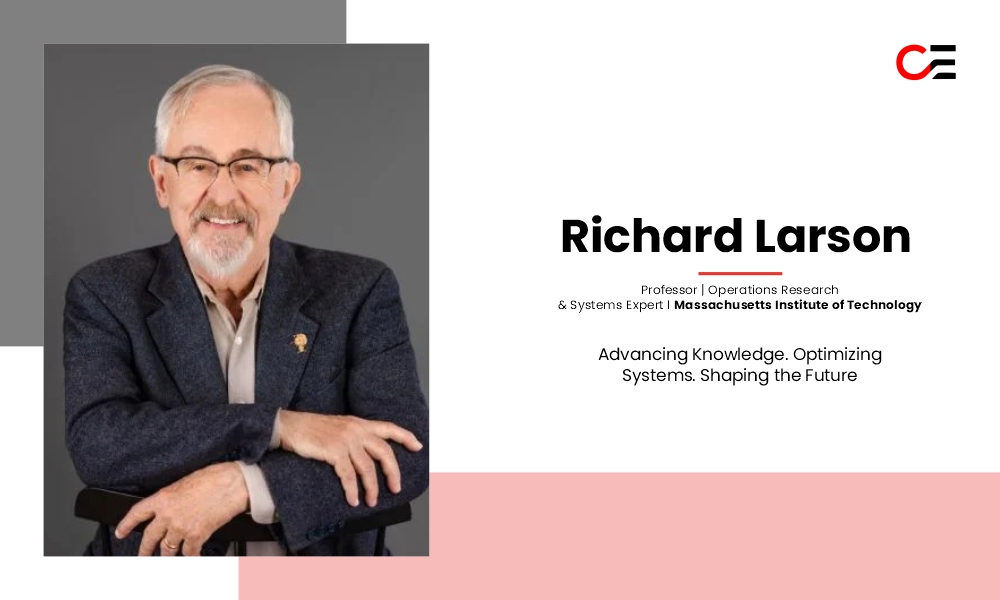
In an era defined by data, systems thinking, and technological transformation, few individuals have shaped the discipline of operations research as profoundly as Richard C. Larson. A distinguished professor at the Massachusetts Institute of Technology (MIT), Larson has spent decades advancing the science of complex systems, influencing industries ranging from public safety and logistics to healthcare and education.
Often referred to as “Dr. Queue” for his pioneering research on queueing theory and waiting-line systems, Larson’s work has had a remarkable impact on how organizations design and manage service systems. His career stands as a testament to how analytical thinking, technological innovation, and visionary leadership can solve real-world challenges while improving efficiency and decision-making across sectors.
A Lifelong Journey in Systems Thinking
Born in the United States in 1943, Richard Larson’s academic journey has been deeply connected with MIT, where he earned his Bachelor’s, Master’s, and Ph.D. degrees in electrical engineering. Over the years, he developed a strong interest in operations research—a discipline focused on applying mathematical models, analytics, and data-driven insights to optimize complex systems and decision processes.
Throughout his career, Larson has dedicated himself to understanding how complex service systems operate and how they can be improved. His research has explored areas such as emergency response systems, urban services, logistics, workforce planning, disaster preparedness, and public health management. By applying analytical modeling to these domains, he has helped organizations better allocate resources, reduce inefficiencies, and improve operational outcomes.
His work demonstrates that operations research is not just theoretical it has real-world applications that affect everyday life, from reducing waiting times in hospitals to improving the efficiency of emergency services.
The Science Behind Waiting Lines
One of Larson’s most influential contributions lies in the study of queueing systems the mathematical modeling of waiting lines and service processes. His groundbreaking research introduced computational methods such as the Queue Inference Engine and the Hypercube Queueing Model, which transformed how organizations analyze and manage service demand.
These innovations have helped organizations improve the performance of systems where demand fluctuates, and resources must be carefully allocated. For example, his models have been applied to emergency response services, where determining the optimal deployment of resources such as ambulances or police units can save lives.
Beyond technical analysis, Larson also explored the psychology of waiting, highlighting how people perceive wait times differently depending on how information is communicated and how environments are designed. These insights have influenced service design in industries ranging from healthcare and banking to airports and entertainment venues.
Leadership in Operations Research
In addition to his academic achievements, Larson has played a major leadership role in shaping the field of operations research globally. He served as President of the Operations Research Society of America (ORSA) and later as President of the Institute for Operations Research and the Management Sciences (INFORMS), two of the most influential professional organizations in the discipline.
Through these leadership roles, Larson helped guide the evolution of operations research, encouraging collaboration between academia, government, and industry. His efforts helped expand the reach of data-driven decision-making in areas such as urban planning, supply chains, and public policy.
His contributions have also been recognized by prestigious institutions. Larson was elected to the U.S. National Academy of Engineering and has received numerous awards, including the Lanchester Prize, the INFORMS President’s Award, and the Daniel Berg Lifetime Achievement Medal for his contributions to technology innovation and service systems.
Transforming Education Through Technology
Beyond his research in systems engineering and analytics, Larson has been a strong advocate for transforming education through technology. At MIT, he served as Director of the Center for Advanced Educational Services (CAES), where he worked to expand technology-enabled learning for students worldwide.
One of his most notable initiatives is the MIT BLOSSOMS project, an educational program that provides interactive video lessons in science and mathematics for classrooms around the world. The program promotes collaborative learning and helps educators integrate innovative teaching methods into their classrooms.
Larson also founded the Learning International Networks Consortium (LINC), an initiative designed to explore how digital technologies can expand access to quality education across the globe. These efforts reflect his belief that education should be accessible, collaborative, and continuously evolving.
Research with Real-World Impact
Throughout his career, Larson has maintained a strong connection between academic research and real-world applications. His consulting work has supported organizations such as the U.S. Postal Service and the City of New York, where he helped develop models for improving operational efficiency and service delivery.
His research has also addressed critical global challenges. During the H1N1 influenza outbreak, Larson co-authored research on optimizing vaccine distribution in the United States, demonstrating how operations research can contribute to effective public health responses.
More recently, he has continued to explore how analytics and systems modeling can help address complex societal issues such as pandemic response, workforce planning, and large-scale decision-making.
A Legacy of Innovation and Impact
After more than five decades in academia, Richard Larson remains an influential figure in the fields of systems engineering and operations research. His work has shaped how organizations analyze complex systems, allocate resources, and make data-driven decisions.
At MIT, his research continues to inspire new generations of scholars and practitioners who seek to apply analytical thinking to real-world challenges. By bridging the gap between theory and practice, Larson has demonstrated how mathematical modeling and systems thinking can create tangible improvements in society.
His legacy is defined not only by groundbreaking research but also by his commitment to education, mentorship, and innovation. Through his contributions to operations research, technology-enabled learning, and service system design, Larson has helped transform how the world understands and manages complexity.