
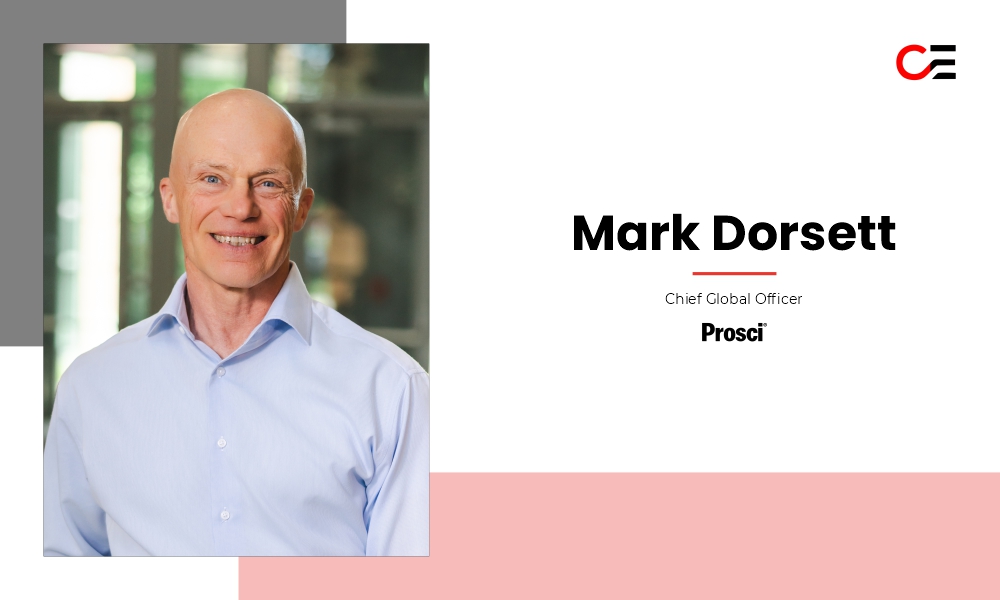
In an era defined by artificial intelligence, digital reinvention, and relentless organizational disruption, one truth remains constant: strategy alone does not create transformation. People do.
For Mark Dorsett, Chief Global Officer at Prosci, that truth was not conceived in a boardroom. It was forged on the frontlines of enterprise technology, where he repeatedly witnessed a pattern that would shape his leadership philosophy for decades: even the most advanced systems fail when the people expected to adopt them are overlooked.
Organizations invested heavily in innovation. Systems were deployed. Strategies were approved. Yet outcomes often stalled, not because technology lacked sophistication, but because leaders underestimated the human realities of adoption.
That realization became his defining principle: technology alone never delivers results. People using technology do.
Today, as Chief Global Officer at Prosci, Mark leads global growth strategy, acquisitions, partnerships, and market expansion across more than 70 countries worldwide. But his role extends beyond international growth. He is helping redefine transformation itself by shifting it from isolated implementation to sustained adoption, from temporary initiatives to enterprise-wide capability, and from strategy in theory to behavioral alignment in practice.
His story is not simply about scaling a company. It is about reshaping how organizations build relevance, resilience, and competitive advantage in a world where disruption is continuous.
From Enterprise Systems to Human Systems
Mark’s career began in enterprise technology, with leadership roles at HP Enterprise Services and PTC that exposed him to large-scale transformations within highly complex organizations. These experiences sharpened his technical expertise, but more importantly, they revealed a critical gap many leaders fail to recognize deployment is not adoption.
Time and again, he saw organizations prioritize systems, infrastructure, and implementation while underestimating the behavioral, cultural, and emotional factors that ultimately determine whether change succeeds.
Rather than seeing this as a project flaw, he recognized it as a leadership challenge.
That insight deepened as Mark embraced international leadership opportunities early in his career, including living in Japan, building global solution centers, and leading teams and developing business across Asia-Pacific, Latin America, Europe, and Australia.
These experiences transformed his worldview.
He learned that global growth is not achieved through replication alone. What succeeds in one market may fracture in another. Over-standardization can erode trust, while over-localization can fragment strategic cohesion. Sustainable scale requires leaders to understand what must remain globally consistent and what must adapt locally.
For Mark, global leadership became less about exporting systems and more about translating intent.
His commitment to cultural fluency extended beyond strategy. While living in Japan, he invested in learning the language and later continued Spanish studies, reinforcing his belief that trust is often built through demonstrated effort before authority.
This philosophy became foundational: shared understanding is the true infrastructure of global scale.
The Calculated Risks That Shaped a Global Leader
Like many transformational executives, Mark’s path was defined by his willingness to embrace complexity before certainty.
Taking international leadership mandates, building globally integrated teams, and helping reshape Prosci’s trajectory required more than ambition. It demanded calculated risk.
At pivotal moments, Mark consistently chose challenge over familiarity.
One of his most important leadership lessons, however, emerged not from success alone, but from self-awareness.
Earlier in his career, he often moved aggressively toward outcomes, believing speed would consistently outperform hesitation. While this created momentum, he learned that velocity without coalition-building can weaken sustainability.
Even the right strategy can underperform when leaders fail to build sponsorship.
That lesson fundamentally shaped his leadership evolution: progress is not defined by speed alone, but by alignment.
Since then, Mark has balanced ambition with sustainability, recognizing that progress people can absorb will always outperform speed they cannot sustain.
Reinventing Prosci for an Age of Continuous Change
When Mark stepped into Prosci’s global transformation journey, the company already held significant authority through decades of evidence-based research, including 13 editions of Best Practices in Change Management and insights from more than 10,000 projects worldwide.
But a rapidly changing business environment demanded more.
As AI accelerated, digitization intensified, and organizations faced unprecedented change saturation, Prosci confronted a defining strategic question:
How could it evolve from a respected U.S.-focused training organization into a globally integrated, solutions-oriented transformation enterprise?
Under Mark’s leadership, the answer required reinvention.
This meant expanding partnerships, pursuing acquisitions, refining market-entry frameworks, and building scalable systems capable of balancing global consistency with local agility.
Professional standards and certifications require rigor. Market execution requires contextual intelligence.
This distinction helped Prosci avoid one of the most common mistakes in international expansion: confusing replication with scale.
The result was transformational. Prosci evolved into a globally integrated organization with research participation spanning more than 70 countries and more than 25 years of best-practice data, becoming a living example of the principles it teaches while growing revenue more than 8x.
Leading Transformation Where It Happens
Mark’s leadership is shaped not only by strategic vision, but by operational immersion.
While supporting major financial services transformations in Latin America, for example, he worked directly with CEOs and CHROs whose strategic priorities mirrored those of global peers, yet whose organizational environments required deeper relationship proximity and face-to-face trust.
The lesson was clear: transformation principles may be universal, but adoption mechanisms are contextual.
By combining Prosci’s research-backed frameworks with regional trust dynamics, Mark reinforced a core belief: organizations scale more effectively when leaders understand how people experience change where they live and work.
Why Transformation Efforts Fail
Across industries, Mark has developed a clear perspective on why transformation initiatives often fail, even when strategic logic appears sound.
Leaders underestimate adoption.
Too often, organizations treat change as a communication exercise supported by announcements, presentations, and training. But transformation does not happen organizationally first. It happens individually.
Resistance rarely stems from opposition to progress itself. More often, it emerges because people do not fully understand why change is happening, why it matters now, how it affects them personally, or whether they can succeed within it.
Fear of uncertainty, role insecurity, failed past initiatives, and cumulative change fatigue all influence adoption.
Mark identifies change saturation, the stacking of individually rational initiatives into collectively overwhelming environments, as one of leadership’s greatest blind spots.
Prosci’s research consistently reinforces another decisive factor: active sponsorship.
People want to hear directly from leaders about why change matters.
For Mark, transformation is not merely operational execution. It is behavioral architecture
AI, Innovation, and the Human Equation
As AI reshapes industries, Mark remains both optimistic and disciplined.
He views AI as a force multiplier capable of accelerating transformation at extraordinary scale. But he also warns against technological enthusiasm detached from leadership responsibility.
AI creates value only when paired with role clarity, ethical frameworks, accountability, and adoption capability.
Without these, organizations risk mistaking tool deployment for transformation.
Mark emphasizes that people adopt innovation differently, from early adopters to cautious majorities, and leadership must account for that spectrum.
Implementation alone is insufficient.
Leadership requires visible sponsorship.
Prosci’s AI adoption research reinforces this principle: organizations gain the greatest advantage when leaders actively model adoption themselves.
In Mark’s framework, innovation becomes meaningful only when it is tied to outcomes, ownership, and reinforcement.
Culture as Competitive Infrastructure
Having worked across more than 50 countries, Mark rejects the idea that culture is too intangible to manage strategically.
He sees culture as competitive infrastructure.
Drawing from frameworks influenced by GLOBE, Hofstede, and Trompenaars, he applies dimensions such as power distance, collectivism, uncertainty avoidance, and assertiveness to execution strategy.
This is not theory. It is operational discipline.
Culture shapes governance, communication, trust, and pacing.
For Mark, alignment does not require identical execution. It requires shared purpose, strategic coherence, and contextual intelligence.
This philosophy has helped Prosci scale globally while preserving local credibility.
Strategic Discipline in Global Expansion
Mark also challenges one of global business’s most dangerous assumptions: that opportunity alone justifies expansion.
He prioritizes readiness over hype.
GDP, population, and growth trends matter, but leadership maturity, capability, appetite, and reciprocal market demand matter more.
His philosophy is grounded in disciplined trade-offs:
Every “yes” requires another “no” or “not now.”
This principle has enabled Prosci to expand deliberately, focusing resources where strategic alignment is strongest.
Leadership for the Next Era
As Prosci enters its next phase, Mark remains focused on extending global reach through broader partnerships, deeper technological integration, and continued investment in strengthening human capability.
But he defines success differently than many executives.
Not by scale alone, but by whether organizations become more capable of sustaining change.
This may be his most forward-looking insight.
In a world where disruption is no longer episodic but continuous, competitive advantage will increasingly belong not to organizations that simply move faster, but to those that build the deepest capacity to absorb, adapt, and sustain transformation over time.
The Legacy Beyond Growth
Mark Dorsett’s story is not one of a conventional executive ascent.
It is the story of a leader who recognized early that systems fail when people are treated as afterthoughts, and who built a global blueprint around solving that challenge.
Through Prosci’s evolution, he has demonstrated that transformation is not fundamentally a technology problem, process problem, or strategy problem alone.
It is a human challenge.
And therefore, a leadership opportunity.
By combining global discipline with local intelligence, innovation with accountability, and scale with shared understanding, Mark has helped position Prosci as more than an organization navigating change.
He has helped shape how transformation itself should be led.
As AI accelerates and volatility intensifies, his philosophy may prove more relevant than ever:
Global scale is not broken by distance.
It is broken by a lack of shared understanding.
And for leaders capable of building that understanding, the opportunity is not merely to manage change, but to shape the future through it.