
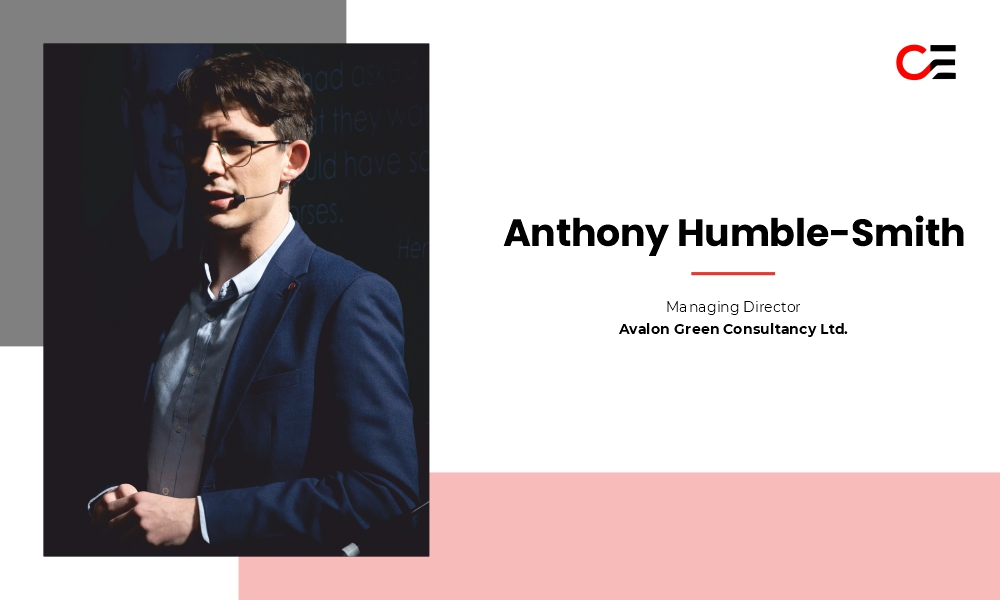
In logistics, sustainability is often discussed in structured frameworks, emissions targets, compliance mandates, and long-term net-zero commitments. On paper, the path appears linear. In practice, it rarely is.
For Anthony, that disconnect has never been theoretical. He has seen it from the inside, where decisions are not made in isolation, but under pressure from margins, delivery schedules, and operational constraints that leave little room for abstraction. In that environment, sustainability is not debated as an idea; it either works within the system, or it doesn’t.
That perspective was shaped early. Before stepping into leadership roles, Anthony’s experience cut across fleet compliance, finance, and day-to-day operations. He often references his time working in the back of DPD vans, not as a symbolic origin story, but as a practical reference point. It was where the realities of logistics became clear: time discipline, cost sensitivity, and the fact that every decision eventually translates into something physical, fuel consumed, miles driven, commitments met or missed.
Those early experiences would later define how he approached sustainability, not as a layer added onto operations, but as something that must function within them.
Where Theory Meets Operational Reality
The most defining chapter of Anthony’s career came during his tenure as Head of Sustainability at The Gregory Group, a legacy transport organisation where efficiency is not a strategic ambition, it is a baseline requirement.
Leading sustainability in that environment was not about introducing new ideas in isolation. It was about integrating them into a system already operating at full capacity.
“There were moments where sustainability was understood intellectually, but not always felt operationally,” he reflects. “And that gap matters more than agreement.”
The challenge was rarely outright resistance. It was prioritisation. Delivery commitments, driver availability, fuel costs, and client expectations do not pause to accommodate transition strategies. Sustainability, while acknowledged as important, often competed with what was immediately urgent.
What followed was not a linear transformation. It was a process of continuous adjustment, revisiting decisions, navigating trade-offs, and building alignment over time rather than expecting it upfront.
“Running a company responsibly and running it successfully are not separate objectives,” Anthony says. “But in reality, you spend a lot of time proving they can coexist.”
Transforming Gregory Group into a recognised name in sustainable logistics remains one of his proudest achievements. Not because it was seamless, but because it was grounded in operational reality. It was here that his long-held belief, doing more with less, moved beyond efficiency rhetoric and became a working constraint.
Recognising the Gap Others Overlooked
As sustainability expectations accelerated across the sector, Anthony began to notice a structural divide, not between companies that cared and those that didn’t, but between those that could keep up and those that couldn’t.
Large organisations had the advantage of internal teams, advisory support, and the capital to experiment. For small and mid-sized hauliers, the transition presented a different challenge altogether. ESG frameworks, regulatory requirements, and carbon reporting systems were arriving faster than many could realistically integrate them.
“The issue was rarely unwillingness,” he explains. “It was the gap between expectation and capacity.”
That gap had tangible consequences, reduced tender success, shrinking client opportunities, and increased operational risk. Businesses weren’t opting out of the transition; they were being edged out of it.
Avalon Green Consultancy Ltd was built in response to that reality.
Rather than operating as a traditional consultancy, the firm was designed to function as an embedded sustainability capability, an external team that provides the expertise many logistics businesses cannot justify building internally.
The model is deliberately practical: make sustainability accessible, actionable, and aligned with how logistics companies actually operate.
Leadership Without Abstraction
Anthony is measured when it comes to leadership labels. He avoids positioning himself through conventional frameworks, preferring a more grounded description of his role.
“I’m a professional busy-body,” he says, without irony.
The phrase reflects how he operates, moving across conversations, gathering perspectives, filtering information, and translating complexity into something usable for the industry.
Within Avalon Green, his leadership approach is shaped by three consistent priorities: people, process, and perspective.
People, because logistics ultimately runs on individuals making decisions under pressure.
Process, because without structure, operational complexity quickly becomes inconsistency.
Perspective, because decisions only make sense when viewed across the system, from client expectations to ground-level execution.
Throughout his career, Anthony was frequently told that he was “ambitious beyond his years.” In a legacy industry, often being one of the youngest people in the room, particularly while advising senior leadership teams and board members, created an understandable level of healthy scepticism. Rather than discouraging him, those experiences shaped him into a more thoughtful manager of people. They reinforced the importance of listening carefully, earning trust through results rather than hierarchy, and creating environments where younger professionals feel empowered to contribute without needing to justify their ambition.
As the business has grown, there has naturally been an expectation that he would become more management-focused and move further away from projects and client work. However, Anthony remains passionate about staying close to the operational side of the business, the clients, projects, and wider industry conversations that first drew him into the sector. Instead, he credits the strength of his team for allowing that balance to work effectively, managing what he jokingly refers to as “the boring side of the business” while he continues to focus on strategy, client relationships, and industry engagement.
Reframing Sustainability as Commercial Reality
One of the more persistent challenges in the sector is how sustainability is perceived.
For many operators, it is still viewed as a compliance burden, something driven by regulation rather than opportunity. Anthony sees that mindset as a risk.
“If sustainability isn’t embedded at the core of the organisation, it will always feel like something being imposed from the outside,” he says.
At Avalon Green, the focus is on repositioning sustainability as a commercial lever. Fuel efficiency, route optimisation, and emissions reduction are not treated as separate from financial performance, they are part of the same equation.
The misconception that decarbonisation is inherently expensive is one he encounters frequently.
“In logistics, sustainability often just means using less fuel,” he explains. “And using less fuel is directly tied to cost reduction.”
From that perspective, the greater risk is not the cost of transition, but the cost of delay.
What It Looks Like in Practice
A recent engagement illustrates how that thinking translates into measurable outcomes.
A transport organisation operating a fleet of approximately 500 heavy goods vehicles approached Avalon Green at a point of growing commercial pressure. Competitors with stronger sustainability credentials were increasingly winning contracts, not necessarily on price, but on alignment with client expectations.
The starting point was clarity. A detailed benchmarking exercise established where the business stood relative to competitors, followed by a gap analysis across ESG performance.
From there, a structured three-year roadmap was developed, focused on carbon measurement, operational efficiency, and commercial positioning.
The process was incremental rather than disruptive. Priorities were sequenced, not overhauled. Progress was measured, not assumed.
The results were tangible. Improved environmental performance, stronger market positioning, and significant commercial gains, including the expansion of a relationship with a global client, strengthening the company’s position within its UK carrier network.
For Anthony, the outcome is less about transformation as a headline, and more about alignment, between operational capability and market expectation.
Technology as an Enabler, Not a Narrative
As a lean organisation, Avalon Green has built its operating model around speed and efficiency. Its use of AI reflects that.
Rather than positioning technology as innovation for its own sake, the firm uses it to enhance accuracy, accelerate data processing, and improve reporting consistency.
The advantage is twofold: faster delivery of complex projects, and broader accessibility of high-level expertise.
Anthony’s view is pragmatic. Technology amplifies capability, but it does not replace judgment. Decisions remain grounded in operational understanding.
An Industry Still in Transition
Despite progress, the sector continues to face structural challenges, driver shortages, volatile fuel pricing, and a persistent perception gap that affects talent attraction.
For Anthony, the issue is not just operational, but cultural.
Logistics remains central to modern economies, yet it is still often viewed through an outdated lens. That disconnect risks slowing the very transition the industry is trying to accelerate.
Addressing it requires more than technology. It requires a shift in how the sector positions itself, both internally and externally.
What Comes Next
Looking ahead, Anthony does not frame the future in terms of a single breakthrough. Instead, he points to layered change, charging infrastructure, grid capacity, and evolving ownership models that may move away from traditional asset-heavy structures toward service-based access.
The scale of that shift is significant, both technically and financially. But for him, the direction is clear.
“The transition isn’t optional,” he says. “It’s already underway.”
Avalon Green’s role within that future remains deliberately close to operational reality, working alongside businesses as they navigate change, rather than prescribing it from a distance.
A Mind-set Built for the Long Term
Anthony’s motivation is rooted in the complexity of the challenge itself.
“I’ve always been drawn to hard problems,” he says. “And this is one of the biggest ones out there.”
For leaders navigating similar transitions, his advice is direct: focus on people, rely on data, and don’t wait for perfect conditions to act.
Because in logistics, as in most industries under pressure, progress rarely comes from ideal scenarios. It comes from making better decisions within the constraints that already exist.
And in that context, sustainability is not a separate agenda. It is increasingly becoming the condition for staying competitive at all.