
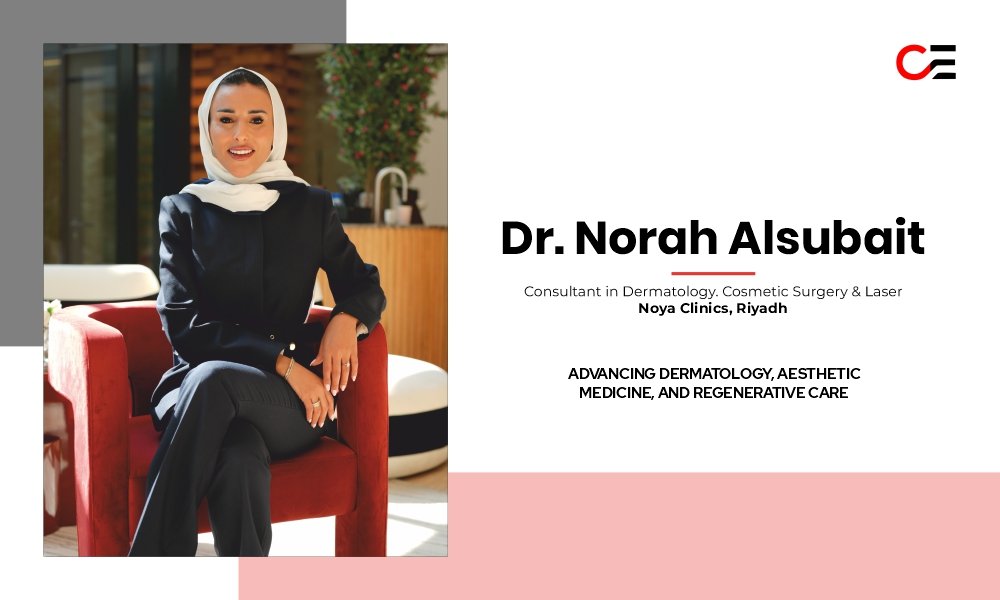
Dr. Norah: Redefining Aesthetic Medicine Through Precision, Restraint, and Patient Trust
Aesthetic medicine is often presented through its most visible outcomes: smoother skin, refined contours, restored volume, or a more youthful appearance. Yet behind a successful treatment is a less visible process involving diagnosis, anatomy, patient selection, communication, technical judgement, and, sometimes, the decision not to treat at all.
For Dr. Norah, Consultant in Dermatology, Cosmetic Surgery and Laser at Noya Clinics in Riyadh, that distinction is central to her approach. Her philosophy is not built around doing more. Instead, she focuses on understanding what a patient needs, selecting the appropriate intervention, and preserving the individuality of the person sitting in front of her.
Her career has developed across clinical dermatology, cutaneous surgery, laser medicine, aesthetics, education, and professional training. After graduating with an MBBS from King Saud University in Riyadh in 2011, Dr. Norah completed her internship before pursuing dermatology residency through King Saud University and the Saudi Commission for Health Specialties. Her interest gradually became more focused on procedural dermatology, dermatosurgery, laser medicine, and aesthetic medicine.
A significant stage in that development came through advanced fellowship training in Laser and Cutaneous Surgery at King Saud University in 2020–2021. The experience strengthened her expertise in laser-based treatments and dermatologic aesthetic surgery while complementing more than 16 years of clinical experience and over a decade focused on aesthetic medicine and minimally invasive facial and body procedures.
Her years within Saudi Arabia’s Ministry of Health also exposed her to the demands of high-volume tertiary care. There, her work extended beyond treating individual patients to training residents and junior physicians. Serving as Deputy Head of the Dermatology Department added another dimension to her career, developing her leadership experience and reinforcing her interest in academic and professional education.
Today, her practice at Noya Clinics brings together medical dermatology, dermatosurgery, laser treatments, aesthetic medicine, injectables, and regenerative approaches. But clinical work represents only one part of her professional identity. She is the founder and CEO of Aurea Aesthetic Academy, Head of the Scientific Committee of SAAM, a faculty member of the International Aesthetic Anti-Aging Diploma, and a professional trainer in collagen biostimulators and hyaluronic acid injectables.
Her work as a Global Key Opinion Leader and international speaker, including participation at AMWC Monaco, has further connected her with developments and conversations taking place across the international aesthetic medicine community. For Dr. Norah, however, professional recognition is not an endpoint. It is an opportunity to contribute to the specialty through knowledge-sharing, education, and continued clinical development.
Moving Beyond the Procedure
The practice of dermatology and aesthetic medicine has changed considerably during Dr. Norah’s career. Patients are more informed than ever, exposed to international techniques and beauty trends through digital platforms, and increasingly interested in prevention, skin health, and maintaining a natural appearance.
This has also changed the questions physicians need to ask.
Rather than beginning with a particular procedure, Dr. Norah believes the starting point should be the patient and the underlying concern. A request for an injection, for example, may not necessarily mean that additional volume is required. The appropriate solution could instead involve improving skin quality, stimulating collagen, restoring subtle structural support, treating pigmentation or scarring, or combining different modalities.
This represents a broader shift from procedure-led aesthetics toward a more comprehensive approach.
Patients increasingly want effective interventions with limited downtime, but their expectations can also be more complicated. Social media has made information more accessible while simultaneously exposing patients to filter images, edited photographs, rapidly changing trends, and sometimes unrealistic standards.
For the physician, this creates an educational responsibility.
Dr. Norah believes that consultation should help patients distinguish between what is trending and what is genuinely appropriate for their anatomy, skin, goals, and long-term wellbeing. The objective is not to reject a patient’s aesthetic concerns, but to place those concerns within a medically responsible framework.
Personalisation Begins with Listening
For Dr. Norah, personalised care starts before any device is selected or product is prepared.
She first wants to understand why the patient has sought treatment, what concerns them, what outcome they hope to achieve, and what expectations they bring into the consultation. From there, she assesses factors including skin quality, facial anatomy, proportions, ageing patterns, previous procedures, medical history, lifestyle, and overall suitability.
An important part of this process is distinguishing between what a patient asks for and what they actually need.
That distinction can sometimes lead to a different recommendation from the one a patient initially expected. Someone requesting more facial volume, for instance, may benefit more from improving skin quality or stimulating collagen. Similarly, not every concern needs to be addressed during a single appointment.
Dr. Norah favours prioritisation and, where appropriate, a staged approach. Treating everything at once is not necessarily the path to the most harmonious outcome. Allowing time to assess how a patient responds can create a more measured and controlled treatment journey.
This philosophy is closely connected to her belief that natural-looking aesthetics require restraint.
“Aesthetic medicine should enhance a person’s features rather than replace them” is the principle underlying her approach. She does not believe in applying a universal aesthetic template to every patient. Facial proportions, anatomy, ageing patterns, and individual characteristics differ, and what creates balance in one person may not be suitable for another.
In that context, knowing when to use less can be as important as knowing how to use more.
Knowing when not to inject, when to select collagen stimulation rather than additional volume, or when to recommend no treatment at all requires clinical judgement. The desired outcome is not an obvious indication that a procedure has been performed. It is a patient who looks refreshed, healthy, balanced, and confident while still looking like themselves.
Technology With Clinical Judgement
Laser and energy-based technologies have become increasingly sophisticated, offering greater precision, customisation, and control over how specific tissue characteristics are addressed. Dr. Norah is particularly interested in technologies and protocols that focus on skin quality and controlled biological responses rather than simply producing an immediate superficial effect.
Developments in fractional technologies, energy-based skin remodelling, scar treatment, pigmentation management, and combination protocols are expanding the possibilities within dermatological and aesthetic care.
But technology, in her view, should never become the centre of the treatment decision.
The most advanced device cannot compensate for poor patient selection, an incorrect indication, or inappropriate treatment settings. Skin type, the patient’s condition, medical history, expectations, and risk profile all influence whether a treatment is appropriate.
This same principle applies to newer products and techniques. Innovation matters, but novelty alone does not establish clinical value. Dr. Norah considers evidence, safety, mechanism of action, patient selection, and reproducibility when evaluating new approaches.
Her position is straightforward: technology should serve the patient, rather than the patient being fitted around the technology.
When Saying “No” Is Part of Good Medicine
Patient selection is one of the areas where Dr. Norah’s philosophy becomes particularly clear.
Before recommending a cosmetic or laser procedure, she considers medical history, skin type and condition, medications, previous procedures, allergies, healing capacity, active dermatological conditions, contraindications, and the anatomical indication for treatment.
But suitability is not exclusively clinical.
Expectations matter.
A patient may be technically suitable for a particular procedure but still not be an appropriate candidate if the desired outcome is unrealistic or if the underlying concern cannot be safely addressed through aesthetic treatment.
For Dr. Norah, a responsible physician must be comfortable telling a patient that a particular treatment is not appropriate or that it may not be necessary.
That approach also shapes how she views informed consent. She does not see it as a document to be signed at the end of a consultation, but as an ongoing conversation about what a treatment can achieve, what it cannot, the likely number of sessions, recovery, potential complications, alternatives, and the option of doing nothing.
Aesthetic medicine rarely requires a patient to make a rushed decision. Giving patients enough information and space to ask questions creates a relationship based on understanding rather than expectation.
Beyond the Influence of Social Media
Social media has undeniably expanded awareness of dermatology and aesthetic medicine. Patients are now familiar with concepts such as collagen stimulation, regenerative medicine, preventive aesthetics, and skin-quality treatments that were once largely discussed within professional circles.
But increased awareness does not always mean increased understanding.
Highly curated images can make certain facial features or treatment outcomes appear universal. Patients may arrive requesting a particular feature because it is currently fashionable, without considering whether it fits their own anatomy.
Dr. Norah sees the consultation as an opportunity to redirect that conversation.
Instead of following trends, she encourages patients to consider individuality, proportion, skin health, and long-term outcomes. Aesthetic medicine, in her view, should support a person’s appearance rather than force that person into a temporary definition of beauty.
The same principle applies to ageing. Treatment cannot stop the ageing process, and attempting to erase every sign of time can ultimately work against natural facial harmony.
The objective is healthier and more balanced ageing, not the elimination of every visible indication of it.
A Multidisciplinary Perspective
Working within Noya Clinics provides Dr. Norah with an environment in which dermatology and aesthetics can be considered from multiple perspectives. Patients may have needs that extend beyond a single procedure or treatment category, making communication between professionals valuable.
Her work can incorporate dermatology, dermatosurgery, laser treatments, injectables, regenerative approaches, and other relevant areas when clinically appropriate.
The advantage of a multidisciplinary model is not simply having access to more treatments. It is being able to consider the patient more comprehensively rather than viewing each intervention in isolation.
That broader perspective aligns with her overall philosophy: the treatment should be built around the patient, not the other way around.
Education as a Continuing Responsibility
Continuous learning is particularly important in aesthetic medicine because the field changes quickly. New devices, injectables, regenerative approaches, techniques, and treatment combinations continue to emerge, making it necessary for practitioners to evaluate new developments critically rather than simply follow them.
Dr. Norah remains engaged through international conferences, professional speaking, scientific literature, research, publications, and physician training. Her academic and research interests have included vitiligo, dermoscopy, cutaneous oncology, dermatologic surgery education, and regenerative aesthetic applications.
Education has also become a major part of her professional contribution through Aurea Aesthetic Academy and her roles as a trainer and faculty member.
For her, teaching is not separate from clinical practice. Explaining a technique to another physician requires a deeper examination of its science, indications, limitations, and risks. In that sense, education becomes another form of continuous professional learning.
Her long-term objective is to help develop practitioners who understand more than the mechanics of a procedure. Anatomy, biology, patient psychology, safety, patient selection, and individuality all have to be part of the decision-making process.
Building Trust Beyond the Treatment Room
Technical expertise alone does not create a lasting physician-patient relationship.
Dr. Norah identifies empathy, honesty, consistency, communication, and humility as equally important qualities. Patients may seek treatment for a concern that appears minor from a medical perspective but carries significant emotional weight for them.
Recognising that difference matters.
So does understanding the limits of medicine.
Trust is strengthened when patients know that a recommendation is being made because it is appropriate for them, rather than because another procedure can be sold. That is why the willingness to recommend less, delay treatment, or decline a procedure can be just as important as technical ability.
It is also why the relationship cannot be reduced to a single treatment outcome. The patient needs to feel heard, respected, and understood throughout the process.
The Next Chapter for Aesthetic Medicine in Saudi Arabia
Saudi Arabia is undergoing significant growth across healthcare, medical education, technology, and aesthetic medicine. Dr. Norah believes this development is likely to move the market toward increasingly sophisticated, evidence-based, and personalised care.
Regenerative medicine, biostimulation, advanced energy-based treatments, combination protocols, artificial intelligence, imaging technologies, and more precise patient assessment are among the developments she expects to influence the field.
But she also sees an opportunity for Saudi Arabia to contribute to international conversations rather than simply adopt developments originating elsewhere.
Saudi physicians are increasingly involved in research, education, conferences, and innovation. This creates the potential for the country to become a regional centre for excellence in dermatology and aesthetic medicine.
Dr. Norah wants to contribute to that progression through both clinical practice and education.
Through Aurea Aesthetic Academy, she aims to help raise the standard of physician training, with emphasis on anatomy, patient selection, safety, evidence-based practice, and advanced technical skills. Clinically, she remains particularly interested in regenerative and biostimulatory approaches, including their potential applications in skin quality, facial and body rejuvenation, and acne scarring.
She also plans to continue contributing to international education, scientific discussions, and mentorship.
Choosing the Physician Before the Procedure
For patients considering dermatological or aesthetic treatment, Dr. Norah’s advice begins with a decision that comes before selecting a device, product, or procedure: choose the physician carefully.
Patients should research the practitioner’s qualifications and experience, undergo a proper consultation, and understand what the proposed treatment can realistically achieve. A procedure should not be selected simply because it is trending online or because it produced a particular result for someone else.
Patients should also be willing to listen when a qualified physician recommends an alternative approach.
Perhaps most importantly, safety should not be sacrificed for speed or price. Aesthetic medicine remains medicine, with indications, limitations, contraindications, and potential risks.
This philosophy also defines the legacy Dr. Norah hopes to build.
Her ambition extends beyond individual treatment outcomes. Through clinical practice, research, speaking, physician training, and Aurea Aesthetic Academy, she wants to contribute to a culture of safe, ethical, evidence-based, and natural-looking aesthetic medicine in Saudi Arabia and internationally.
Ultimately, her measure of success is not simply whether a treatment produces a visually pleasing result. It is whether that result was achieved responsibly, whether the patient’s individuality was preserved, and whether the person felt listened to and respected throughout the process.
For Dr. Norah, the future of aesthetic medicine is not about doing more. It is about understanding more: understanding anatomy, biology, technology, psychology, expectations, and the individual patient.
And sometimes, the most sophisticated decision a physician can make is knowing when less is enough.