
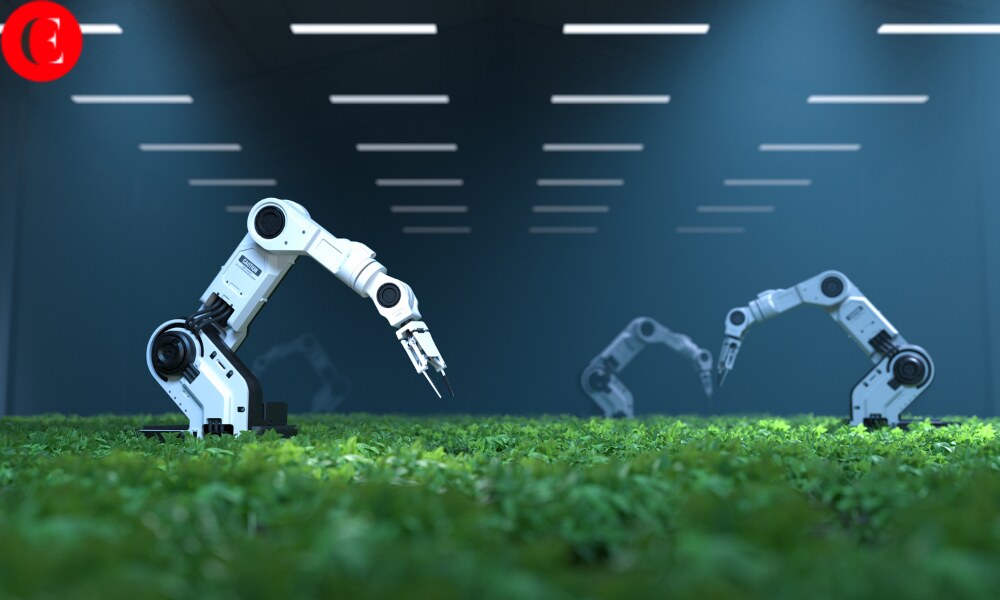
Automation, artificial intelligence, and robotic mobility are ushering in a new era in agriculture, changing the way farms function. Farming robot dogs, agile four-legged devices intended to assist harvest operations, monitor crops, and increase overall farm productivity, are among the most cutting-edge gadgets now being developed. These robotic assistants are increasingly indispensable to contemporary, data-driven farming systems as the world’s food demand rises and manpower shortages worsen.
This article examines how robotics may assist farmers, how millions of acres are harvested by robots, and why smart agricultural harvesting robots are swiftly becoming a component of the industry’s long-term plan.
Farming Robot Dogs: What Are They?
Farming robot dogs are self-governing, artificial intelligence (AI)-driven devices that can move around fields, orchards, and greenhouses with the dexterity of a real dog. They assist farmers in monitoring conditions, inspecting plants, and making harvesting decisions thanks to their sensors, cameras, GPS modules, and machine-learning capabilities.
Instead of taking the role of farmers, these robot canines serve as mobile assistants, gathering information, automating tedious duties, and guaranteeing quicker decision-making during harvest seasons.
How Can Robot Dogs Increase Harvest Productivity?
1. Crop Monitoring in Real Time
Robot dogs use cutting-edge imaging equipment to continuously patrol the areas, such as
- Multispectral cameras
- Sensors that detect heat
- Mapping with LiDAR
They assist in identifying early indicators of nutrient deficits, water stress, and pests that human workers might overlook. This demonstrates how robotics can aid farming by facilitating quicker and more accurate treatments.
2. Accurate Harvesting Guidance
Robotic dogs map crop quality and maturity thanks to AI tracking. Their data increases yield accuracy by directing harvesting equipment directly to areas with high productivity.
This is similar to how robots use synchronized data and machine operations to harvest millions of acres.
3. Moving Light Weights
A few farming robot dogs are capable of carrying:
- Baskets for harvest
- Instruments
- Packs of seeds
- Samples of soil
This lessens the physical strain on employees and boosts productivity on big farms.
4. Assisting Farmers in Times of Labor Scarcity
Due to labor shortages in agriculture in several areas, robot dogs play crucial roles:
- Keeping an eye on fields at night
- Helping at periods of high harvest
- assisting in the upkeep of regular workflows
- This demonstrates how farming robots are quickly becoming a practical requirement.
The Benefits of Robot Dogs for Complicated Terrain
Four-legged robots glide across surfaces more easily than wheels or drones.
Fields that are muddy
Rocky terrain
Thick orchards
incline
Unbalanced soil
Because of their agility, they can work in environments that are inaccessible to conventional robots. This versatility makes robot dogs reliable companions for smart agriculture ecosystems.
Farming Robot Dogs versus. Harvesting Robots
Harvesting robots in agriculture are devices made especially to pick fruits, cut crops, or sort produce, whereas agricultural robot dogs mostly gather data and assist field activities.
The best uses for robot dogs are:
- Monitoring in the field
- Crop evaluation
- Mapping of farms
- Assistance with logistics
The best uses for harvesting robots are:
- Picking apples
- Harvesting berries
- Sorting tomatoes
- Cutting grains
- Vegetables with leaves
When combined, they form a potent combination that sustains ongoing food supply chains, increases productivity, and decreases waste.
Benefits of Sustainability: More Intelligent Farming Using Fewer Resources
Robotic dogs assist farmers by identifying problems early and lowering:
- Use of pesticides
- Overuse of irrigation
- Waste of fertilizer
This results in better soil systems and more sustainable resource management. Global objectives for efficient food production and environmental resilience are supported by smart agriculture powered by AI-driven robots.
How Agriculture Will Change Due to Robotics
Analysts predict that robot dogs will become commonplace on large farms within the next ten years. These machines will perform tasks like these as prices come down and learning algorithms get better:
- Self-sufficient harvesting
- Observation of livestock
- Automation of greenhouses
- Optimization of soil health
The potential of smart agriculture will continue to be unlocked by the closer integration of AI, robots, and IoT, which will increase farming’s accuracy, predictability, and profitability.