
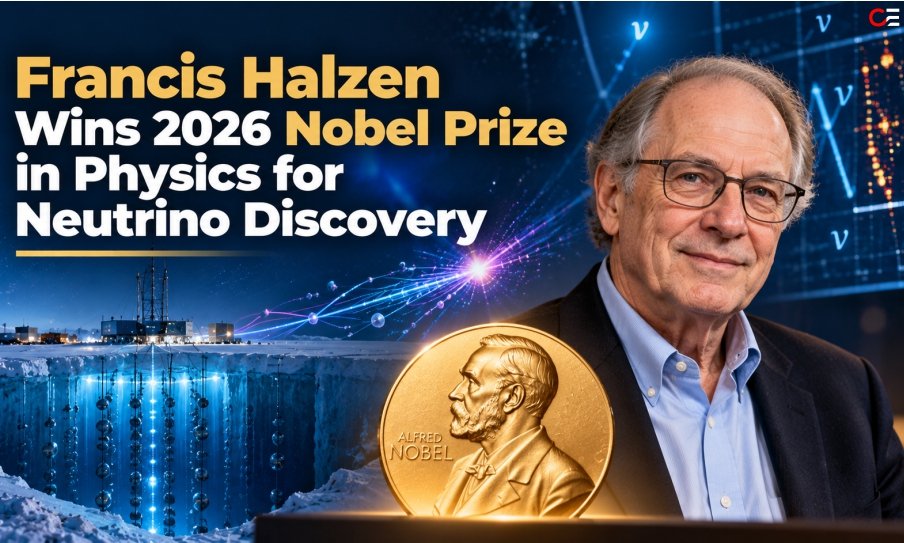
Belgian-American particle physicist Francis Halzen won the 2026 Nobel Prize in Physics on Tuesday for his decisive contributions to the IceCube Neutrino Observatory and the discovery of high-energy neutrinos of astrophysical origin.
The Royal Swedish Academy of Sciences announced the award in Stockholm on October 6. Halzen, 82, is a professor at the University of Wisconsin–Madison and the principal investigator of the IceCube Neutrino Observatory.
The Nobel committee recognized Halzen for his scientific vision and leadership in developing IceCube, a giant neutrino detector embedded in the ice at the South Pole. The observatory uses a cubic kilometre of Antarctic ice equipped with light sensors to detect rare interactions involving neutrinos.
“Francis Halzen has led an international team of researchers and engineers who have provided us with a fantastic instrument,” Mark Pearce, chair of the Nobel Committee for Physics, said in the announcement. He praised Halzen’s tenacity and scientific vision for opening the way to a new form of astronomy.
Halzen first presented his idea of using the South Pole’s ice to detect neutrinos in 1988. When a neutrino interacts with an atomic nucleus in the ice, it can produce a flash of light that is recorded by IceCube’s sensors. The observatory was completed in 2011 and has enabled scientists to identify high-energy neutrinos originating from astrophysical sources.
IceCube has played a role in this. It has shown that neutrinos are a tool for studying the cosmos. They give us clues about events that we can’t see with regular telescopes. These events are far away or too hidden. Neutrinos help us see what’s going on in places we can’t reach. This opens up a new way to look at the universe.
The 2026 Nobel Prize in Physics carries a total prize amount of 12 million Swedish kronor, about $1.2 million. Because Halzen is the sole laureate in physics this year, the prize money will not be divided among multiple physics laureates.