
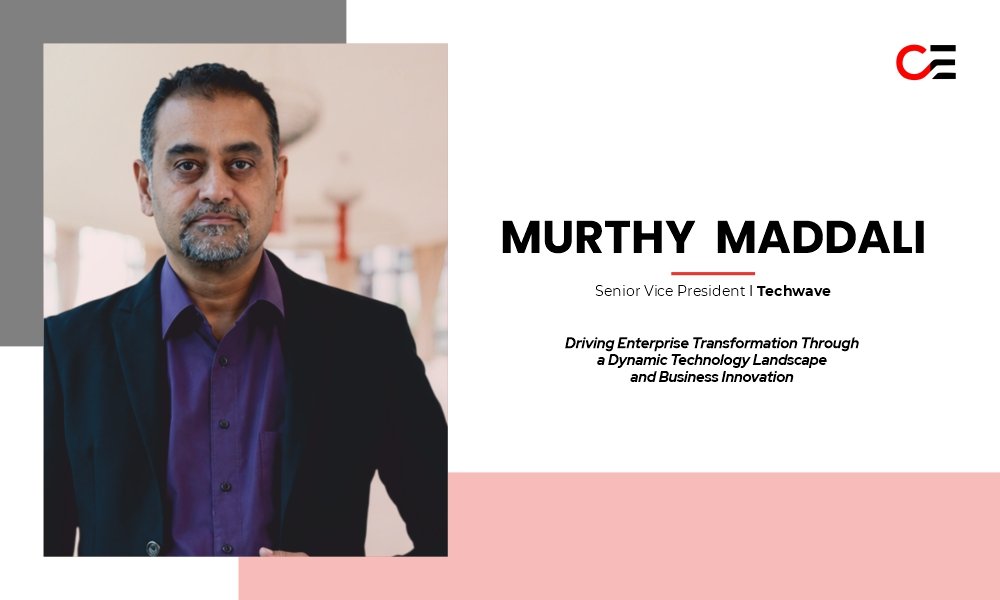
Technology has evolved at an extraordinary pace over the past three decades, yet one principle has consistently guided Murthy Maddali’s career: technology delivers its greatest impact only when it creates meaningful value for businesses. Throughout his professional journey, he has remained committed to helping organizations modernize their operations, improve performance, and embrace innovation with a clear strategic purpose rather than adopting technology for its own sake.
Today, as Senior Vice President & Managing Director, Europe West at Techwave, Murthy leads the company’s operations across the United Kingdom, Germany, France, and the Benelux region. In this role, he is responsible for driving regional growth while helping enterprises navigate increasingly complex digital transformation initiatives through a combination of strategic leadership, operational excellence, and customer-centric innovation.
His responsibilities extend well beyond regional management. Murthy oversees business strategy, market expansion, client relationships, innovation, operational performance, and full profit-and-loss accountability. Over the years, he has played an instrumental role in strengthening Techwave’s presence across Europe while helping establish the organization as a trusted transformation partner in SAP, cloud technologies, digital engineering, artificial intelligence, and data-driven innovation.
A Journey Driven by Curiosity and Continuous Learning
Murthy’s passion for technology began during his academic years while pursuing a master’s degree in computer applications at Andhra University. He entered the IT industry during one of its most transformative periods, when internet technologies were rapidly gaining momentum and organizations around the world were preparing for the Y2K transition. It was an exciting time to begin a career in technology, and the industry’s constant evolution reinforced his desire to work in an environment where learning never stopped.
What initially attracted him to the profession was technology’s ability to solve real business challenges. As enterprise systems became more sophisticated, his own career evolved from developing software applications to leading large-scale digital transformation programs that influence both technology strategy and long-term business performance.
A defining milestone came in 2015 when he joined Techwave to establish and lead the company’s European delivery organization from the High Tech Campus in Eindhoven, Netherlands. At that time, the company’s presence in Europe was still developing, presenting an opportunity to build both operational capability and market credibility. Through consistent delivery excellence, strong customer relationships, and strategic leadership, his responsibilities gradually expanded from managing delivery operations to leading overall business strategy and regional growth across Europe West.
Over the years, several milestones have shaped this journey. These include establishing the Netherlands office, expanding the customer base across Europe, creating Digital Centers of Excellence in Europe and India, supporting private equity firms with value creation initiatives, and contributing to industry recognition for the company’s digital engineering capabilities. Collectively, these achievements reflect the organization’s evolution from being viewed primarily as an implementation partner to becoming a trusted advisor for enterprise-wide transformation.
Leading Growth Across Europe
As Managing Director for Europe West, Murthy oversees every aspect of the regional business. His responsibilities include defining growth strategies, strengthening market positioning, cultivating long-term client relationships, delivering innovative solutions, and ensuring sustainable financial performance across multiple European markets.
Working closely with leadership teams across sales, marketing, consulting, delivery, and business support functions, he places significant importance on maintaining alignment between strategic planning and operational execution. Sustainable growth, he explains, is achieved only when every part of the organization works toward a common objective with clarity and consistency.
Among his key priorities is expanding the company’s engagement with private equity firms and venture-backed organizations undergoing business carve-outs. These initiatives involve designing end-to-end IT environments while helping portfolio companies improve operational efficiency, enhance EBITDA, and create long-term enterprise value through carefully planned transformation strategies.
Another important focus is the expansion of CoreXcel, the organization’s SAP-certified accelerator designed to strengthen SAP transformation capabilities across Europe. At the same time, the company continues embedding artificial intelligence into its delivery models while investing in scalable business capabilities that support sustainable regional expansion.
By combining deep industry expertise with a strong execution model, Murthy continues to position the organization as a strategic partner capable of helping enterprises navigate complex business and technology challenges while preparing for long-term growth.
Delivering Business Value Through Technology
The organization has built its global reputation by helping enterprises modernize their technology landscape through cloud services, infrastructure management, enterprise applications, SAP, digital engineering, telecommunications, utilities engineering, data platforms, and artificial intelligence.
For Murthy, however, technical expertise alone is never enough to distinguish between a technology partner. Every client’s engagement begins with understanding the organization’s strategic priorities before recommending any technology solution. Whether modernizing SAP environments, migrating infrastructure to the cloud, or implementing AI-driven capabilities, the objective remains consistent: enabling measurable improvements in operational efficiency, resilience, agility, and overall organizational performance.
This consultative, business-first approach has enabled the company to establish long-term relationships across multiple industries. Its recognition in the ISG Provider Lens Europe 2026 study for AI-native Digital Engineering delivery reflects its ability to combine deep technical expertise with repeatable delivery excellence while maintaining a strong focus on measurable client value.
Rather than simply implementing technology, Murthy and his team work alongside customers to design and execute transformation strategies that deliver sustainable results, strengthen competitiveness, and prepare organizations for the future.
The Technologies Shaping the Next Five Years
Looking ahead, Murthy sees Agentic AI as one of the most transformative technologies for modern enterprises. Unlike today’s AI solutions, which primarily assist with individual tasks, Agentic AI has the potential to manage complete business workflows—from infrastructure provisioning and transaction processing to customer support and operational decision-making.
As these capabilities mature, the role of people will increasingly shift from execution to supervision, governance, and strategic decision-making. Organizations that redesign their operating models around these intelligent systems, rather than simply adding AI to existing processes, will be better positioned to gain a lasting competitive advantage.
Cloud adoption is also entering a new phase. The conversation is no longer centered on migration alone but on optimizing cloud investments, improving operational efficiency, managing costs, and supporting sustainability goals through intelligent resource utilization.
Within financial services, Murthy expects emerging innovations such as stablecoins and agentic commerce to reshape payment ecosystems while introducing new regulatory and governance challenges. At the same time, cybersecurity will become even more critical as AI-powered, cloud-native, and API-driven environments continue to expand. Organizations that embed resilience into their digital strategies from the outset will be better equipped to navigate this evolving landscape.
A Leadership Style Built on Trust, Collaboration, and Accountability
Murthy describes his leadership philosophy as collaborative, agile, and strongly focused on outcomes.
Rather than directing every decision, he believes effective leaders establish a clear vision, define measurable objectives, and empower their teams to determine the best path forward. When talented professionals are trusted with ownership and responsibility, innovation becomes a natural outcome.
Transparency is another principle that shapes his approach. Throughout complex transformation programs, he encourages open communication and early visibility into challenges, allowing teams to address potential risks before they become larger operational or financial issues.
Leading multicultural teams across Europe has further strengthened his appreciation for listening, adaptability, and cultural awareness. Every market has its own business practices, customer expectations, and decision-making styles. Successfully leading across these diverse environments requires respecting local perspectives while maintaining consistent organizational values and strategic direction.
Integrity, customer focus, curiosity, and continuous learning remain at the heart of both his leadership philosophy and the culture he strives to foster across the organization.
Building Credibility Across Borders
One of the most significant challenges Murthy faced during his career was establishing confidence in an India-based delivery model among European organizations that had traditionally preferred working with local service providers.
Geographical distance, language differences, cultural expectations, and time zone considerations initially created barriers to trust. Rather than relying solely on presentations or marketing messages, the company invested in building a strong European presence, including its Eindhoven office, while ensuring senior delivery leaders remained closely engaged with customers throughout every stage of project execution.
Consistent communication, transparency around project risks, and a commitment to delivering promises gradually strengthened long-term client relationships and reinforced confidence in the organization’s capabilities.
For Murthy, this experience highlighted an important leadership lesson that continues to guide his approach today: trust is not built through presentations or credentials alone—it is earned through consistent execution, honest communication, and the ability to deliver meaningful results over time.
Responsible AI and Cybersecurity: Building Trust in the Digital Age
Artificial intelligence is rapidly transforming industries, but Murthy emphasizes that successful adoption requires balancing innovation with strong governance.
While AI has the potential to significantly improve productivity, governance frameworks must evolve alongside technological capabilities rather than being treated as an afterthought. Responsible AI requires robust data governance, privacy protection, regulatory compliance, human oversight, and clear transparency regarding the strengths and limitations of AI models.
These considerations become even more important in highly regulated sectors such as financial services, where biased outcomes, compliance failures, or weak governance can create significant operational and reputational risks.
Equally important is cybersecurity, which Murthy views as an integral part of every transformation initiative rather than a final checkpoint before deployment. Modern enterprises should embed security into every stage of solution design by adopting zero-trust architectures, resilience testing, recovery planning, and governance as standard practices.
As organizations accelerate digital transformation, protecting data, applications, and digital infrastructure becomes essential for maintaining customer confidence and business continuity. Treating security as a strategic investment—not simply a compliance requirement—allows organizations to innovate with greater confidence while strengthening long-term digital resilience.
To achieve this balance, the company advocates a measured approach to AI adoption, supported by continuous performance evaluation, clear accountability, and governance frameworks that align technology investments with business objectives. Building lasting trust with customers, regulators, and stakeholders ultimately depends on responsible innovation supported by strong security and governance practices.
Making Digital Transformation Successful
Having led numerous enterprise transformation initiatives throughout his career, Murthy has observed that successful programs consistently share a common set of principles. While every organization has unique objectives and challenges, the foundations of successful transformation remain remarkably consistent.
One of the most critical factors is strong executive sponsorship. Effective leadership goes far beyond approving budgets or launching initiatives—it requires sustained involvement throughout the transformation journey. When business leaders remain actively engaged, they help maintain strategic alignment, accelerate decision-making, and reinforce organizational commitment to change.
Equally important is defining success through measurable business impact rather than technology implementation alone. Digital transformation should deliver tangible improvements in operational efficiency, customer experience, productivity, and long-term organizational performance. Technology serves as an enabler, but business value remains the ultimate measure of success.
Murthy also advocates a phased approach to execution. Breaking large initiatives into clearly defined milestones enables organizations to reduce risk, maintain momentum, and continuously measure progress instead of attempting enterprise-wide transformation in a single step.
Perhaps the most overlooked aspect of transformation is preparing people alongside technology. New platforms and digital tools alone rarely determine the success or failure of an initiative. More often, challenges arise when employees, business processes, and organizational culture fail to evolve at the same pace as technology itself. Investing in change management, communication, and workforce readiness is therefore just as important as investing in the technology platform.
Encouraging Collaboration and Innovation
For Murthy, innovation is not driven solely by research labs or formal innovation programs. It begins by creating an environment where people understand how their individual contributions support broader organizational objectives and feel empowered to share new ideas.
Across the organization’s operations in Europe and India, collaboration extends well beyond geographical boundaries. Cross-functional and cross-border teams regularly work together on client engagements, giving employees valuable exposure to diverse industries, cultures, and business environments. This exchange of perspectives often leads to more creative solutions and stronger customer outcomes.
Continuous learning also remains a defining element of the company’s culture. Employees are encouraged to explore emerging technologies, expand their expertise, and openly share ideas without waiting for multiple layers of approval. Promising concepts are evaluated quickly, allowing innovation to move from discussion to implementation at greater speed.
Many successful client engagements have originated from ideas proposed by professionals working directly with customers. Those closest to business challenges often recognize opportunities that may not be immediately visible at the leadership level.
For Murthy, genuine innovation is measured less by structured programs and more by an organization’s willingness to recognize valuable ideas, encourage experimentation, and act on them regardless of where they originate.
Sustainability Through Smarter Operations
Murthy views sustainability not as a standalone corporate initiative but as a natural outcome of building more intelligent and efficient business operations.
Organizations can significantly reduce both operational costs and environmental impact by optimizing infrastructure, eliminating unnecessary workloads, automating repetitive processes, and improving overall resource utilization. Efficient technology environments consume fewer resources while delivering stronger business performance, creating value for both the organization and the broader ecosystem.
Cloud optimization, intelligent automation, and data-driven decision-making all contribute to this objective by enabling enterprises to operate with greater efficiency while reducing waste across technology operations.
He believes technology companies make their greatest contribution to sustainability by helping businesses become more productive, resilient, and resource efficient. When organizations improve operational performance through smarter technology decisions, sustainability becomes an integrated business outcome rather than a separate objective.
This perspective reflects a broader shift in enterprise transformation, where operational excellence, financial performance, and environmental responsibility increasingly reinforce one another instead of competing for attention.
Looking Toward the Future
Murthy sees the technology consulting industry entering a new era in which organizations expect far more than traditional implementation services. Clients increasingly seek strategic partners capable of combining AI-enabled engineering, enterprise transformation expertise, and measurable business value to help them navigate continuous change.
Private equity firms are looking for transformation partners that can support portfolio companies throughout the entire business lifecycle—from carve-outs and integration to operational maturity and long-term value creation. At the same time, conventional ERP implementation models are evolving toward outcome-based engagements, creating greater demand for professionals who combine deep enterprise knowledge with expertise in artificial intelligence, cloud technologies, and digital engineering.
For the organization, the immediate priorities include expanding private equity transformation services, scaling the CoreXcel SAP accelerator across Europe, strengthening strategic customer relationships, and pursuing inorganic growth opportunities across Germany and the United Kingdom. These initiatives are designed to reinforce the company’s position as a trusted partner capable of helping enterprises respond to rapidly changing market conditions while preparing for future growth.
Across each strategic initiative, the objective remains consistent: enabling organizations to accelerate transformation, strengthen operational resilience, and create sustainable value through innovative technology solutions.
A Message for the Next Generation of Leaders
Reflecting nearly three decades in the technology industry, Murthy encourages aspiring leaders to focus first on solving business challenges rather than becoming attached to any single platform or technology.
“Technologies will continue to evolve, but understanding customers, solving meaningful problems, and creating lasting value will always remain at the heart of effective leadership,” he says.
He also encourages professionals to step beyond their comfort zones, embrace continuous learning, develop cross-cultural leadership skills, and actively share knowledge with others. In today’s global business environment, adaptability and collaboration are just as important as technical expertise.
For Murthy, leadership is measured not only by personal achievements but also by the ability to inspire, mentor, and help others succeed. Building high-performing teams, fostering trust, and creating opportunities for people to grow are, in his view, among a leader’s most enduring responsibilities.
As technology continues to reshape industries, he remains guided by a philosophy that has defined his career from the very beginning: innovation has real significance only when it creates measurable value for businesses and meaningful progress for people. Leaders who keep that purpose at the center of every decision will be best positioned to shape the future of enterprise transformation.