
In today’s rapidly evolving life sciences landscape, transformation is no longer defined by technology alone. Artificial intelligence, advanced analytics, and digital platforms continue to dominate boardroom conversations, yet the organizations creating lasting impact are those that know how to translate innovation into disciplined execution and measurable commercial outcomes.
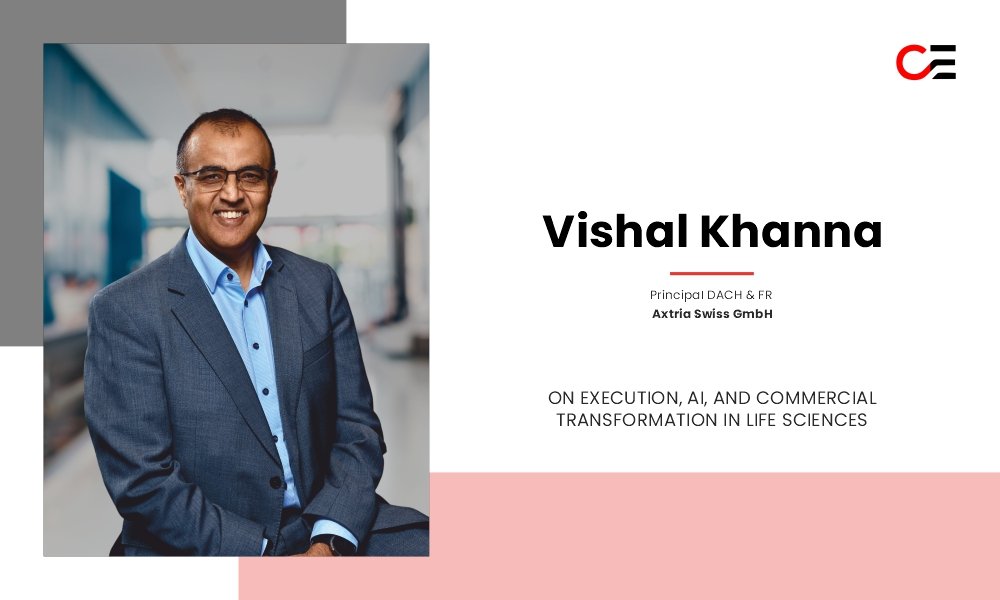
At the centre of this shift is Vishal Khanna, who leads Axtria’s business across D-A-CH and France, working closely with pharmaceutical, biotech, and medical technology organizations as they navigate one of the most important transitions in the industry: moving from fragmented digital initiatives to scalable, AI-enabled commercial transformation.
For him, the story is not simply about adopting new tools. It is about building operational clarity, strengthening organizational readiness, and ensuring that people, processes, and platforms evolve in sync.
Building a Career Around Complexity and Purpose
Vishal Khanna’s professional journey has consistently revolved around a single theme: helping life sciences organizations make better commercial decisions through data, technology, and operating-model transformation.
Over the years, he has worked across pharmaceutical commercial strategy, sales force effectiveness, data management, analytics, and digital transformation. These experiences exposed him to the operational realities that define modern life sciences enterprises, where scientific innovation alone is never enough without strong execution in the field.
What initially drew him to the sector was its rare combination of complexity, relevance, and impact.
Unlike many industries where success is measured purely in financial outcomes, life sciences carries a deeper responsibility. When commercial systems function effectively, organizations improve engagement with stakeholders, strengthen access to therapies, and ultimately contribute to better patient outcomes.
That intersection of precision, purpose, and real-world impact continues to shape his work today.
A Leadership Style Built on Clarity and Execution
Khanna describes his leadership style as structured, pragmatic, and strongly outcome oriented.
Comfortable operating in ambiguity, he focuses on breaking complex challenges into clear decision points: defining the real problem, understanding the facts, evaluating trade-offs, and determining the next course of action.
Clients and colleagues often describe his communication style as candid and direct. He believes organizations benefit more from clear diagnosis and practical solutions than from overly polished narratives that avoid difficult conversations.
This mindset has become particularly relevant in life sciences transformation programs, where initiatives often lose momentum due to fragmented ownership, organizational silos, and competing priorities.
At the same time, he sees leadership as more than problem-solving. Strong leaders, he believes, create clarity and confidence in others, helping teams grow into stronger operators, sharper thinkers, and more courageous decision-makers.
That philosophy now shapes the way he leads both client engagements and internal teams across Axtria’s regional operations.
Driving Transformation Beyond Technology
At Axtria, transformation is approached as far more than a software implementation exercise.
The company specializes in helping pharmaceutical, biotech, and medical technology organizations improve commercial performance through integrated technology, data analytics, consulting, cloud platforms, and AI-enabled solutions.
Its capabilities span the full commercial value chain, including data management, sales operations, omnichannel analytics, territory design, incentive compensation, marketing analytics, AI-enabled decision support, and enterprise-scale software solutions built specifically for life sciences organizations.
What distinguishes Axtria in a highly competitive market is its ability to connect strategy with execution.
Many firms can provide strategic recommendations. Others can deploy technology platforms. Axtria’s strength lies in combining deep life sciences expertise with scalable technology, strong data engineering, and practical consulting that ensures transformation initiatives generate measurable business outcomes.
This philosophy also defines the perspective he consistently brings to clients.
One of the ideas he strongly advocates is that pharmaceutical organizations must shift their focus from technology implementation to decision transformation.
The important question, he explains, is not whether a company has a CRM platform, analytics dashboard, or AI solution. The real question is whether those tools are enabling faster, smarter, and more evidence-based decisions.
That distinction fundamentally changes how organizations should approach transformation.
Rather than beginning with technology deployment, he encourages companies to start with business outcomes, strengthen data foundations, align operating models, prioritize adoption, and then scale technology responsibly.
In his words, AI can accelerate organizations, but it cannot align them. Alignment still depends on leadership, governance, accountability, and disciplined execution.
Understanding the Human Side of Change
One of the most defining lessons of his career came from leading transformation efforts inside organizations where leaders intellectually understood the need for change but struggled to operationalize it.
This challenge is particularly common across large life sciences enterprises.
Organizations often recognize that their data is fragmented, customer engagement needs improvement, and processes require modernization. However, once transformation begins affecting systems, incentives, budgets, and organizational accountability, momentum frequently slows.
Those experiences taught him that transformation is never achieved through logic alone.
A compelling business case may create awareness, but sustainable change requires stakeholder alignment, trust, sequencing, visible early wins, and a narrative that every part of the organization can believe in.
Most importantly, he learned that while technology may be a visible component of transformation, trust is the real infrastructure underneath it.
That realization continues to shape how he advises organizations approaching large-scale digital modernization programs.
A Pragmatic Perspective on AI
Although AI dominates industry conversations today, his perspective remains grounded in practicality rather than hype.
He sees enormous potential for AI across commercial operations, from smarter segmentation and improved field planning to faster insight generation, better content relevance, and more responsive sales operations.
At the same time, he cautions that many organizations are investing heavily in AI before addressing foundational issues such as data quality, governance, process ownership, and user adoption.
The result is often a collection of impressive pilot programs with limited enterprise-wide impact.
He describes himself less as a traditional entrepreneur and more as an intrapreneur — someone focused on building, challenging, and scaling ideas within a larger enterprise environment.
For him, the real opportunity is not simply using AI to accelerate existing tasks. It is redesigning how humans and technology work together.
In that future model, AI supports speed, scale, and pattern recognition, while human expertise continues to provide judgment, context, accountability, and ethical oversight.
This balanced perspective has increasingly positioned him as a respected voice in conversations surrounding AI maturity, data strategy, and pharmaceutical commercial transformation.
Preparing for the Future of Life Sciences
Looking ahead, he identifies five major trends that will shape the future of life sciences commercial transformation over the next several years.
First, AI will move from experimentation to operationalization. Organizations will demand scalable, governed, and measurable AI applications rather than isolated pilots.
Second, data foundations will become a board-level priority. Without interoperable, high-quality, and well-governed data, AI investments will continue to underperform.
Third, customer engagement models will become more evidence-led, personalized, and respectful of stakeholder time and expectations.
Fourth, global-local operating models will continue to evolve. While global standardization remains important, local markets must increasingly be treated as strategic partners rather than deployment targets.
Finally, the role of field teams will significantly change as AI-enabled insights become integrated into daily workflows.
Preparing organizations for this future requires more than technology capability alone. Companies must also build governance structures, adoption frameworks, process discipline, and measurable value realization strategies.
That is precisely where Axtria continues to focus: helping organizations turn strategy, data, technology, and execution into measurable commercial impact.
Sustainability Through Smarter Operations
For him, sustainability in life sciences extends beyond environmental responsibility alone.
It also involves enabling more efficient, accountable, and socially impactful operations.
Improved data quality, smarter planning, remote engagement models, and better field-force alignment can help reduce operational waste while improving commercial effectiveness.
More importantly, stronger operational alignment enables scientific information and therapies to reach the right stakeholders more efficiently, ultimately supporting improved patient outcomes.
Rather than replacing the sustainability responsibilities of life sciences organizations, Axtria aims to support smarter and more responsible decision-making across the broader life sciences ecosystem.
Recognition Earned Through Impact
The company’s contributions to life sciences transformation have earned significant industry recognition.
Most recently, Axtria was recognized by Frost & Sullivan as the 2025 Global Company of the Year in Pharma Commercial Solutions.
In addition, Vishal Khanna received the Excellence in Healthcare Award at the Health 2.0 Conference in Dubai in December 2025.
Yet despite these achievements, he considers trust to be the most meaningful form of recognition, particularly the trust of clients and colleagues who continue to invite him into complex strategic discussions.
That trust, he believes, is earned through consistency, honesty, and execution.
Turning Ambition Into Measurable Results
As the life sciences industry accelerates toward a more AI-driven future, he believes the next phase of transformation will separate operational maturity from technological ambition.
The organizations that succeed will not necessarily be the ones announcing the largest number of AI pilots. They will be the companies capable of embedding AI into real workflows, governing it responsibly, earning user trust, and demonstrating measurable value.
He frequently returns to a quote from John Doerr that reflects this philosophy:
“Ideas are easy. Execution is everything.”
For him, that quote captures the leadership reality defining modern transformation initiatives. Vision matters, but sustainable success depends on disciplined execution, accountability, and the ability to turn ambition into measurable progress.
In an industry filled with bold digital aspirations, that execution-first mindset continues to define both his leadership journey and Axtria’s role in shaping the future of commercial transformation in life sciences.