
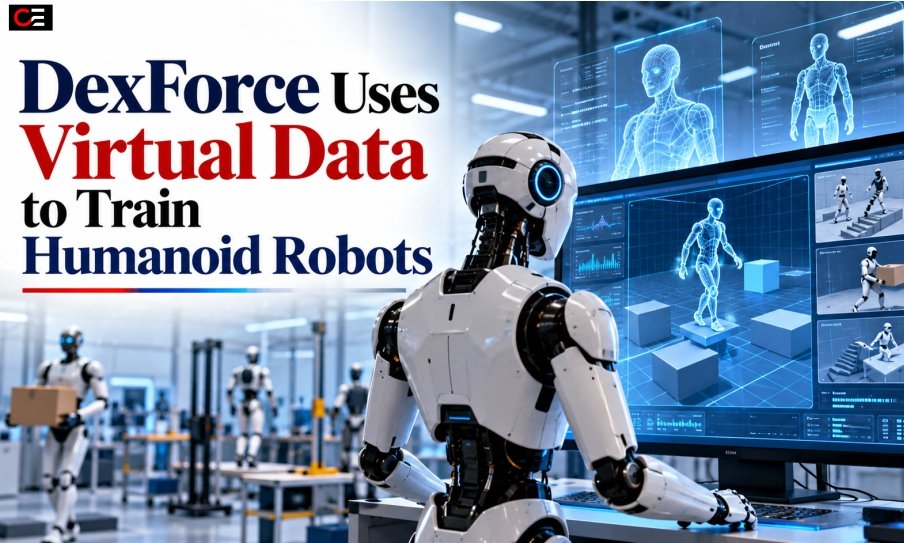
Chinese robotics startup DexForce is using virtual data to reduce the cost of training humanoid robots and improve their ability to perform real-world tasks. Based in Shenzhen, the company relies on simulated environments to teach robots new skills, offering an alternative to collecting large amounts of data from human workers.
The method addresses a major problem facing the robotics industry: how to give humanoid robots the ability to work efficiently on their own in factories, offices, and homes. Chinese robots are capable of doing incredible things with their bodies. Their commercial viability is still a challenge, though.
The DexForce bots are trained in a simulation, which includes how they perform tasks, such as picking things up and setting them down on a table. They are tested in different scenarios by changing the angles they are at and what colour the tables and objects are.
DexForce uses synthetic data created in virtual environments and minimises training costs for manufacturers who typically depend on human-performed real-world datasets across tasks.
The firm makes computer programs that model the physical world and foretell how objects might move. It then transfers the skills learned in simulation to physical robots. DexForce says this process can be faster and cheaper than collecting data from human trainers, who may need to repeat movements more than 100 times to produce precise examples.
The DexForce humanoid robot training approach reflects a wider effort to make robotics development more efficient. Real-world data collection can require substantial time, labour and resources, while simulations allow developers to generate training scenarios at scale.
Chief Executive Jia Kui told Reuters that achieving what he described as “physical artificial general intelligence” through real-world data collection alone would require 10 trillion samples. He argued that manually collecting data for an effectively unlimited range of human tasks is fundamentally inefficient.
However, training robots in simulations does not automatically guarantee reliable performance in the physical world. Robots must still learn to perceive their surroundings, navigate unfamiliar environments and adapt to changing conditions.