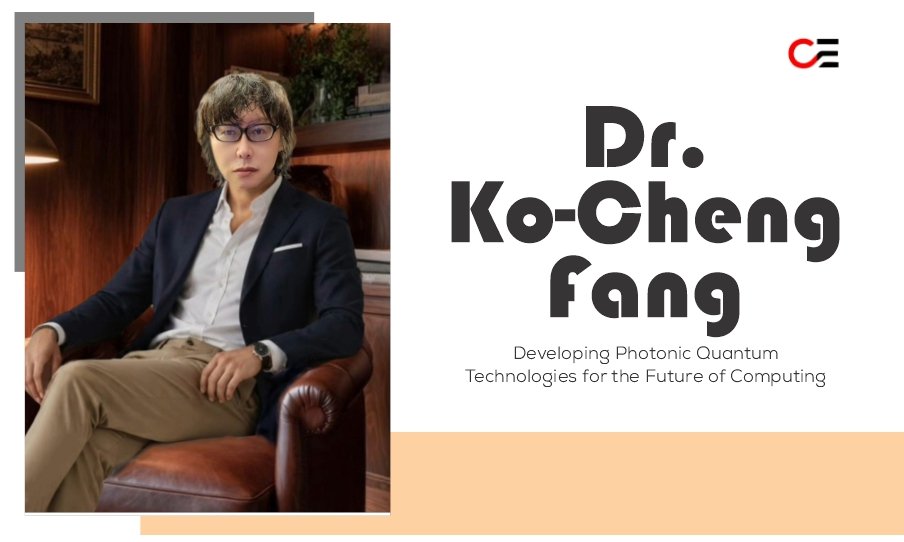
From information security and laboratory-grown Imperial Green jadeite to photonic quantum chips, floating metals, and next-generation energy systems, Dr. Ko-Cheng Fang is pursuing technologies that challenge established scientific and industrial boundaries.
Innovation often begins with a question that established systems are unable to answer. For Dr. Ko-Cheng Fang, Founder, Chairman, and CEO of LongServing Technology, that question has remained consistent throughout his career: if existing systems have reached their limits, can a different approach create a more efficient, sustainable, and transformative solution?
His work spans information security, cloud computing, materials science, biotechnology, photonic quantum technology, nuclear-powered batteries, anti-gravity materials, luxury design, and fashion. While these fields may appear unrelated, they are connected by his belief in independent thinking, persistence, and the courage to explore ideas that conventional institutions may initially reject.
His journey began with art, developed through early technological inventions, gained financial independence through investment, and eventually evolved into a broad research programme aimed at changing the future of computing and energy.
The Artistic Foundations of Scientific Thinking
Dr. Fang’s relationship with creativity began during childhood. He started painting at the age of eight or nine, initially studying traditional Chinese gongbi flower-and-bird painting before moving towards Western watercolour and oil painting.
His childhood home included a dedicated art studio, plaster sculptures of Venus and David, and shelves filled with art books. The smell of mineral spirits and the presence of unfinished artworks formed part of his everyday environment. Art was therefore more than a hobby. It became the foundation of his way of observing, analysing, and solving problems.
His interest in sculpture also influenced his approach to research. A sculptor begins with a rough block of material and gradually removes everything unnecessary until the intended form emerges. Dr. Fang applies the same principle to experimentation and business. Every failed attempt eliminates one possibility, allowing the researcher to move closer to the desired result.
He believes that failure is often a process of removing incorrect answers. If ninety-nine possibilities fail, the remaining possibility becomes more valuable because it has been reached through experience rather than chance.
This philosophy has formed his attitude towards difficult projects. He believes that genuine achievement requires passion, patience, and the willingness to continue working when others have already dismissed the idea.
Early Inventions in Information Security
Dr. Fang’s early technological work focused on information security, cloud storage, and programmable password locks. He developed patented systems designed to strengthen digital protection and control access to information.
Some of these technologies were adopted by the U.S. Department of Homeland Security and became associated with applications supporting counter-terrorism and secure data management. Dr. Fang expected these achievements to bring recognition and commercial rewards, particularly because the technologies were being used in sensitive security-related environments.
Instead, he says he faced accusations of being a patent troll and even a spy. He describes experiencing surveillance, intimidation, and pressure that eventually forced him to leave his homeland.
Despite these experiences, he chose to continue creating rather than pursuing retaliation. For Dr. Fang, the value of an invention is measured by its usefulness to society. He believes programmable encryption systems have helped protect digital information by making it more difficult for attackers to break passwords and giving defenders time to trace, intercept, and stop malicious activity.
He estimates that approximately 4.6 billion people are now connected to technologies involving cloud computing, cloud storage, and data-centre infrastructure related to this broader technological ecosystem.
Investment and the Creation of Financial Independence
Alongside his technological work, Dr. Fang developed a strong interest in investment and financial strategy. He describes creating proprietary formulas that helped him generate substantial wealth through stock-market activities.
He recalls using strategies that involved shorting U.S. stocks at their daily peaks. He also refers to investment activities in Hong Kong, where the success of strategies followed by other investors allegedly contributed to the collapse of a futures company.
Rather than treating investment as a final destination, Dr. Fang used the capital generated through these activities to finance scientific research. This became essential because many of his projects fell outside conventional academic and commercial funding structures.
His investment philosophy is based on discipline, controlled risk, and measurable outcomes. He believes scientific research should be treated as a form of long-term investment, where resources must be allocated carefully between research and development, institutional verification, manufacturing, partnerships, and eventual commercialisation.
His preferred model involves developing a technology independently, validating it through credible institutions, attracting venture capital, and eventually entering public markets when the technology is ready.
This financial independence allowed him to pursue ambitious research without depending entirely on universities, government grants, or corporate research departments.
The Pursuit of Laboratory-Grown Imperial Green Jadeite
One of Dr. Fang’s most difficult materials-science projects involved the development of laboratory-grown Imperial Green jadeite.
Before his work, major research institutions had already attempted to recreate the gemstone. General Electric in the United States and a laboratory in Changchun, China, had pursued similar efforts but failed to produce a reliable result.
The project was considered extremely difficult because Imperial Green jadeite is among the rarest and most valuable forms of jadeite. Dr. Fang explains that thousands, and eventually tens of thousands, of experiments were required before one successful result emerged.
He compares the achievement with naturally occurring Imperial Green jadeite, where tens of thousands of tons of raw ore may produce less than one carat of the desired quality.
The project also carried deep cultural meaning. Imperial Green jadeite was highly valued by the Qing imperial court and was associated with Empress Dowager Cixi. One of the most famous jadeite artefacts is the Jadeite Cabbage preserved at Taiwan’s National Palace Museum.
Dr. Fang intends to recreate this historic masterpiece using laboratory-grown Imperial Green jadeite. His objective is to combine scientific achievement with cultural preservation while reducing dependence on environmentally damaging mining practices.
The project became particularly relevant as restrictions surrounding jadeite mining in Myanmar increased. He believes laboratory-grown jadeite could provide a sustainable alternative while preserving the gemstone’s cultural and aesthetic significance.
The experience reinforced his conviction that ideas considered impossible can become achievable through persistence and repeated experimentation.
Expansion into Biotechnology
After working on advanced materials, Dr. Fang expanded his research into biotechnology. LongServing began examining organic essential oils, plant compounds, and bioactive materials under European Union testing standards.
He states that laboratory research demonstrated the ability of certain compounds to eliminate aggressive lung cancer cells. His proposed next stage involves improving the effectiveness of these compounds through material modification and nanotechnology.
The long-term objective is to develop probe-based treatments capable of delivering therapeutic substances directly into tumour cells. Such a system could potentially suppress tumour growth and prevent metastasis while reducing the need for invasive surgery.
Dr. Fang describes biotechnology as one of the most complex fields because it requires chemistry, materials science, biological research, testing standards, and clinical development to work together.
The project also reflects his broader belief that technological research should address urgent human problems, particularly disease, health, and quality of life.
Establishing LongServing Technology
Dr. Fang established LongServing Technology as a platform for developing frontier technologies that could eventually influence global industries.
The company’s work extends across information security, cloud technology, laboratory-grown gemstones, biotechnology, photonic quantum computing, energy systems, and luxury design. Its diverse portfolio reflects Dr. Fang’s belief that scientific disciplines should interact rather than remain isolated.
He has largely funded the company’s research independently and continues to seek international partners, manufacturing resources, specialised equipment, research collaborators, and commercial institutions capable of helping bring its technologies to market.
LongServing’s operating philosophy is based on independent research, intellectual-property protection, and the development of original technologies rather than imitation or reverse engineering.
The Energy Problem Behind Modern Computing
The development of photonic quantum technology emerged from Dr. Fang’s concern about the growing energy demands of electronic computing and artificial intelligence.
As AI systems become more powerful, data centres require increasing amounts of electricity. Some facilities consume energy on a scale comparable to that of an entire small town. Semiconductor manufacturing itself also requires enormous energy, while advanced chip production creates substantial heat that must be removed through cooling systems.
Dr. Fang points to Taiwan’s continued dependence on coal and gas, the energy requirements of semiconductor factories, and the installation of solar panels over reservoirs as examples of the pressure placed on energy infrastructure.
He argues that many countries lack sufficient low-carbon energy systems while simultaneously needing to expand AI capabilities to remain competitive. This creates a conflict between digital advancement and environmental responsibility.
In his view, the solution requires a different computing medium. Photons, which travel faster than electrons and can carry information through light, offer the possibility of substantially higher performance with lower energy consumption.
Developing Photonic Quantum Computing
Dr. Fang’s photonic research focuses on replacing or reducing the dependence on electronic signal transmission. He believes photonic chips could eventually achieve performance thousands of times greater than conventional electronic chips while producing less heat and consuming less energy.
However, the development of photonic chips requires solving the problem of wavelength.
Silicon photonics generally operates within the range of approximately 1,300 to 1,500 nanometres. Quantum dots operate at wavelengths of approximately 300 to 800 nanometres. Modern semiconductor circuitry, meanwhile, is measured at around 14 nanometres, creating a need for much shorter wavelengths.
Dr. Fang began developing photosensitive nanomaterials in the 2–3-nanometre range. Using semiconductor lasers, he describes a process in which photons are transmitted between successive material layers, similar to passing a torch from one person to another.
The resulting propagation creates what he describes as quasi-X-ray short waves. When the material was examined through Raman spectroscopy and X-ray diffraction, he states that its spectrum did not correspond to existing reference materials.
He interpreted this as evidence that a new material had been created. The material was named X-Photon. The technology is intended to create optical pathways for photonic quantum chips and support a new approach to data transmission and logic processing.
The Semi-Photoresist Logic-Gate System
Dr. Fang explains that conventional electronic chips rely on silicon substrates and complex materials from Groups III and V of the periodic table to control electrical flow through logic gates.
LongServing’s photonic chips, by contrast, use standard ceramic substrates, proprietary X-Photonic materials for optical pathways, and semi-photoresist materials for logic gates.
The semi-photoresist system works through the interaction of photons. When the first photon is blocked, the signal is interpreted as 0. When a second photon penetrates the barrier, the signal is interpreted as 1.
This process uses photoelectric conversion to create a binary logic system. Dr. Fang believes the approach could simplify manufacturing while allowing photonic chips to be integrated into existing semiconductor production environments.
He states that LongServing has secured patents across 26 major semiconductor-manufacturing nations, including the United States and the European Union.
Manufacturing Advantages Over Conventional Chips
Dr. Fang argues that LongServing’s manufacturing process is considerably simpler than conventional electronic chip production.
Traditional semiconductor manufacturing requires expensive Extreme Ultraviolet lithography equipment, with individual machines costing more than 30,000,000,000. Production also depends on highly controlled, dust-free environments and complex fabrication systems similar to those used by leading foundries.
LongServing’s proposed photonic process uses ceramic substrates, X-Photon materials, and semi-photoresist logic gates. Dr. Fang believes this could allow existing semiconductor manufacturers to transition gradually towards photonic production without constructing entirely new factories.
He estimates that building a new fabrication facility could require three to five years, making cooperation with existing foundries a more practical route.
The technology could potentially be used in automotive chips, AI processors, telecommunications systems, and large-scale data centres. Its proposed advantages include lower equipment costs, reduced energy consumption, less heat generation, and simpler cooling requirements.
Challenging the Existing Semiconductor Industry
Dr. Fang is openly critical of the amount of capital invested in conventional silicon-based computing and AI infrastructure. He believes hundreds of billions of dollars have already been committed to technologies that may eventually face serious limitations.
According to his assessment, many established companies have invested so heavily in existing systems that they can no longer easily change direction. He argues that this may explain why the arrival of the photonic era is frequently described as being seven, eight, or even ten years away.
In his view, companies may be attempting to delay the transition until they recover their existing investments. He believes photons will eventually outperform electrons so decisively that the current semiconductor order could face major disruption.
Dr. Fang also argues that banks and investment funds have begun tightening credit because financial institutions recognise the risks associated with industries approaching technological obsolescence.
He expects LongServing’s technology to create significant market consequences once evidence is released. To reduce disruption, the company plans to introduce information gradually to Wall Street investors rather than making one sudden announcement.
LongServing is also establishing a U.S. subsidiary and plans to grant it exclusive rights to its patents. Dr. Fang describes the proposed entity as a “pure-blooded” American company intended to support future commercial expansion and prepare for a potential initial public offering. The company is seeking international underwriters, private-placement institutions, and IPO advisory firms with the capacity to support the next stage of its development.
Protecting Innovation While Avoiding Industrial Disruption
Dr. Fang believes technological breakthroughs must be introduced responsibly. Although he expects photonic chips to challenge conventional semiconductor systems, he does not want the transition to cause unnecessary economic destruction.
He argues that inventors should contribute to the next technological era without deliberately destroying the previous one. LongServing therefore intends to pursue a dual-track approach in which existing electronic-chip production continues while manufacturers gradually introduce photonic technologies.
This would allow factories to use their existing infrastructure while transitioning towards a new platform. Dr. Fang believes this approach could reduce unemployment, protect industrial stability, and give companies time to adapt.
He is also strongly opposed to plagiarism, reverse engineering, and the unauthorised copying of research. He believes intellectual property must be protected because original research requires years of experimentation, financial risk, and personal sacrifice.
An Alternative Model of Innovation
Dr. Fang’s approach differs from conventional research models, which often depend on incremental progress and established academic frameworks.
He believes market-led research can become overly cautious because investors and institutions prioritise risk reduction. When large amounts of capital have already been invested in a particular technology, companies may become reluctant to explore alternatives that could undermine their own financial interests.
LongServing, by contrast, seeks to explore ideas outside accepted frameworks. Dr. Fang describes the company as working towards technologies that may resemble systems associated with advanced civilisations, including cloud intelligence, interstellar travel, magnetic-field manipulation, and highly coordinated networked systems.
Some of his concepts are influenced by meditation and what he describes as experiences involving knowledge beyond ordinary human memory. He believes certain advanced technologies may already exist elsewhere in the universe and that humanity is only beginning to conceptualise them. His objective is to translate unconventional ideas into materials, machines, patents, and commercially testable systems.
Photonic Quantum Intelligence and the Future of Robotics
Dr. Fang believes the next major stage of technological development will involve photonic quantum intelligence.
Although current AI systems and robots have achieved impressive capabilities, he considers them insufficient for complex rescue operations, fully autonomous vehicles, and highly adaptive industrial environments.
He believes photonic chips capable of operating more than one thousand times faster than current electronic systems could change this situation.
He envisions intelligent household robots capable of performing different responsibilities within a home. Several robots could work together as a coordinated team, communicating through a central cloud-based intelligence system.
The same principle could be applied to factories, construction sites, transportation networks, hospitals, and other complex environments. Instead of isolated machines, future systems could involve teams of interconnected robots working together in real time.
Dr. Fang hopes LongServing can become a global centre for photonic development, potentially creating a new technological hub comparable to Silicon Valley.
Floating Metal and Nuclear-Powered Batteries
One of Dr. Fang’s most recent and unconventional research areas involves floating metals, solid-state nuclear batteries, and the possibility of compact flying transportation systems.
LongServing has been secretly researching solid-state batteries for several years. Lithium iron phosphate and nickel-cobalt-manganese batteries remain widely used in the automotive industry, but Dr. Fang identifies limitations involving flammability, energy density, and driving range.
Small-scale nuclear propulsion is also being explored globally, although radiation and contamination concerns have limited its practical use in transportation.
Dr. Fang describes human flight as an enduring dream. He recalls having recurring dreams since childhood in which he could float and fly using only his mind. In some dreams, he travelled above highways and observed vehicles moving below him.
After beginning meditation, he interpreted these experiences as possibly involving an extraterrestrial craft powered by nuclear energy and controlled through brainwaves.
He searched ancient texts, historical archives, and research records for evidence of similar technology but says he found no reliable documentation. He therefore began investigating the concept independently through chemical experiments and metal fabrication.
He concluded that a flying hoverboard would require two fundamental technologies: a floating metal capable of counteracting gravity and a compact solid-state nuclear battery capable of providing sustained energy.
As with his earlier inventions, he says the project attracted accusations of madness and fraud. Critics had previously questioned his work on laboratory-grown Imperial Green jadeite, programmable locks, 2-nanometre X-Photon materials, and other technologies.
Dr. Fang states that he recently recorded a video demonstrating a 90-degree photonic pathway in which the wavelength remained stable on an oscilloscope. He believes this experiment confirmed an important part of the underlying process.
He also says that the core manufacturing process for the floating-metal project has recently been resolved.
The Scientific Concept Behind Floating Metal
Dr. Fang explains the concept through the relationship between matter and antimatter, photons and black holes, and gravity and anti-gravity. He compares the principle with the balance of Yin and Yang in Taiji philosophy.
Gravity attracts matter towards the Earth, while anti-gravity would theoretically produce the opposite effect. Since naturally occurring anti-gravity materials are unavailable, he believes such a material must be synthesised.
This is what he refers to as “floating metal.”
His nuclear-battery research also challenges conventional assumptions. He questions whether uranium and heavy water are the only possible foundations for controlled nuclear fission. He believes alternative materials or methods may eventually allow a non-destructive nuclear reaction capable of producing extremely high energy in a compact form.
Dr. Fang acknowledges that such ideas can be difficult to pursue within conventional academic systems. A researcher proposing a 2-nanometre light-emitting material, for example, could face rejection from academic institutions, lose funding, or even risk dismissal because the concept conflicts with established assumptions.
He therefore relies heavily on self-directed learning and independent experimentation.
Twenty Years of Self-Funded Research
Dr. Fang states that he has spent approximately twenty years funding his research independently. He has avoided borrowing money and has purchased equipment freely according to the needs of his experiments.
He believes this independence has allowed him to investigate ideas without pressure from investors, academic supervisors, or commercial partners.
For Dr. Fang, such relationships represent the practical continuity required for long-term research. Scientific breakthroughs may attract public attention only after they succeed, but they are often built through years of quiet work, repeated purchases, failed experiments, and personal commitment.
He believes the floating-metal and nuclear-battery technologies may eventually be announced publicly. He may either publish the findings early to establish priority or hold the information until LongServing is ready to make an official announcement.
Technology, Fashion, and Cultural Expression
Dr. Fang’s artistic interests continue to influence LongServing’s commercial direction. In 2026, the company introduced a global jadeite handbag collection incorporating laboratory-grown Imperial Green jadeite into luxury designs.
The gemstone is produced through repeated stages of melting and crystallisation under temperatures exceeding 1,400 degrees Celsius, combined with intense heat and pressure. Dr. Fang believes the material carries a distinctive Eastern sense of mystery, refinement, and spiritual beauty.
The collection combines scientific manufacturing with craftsmanship and contemporary fashion. LongServing has also adapted Dr. Fang’s paintings into handbag designs, bringing his artistic expression into the company’s luxury fashion collection.
His interest in luxury design is informed by his appreciation of established brands such as Chanel and Chopard. He views fashion as another form of creative expression in which material, structure, colour, and cultural meaning come together.
For him, technology and art are not separate disciplines. Both require imagination, precision, patience, and the ability to transform raw material into something meaningful.
Human-Centred and Environmentally Responsible Innovation
Despite the unconventional nature of his research, Dr. Fang believes technology must remain human-centred.
He argues that companies should respect employees, communities, society, and future generations. Innovation should improve living conditions and create opportunities rather than simply maximise financial returns.
This principle influenced the development of LongServing’s X-Photonic materials. Dr. Fang states that the materials were required to be non-toxic, environmentally safe, and free from pollution before the company proceeded with the technology.
He also emphasises mass-production capability. According to him, X-Photonic materials can be manufactured at scale while remaining safer and more environmentally responsible than certain compound semiconductor materials, including gallium arsenide, gallium nitride, and indium phosphide.
Recognising Unusual Talent
Dr. Fang believes that rare talent carries a special responsibility. He compares the challenges faced by unconventional inventors with the experiences of figures such as Nikola Tesla, who pursued different approaches to electrical innovation.
He refers to his own portfolio of more than one hundred patents and argues that unusual achievements often appear irrational before they become accepted.
His work across cancer research, photonic chips, energy systems, cloud security, and materials science reflects a willingness to combine disciplines that are usually treated separately.
He believes people with exceptional ability should use their skills for constructive purposes rather than waste them through fear, conformity, or personal conflict.
Taking Taiwanese Innovation to the World
Dr. Fang hopes LongServing can demonstrate that major technological breakthroughs can emerge from Taiwan and reach global markets.
He recognises that international investors and institutions may initially be sceptical of a company operating outside the traditional networks of Bell Labs, Harvard, major multinational corporations, and established semiconductor giants.
However, he argues that manufacturing capability, materials science, and practical performance matter more than reputation. Taiwan’s semiconductor ecosystem, supported by companies such as TSMC, provides an important industrial foundation, but he believes the next stage of progress will depend on new materials and alternative computing principles.
He welcomes independent academic testing and direct comparisons between LongServing’s products and conventional technologies. In his view, the strongest technology should ultimately be determined by measurable performance rather than institutional prestige.
Leadership as Responsibility
For Dr. Fang, leadership is defined by responsibility rather than title. His goal is to move photonic quantum chips from laboratory development into real-world applications.
He believes the greatest value of the technology will emerge at the application layer, where researchers, engineers, businesses, and creative teams can use photonic computing to develop new solutions.
He describes himself as the captain of a photonic team, while inviting researchers, investors, manufacturers, and innovators from around the world to participate in the next stage.
His long-term ambition is to establish a global photonic hub that can become a major centre of scientific and industrial development.
Measuring Success Through Impact
Dr. Fang measures success through the number of people who benefit from a technology rather than through awards or personal recognition.
His early cloud-computing and encryption inventions became part of systems used by billions of people. Although he expected financial rewards and recognition, he believes their wider contribution to digital security remains more important.
He describes the technologies as helping protect information, slow cyberattacks, and give authorities greater opportunities to trace and stop threats.
Even after facing accusations, intimidation, and professional setbacks, he continued developing new systems. His preference has always been to create something useful rather than spend his life responding to those who opposed him.
A Legacy of Courage and Responsibility
Dr. Fang believes the life of an inventor requires endurance. Doubt, dismissal, criticism, and contempt are often part of the process, particularly when an idea challenge established scientific or commercial interests.
He believes governments should support technological pioneers because technology shapes national economies, industrial competitiveness, and the future of society. Political systems, in his view, should create stability for long-term innovation rather than allowing short-term interests to obstruct progress.
His message to the next generation is clear: talent should never be wasted.
He believes a meaningful life should include at least one act of productive madness; an idea pursued with complete commitment despite uncertainty and criticism.
His own work, from programmable encryption systems and laboratory-grown jadeite to photonic quantum chips, floating metals, and nuclear-powered batteries, reflects that philosophy. Ultimately, Dr. Fang hopes his research will honour the pioneers who came before him while encouraging future generations to challenge limitations, protect original thinking, and use technology as a force for shared progress.